


Florence. Part 17
Description
This section is from the book "Florence - John L. Stoddard's Lectures", by John L. Stoddard. Also available from Amazon: John L. Stoddard's Lectures 13 Volume Set.
Florence. Part 17
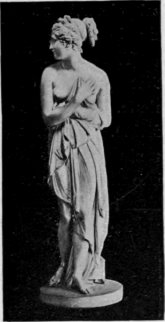
The Venus Of Canova.
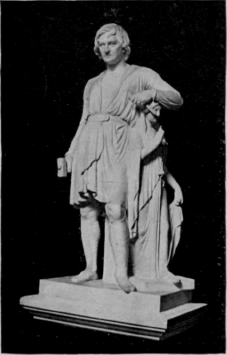
Thorvaldsen.
The eternal difference between the Master and His pupils is that the breath of life, the living soul, is the work of the former alone. Could the sculptor impart this to earth, he too would be divine. He most nearly achieves it, however, when, with his genius consecrated to the pure ideal of eternal truth, he throws into his work, not only his entire skill, but all the concentrated passion of his soul. Sculptors have told me that the very touch of clay was a pleasure to them, because it seems so perfectly responsive, and quickly becomes warm beneath their hands, as if about to tremble into life. To them the original plastic work is infinitely more enjoyable than all the rest, which is largely drudgery; and, quickened by their enthusiasm, I have been better able to understand the beautiful words of Thorwaldsen : "Clay is the birth; plaster the death; and marble the resurrection".
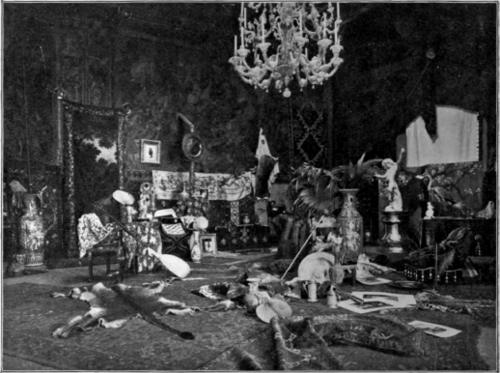
A Studio, Florence.
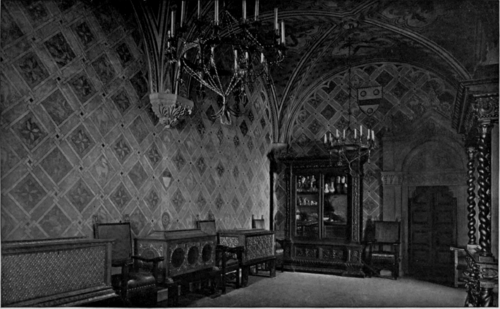
Hall Of Honor, Vincigliata.
Prominent among the structures on these Tuscan hills is the Castle of Vincigliata. A quarter of a century ago, it was a crumbling, mediaeval fortress, utterly useless to its owner, and interesting to the public merely as a pleasant terminus for a walk or drive. One day, however, Mr. Temple Leader, an English gentleman of wealth and leisure, became so enamoured of the old ruin, that he immediately purchased and proceeded to restore it; and now, in the absence of its owner, the public is admitted to enjoy its beauties. In response to our knock on the iron door, the custodian smilingly granted our request to enter, and led us into a superbly decorated courtyard. I looked about me with surprise, not that the purchaser had spent a large amount of money here (such eccentricities are not unknown), but that the restoration was so perfect as to challenge criticism. In fact, the guardian and ourselves appeared to be the sole anachronisms in the place; for the narrow windows, quaint medallions, arches, columns, and stone pavement told us, as books could never do, how life went on upon the Tuscan Apennines, when Dante wrote his immortal poem, and Brunelleschi planned his dome. This castle, however, existed nearly three hundred years before the age of Dante, being mentioned in the annals of Florence as early as 1031. Not much is known of its history; but it probably did not differ materially from that of most of the mediaeval fortresses of Europe, and, no doubt, furnished its full share of cruelty and bloodshed, as well as of chivalry and warlike exploits. At all events, perched on this hill eight Hundred feet above the sea, it must have been a stronghold easily defended against attack.
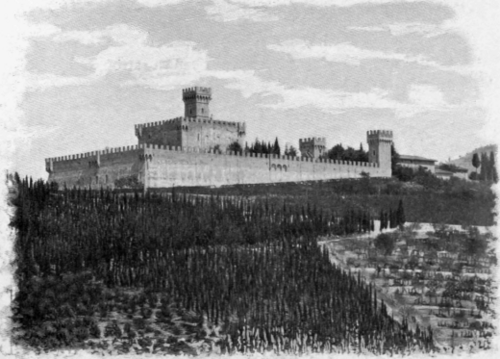
The Castle Of Vincigliata.
We found an hour far too short a time in which properly to see and enjoy this building. It is not only a valuable museum of antiquities, but a most instructive object lesson in the life and customs of the Middle Ages, since every detail of decoration and construction has been worked out with absolute historic accuracy. Thus, the square points along the walls and towers indicate the form of architecture chosen by the Guelfs to distinguish their structures from those of their rivals, - the Ghibellines. The walls of the cloister, too, are adorned with frescos representing prominent events connected with the castle's history; the rooms are enriched with valuable specimens of antique furniture; and even the kitchen has enormous cupboards and cooking-utensils in brass, such as were used in former centuries. The amount of stone-carving that ornaments the edifice is astonishing, and must have cost its artistic owner a small fortune. Thus, at almost every angle emerges an elaborately carved gargoyle; above each doorway is a statue; every column has a beautifully sculptured capital; the well, which supplies good water from a depth of two hundred and forty feet, has a richly decorated curb; and the adjoining walls have been adorned with carved heads, portions of Roman ruins, and the statues of saints. By a singular fancy of the owner, too, marble tablets have been inserted in the masonry of the courtyard to commemorate visits paid to Vincigliata by distinguished people. Anywhere else in the world, we should expect to see such souvenirs preserved in the form of cards, or inscriptions in a Visitor's Book; but in this land of sculpture they are recorded in enduring marble. As we were taking our leave, the guardian of the building pointed to a fresco representing St. Christopher. "Take a good look at that," he said; "a glance at it will save you, during the entire day, from the danger of sudden death! That is why the master had it painted near the gateway, so that no one who enters or leaves the castle can fail to see it".
Continue to:


My Books

