


Florence. Part 10
Description
This section is from the book "Florence - John L. Stoddard's Lectures", by John L. Stoddard. Also available from Amazon: John L. Stoddard's Lectures 13 Volume Set.
Florence. Part 10

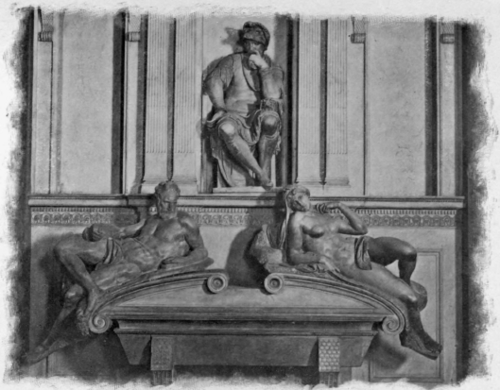
The Tomb Of Lorenzo De' Medici.
"The Night which here thou seest thus sweetly sleeping, Was by an angel carved in this pure stone; Because she sleeps, she is alive; Awake her, if thou doubtest; she will speak to thee".
On reading this, Michelangelo replied in words which show the melancholy which the oppressed condition of his country then inspired:
"Welcome to me is sleep, and still more so Is to be made of stone in these dark days Of shame and wrong. Not to perceive or feel Is joy to me. So wake me not. Speak low".
The statues of the Medicean princes, Lorenzo and Julian, are not portraits, and Michelangelo seems to have made no effort to produce their likenesses; for he remarked, "Who will appear a thousand years from now to prove that they looked otherwise ?" The truth is, neither of them merited such a monument, nor ever had in life either the manly vigor or the intellectual force which these magnificent figures so effectually display. There are few statues in the world more interesting and suggestive than that of Lorenzo, which from its meditative attitude, with drooping head and the forefinger pressed upon the lip, has been sometimes called "Il Pensiero" "The Thinker," and sometimes "The Thought of Michelangelo." No more expressive head than this was ever chiseled. It is that of a strong man who has endured suffering. We feel instinctively from something in his face and posture that he is not meditating an act of cruelty. There is a tender heart behind the cold exterior. Yet, though it does not indicate a man advanced in years, the statue is of one who has lived much and has no more illusions. "He who has passed through the door of disillusion," it is said, "has died twice." Whatever be the number of his years, such a man is really old. For him who hopes and believes, there is a future; for him who has lost hope and faith, there is only a past. One anticipates, the other remembers.
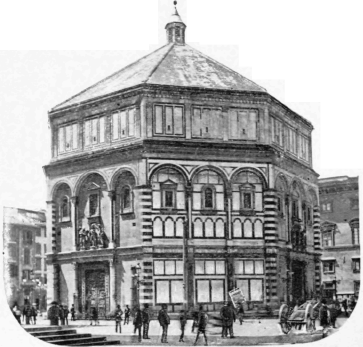
The Baptisi'Ery.
One of the oldest and most interesting structures in Florence is the Baptistery, which, though comparatively small, was originally the cathedral of the city. The erection of the grand Duomo near it has not robbed it of its usefulness, for at its font, even now, all the children born in Florence are baptized. In point of art, too, the Baptistery, though far more modest in appearance than the adjoining Campanile and Cathedral, is inexpressibly rich in the possession of a series of bronze doors which have elicited for centuries the admiration of the world. These wonderful portals by Andrea Pisano and Ghiberti, with their elaborate panels filled with life-like figures, would of themselves make Florence famous; and when Andrea's were completed, the Senators of the Republic, who never left the Palazzo Vecchio together except for the most important ceremonies, came in a body to behold them, and to bestow distinguished honors upon the artist who had labored on them forty years. Even more significant and enduring was the praise bestowed upon Ghiberti's masterpiece by Michelangelo, a hundred years later, when he exclaimed, "They are worthy to be the gates of Paradise." Words are fleeting, it is said, but this eulogy pronounced by the greatest artist of the modern world may, possibly, outlast the bronze gates which inspired it. Standing in close proximity to the Baptistery is the most conspicuous feature of the Tuscan capital - the first to greet us on approaching Florence, the last to linger in our vision as we take our leave - its world-renowned cathedral. Crowned with the glorious dome of Brunelleschi, and sheathed from street to roof with blocks of variegated marble and adorned with countless specimens of artistic sculpture, the noble edifice rises in majestic beauty from the centre of the city, like a stupendous mountain of Florentine mosaic. Viewed from the hills encircling Florence, the other buildings seem to cluster about this structure as soldiers gather round a standard elevated in the sight of all. What a conception of the noble spirit of the early-Florentines we gain by reading the decree which, in 1294, ordered Arnolfo, the first of the cathedral's architects, "to raise the loftiest, most sumptuous, and most magnificent pile that human invention could devise and human labor execute "! Succeeding generations for six hundred years have carved their epitaphs upon its mass, as coral insects leave their skeletons in the reefs they build; and every stone within its walls bears witness to the grand ideals or sublime achievements of Brunelleschi, Donatello, Giotto, and scores of their contemporaries or followers, whose names have won an immortality of fame.
Continue to:


My Books

