


Florence. Part 9
Description
This section is from the book "Florence - John L. Stoddard's Lectures", by John L. Stoddard. Also available from Amazon: John L. Stoddard's Lectures 13 Volume Set.
Florence. Part 9
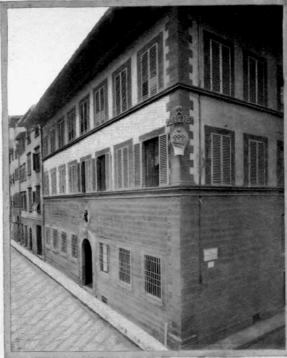
The House Of Michelangelo.
One of the most peculiar works of art in Florence is the mask of a satyr, carved by Michelangelo when a boy fifteen years of age. Lorenzo the Magnificent, who then governed Florence, was a great lover of art as well as a patron of painters, sculptors, and architects. Among the youth who came to study sculpture, in the school which had been founded by the Medici in Florence, was Michelangelo; and after a few days of application, this precocious lad had the courage to attempt to copy a faun's head in marble, and was so successful that Lorenzo was greatly impressed with his ability. He took occasion, however, to remind the lad that his faun was old and that aged people rarely have mouths well filled with teeth. Young Michelangelo immediately acted on the Prince's suggestion, breaking out two or three teeth, and indenting the jaw in such a way as to make the loss appear entirely natural. Next day Lorenzo, pleased at the youthful sculptor's quick appreciation of his criticism, invited him to his palace, treated him like one of his own children, and gave him every opportunity to progress in his chosen profession.
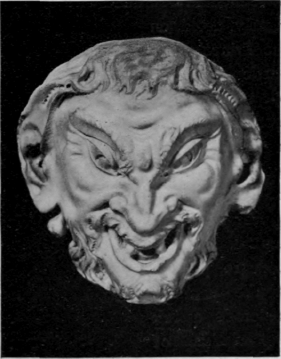
Mask Of A satyr. (Michelangelo).
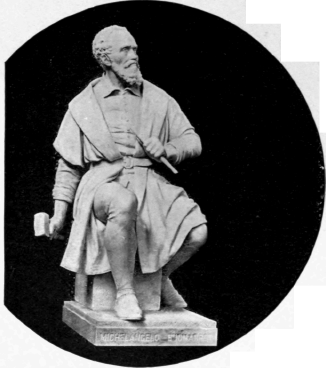
Michelangelo " Pausing".
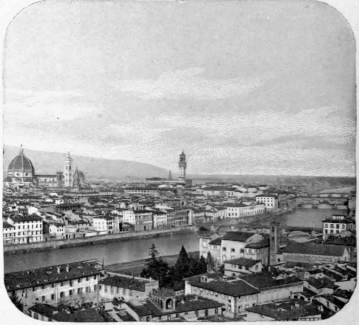
Florence And The Arno.
A modern sculptor has represented Michelangelo as if pausing a moment from impetuous toil. Yet we are sure that the great master did not pause long at any time. In one of his letters occur the words, "It is only well with me, when I hold the chisel in my hand." He meant by this, undoubtedly, that then alone could he forget his individual sorrows and the misfortunes of his country; for he had learned that the busiest existence is the least unhappy, and that the true science of living is knowing how to fill the void in life with useful occupation. Even when more than sixty years of age, he would attack the marble with such fury as to make an ordinary sculptor catch his breath; and it is said that in fifteen minutes Michelangelo would strike off more pieces than three young stone-cutters could hew in thrice the time. In fact, the sight of a block of marble often awoke in him a fever of excitement; for, teeming with possibilities, it seemed to him to be a kind of prison, confining an idea which waited to be set at liberty by him. In one of his sonnets, addressed to Vittoria Colonna, the noble woman whom he loved, he well expressed this sentiment:

The Church Of San Lorenzo.
"As when, oh, lady mine, with chiseled touch,
The stone unhewn and cold
Becomes a living mold, The more the marble wastes, the more the statue grows; So, if the working of my soul be such, That good is but evolved by Time's dread blows,
The vile shell, day by day,
Falls like superfluous flesh away; Oh! take whatever bonds my spirit knows, And reason, virtue, power, within me lay".
No visitor to Florence fails to see those wonderful productions of Michelangelo's genius in the sacristy of the Church of San Lorenzo, - the tombs of Lorenzo and Julian de' Medici. To comprehend the colossal figures which recline on these sarcophagi, one must understand something of the man who called them into being. No other sculptor who has ever lived could have created them. The intellectual and moral nature of this lonely, contemplative man revealed itself in marble, as Shakespeare's genius showed itself in words. The recumbent statues of Day and Night, Twilight and Dawn, were not intended to be beautiful; they are, however, Titanic, superhuman, and terrible, like the forces of Nature. One knows in looking at them that Michelangelo must have suffered. Thus, Dawn, as portrayed by him, is not a lovely maiden, joyously awakening to a day of happiness and love, but a mature woman whose brow is knit with pain, as if arising wearily to resume a hopeless task. Twilight, on the contrary, her male companion, yields willingly to an inclination to repose. The colossal statue of Day remains unfinished; but though the face is only roughly sketched, tremendous strength is visible, peering through the film of marble, like the sun struggling to pierce the clouds. Night seems the happiest of all, lying unconscious in a dreamless sleep. That this profoundly sad interpretation of the meaning of these figures is correct would seem to be proven by the oft-quoted lines written by the sculptor himself in reference to the statue of Night. Giovanni Strozzi, entering the sacristy one day during the absence of Michelangelo, had traced upon the wall lines which may be translated:
Continue to:


My Books

