


Florence. Part 11
Description
This section is from the book "Florence - John L. Stoddard's Lectures", by John L. Stoddard. Also available from Amazon: John L. Stoddard's Lectures 13 Volume Set.
Florence. Part 11
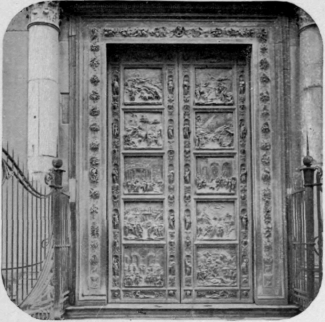
Ghiberti's Gates.

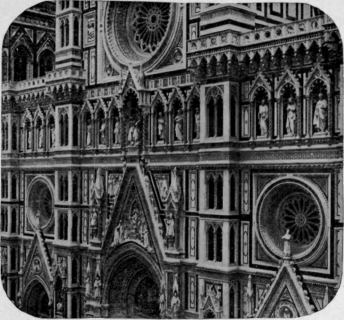
Exterior Of The Cathedral.
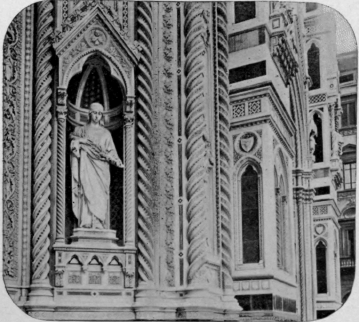
A Corner Of The Cathedral.
Superior even to the walls of this cathedral, encrusted though they are with marble panels, is the especial glory of the edifice, - its matchless dome. The creation of this by Brunelleschi marked an epoch in the history of architecture. As the huge framework of the noble edifice climbed slowly heavenward, it was perceived that the construction of a dome, to span the gulf which yawned between its lofty walls, would be supremely difficult. In fact, no dome of such dimensions had then been attempted since the completion of the Pantheon at Rome, before the birth of Christ; and even the Pantheon's majestic cupola rested on walls but seventy-two feet high, while those of this cathedral were one hundred and thirty feet in altitude. But Brunelleschi solved the difficult problem, and made a model which he submitted to the judges. How confident he was that he alone was master of the situation is shown by his suggestion that artists from all parts of Italy, France, and Germany be invited to compete with him, and by the fact that during the discussion of their relative merits he left Florence for Rome, and remained there until he was entreated to return.
At last, in 1420, before a concourse of artists and architects, Brunelleschi proposed his plan of erecting a double dome, one inside the other, leaving a space between the two. When his astonished auditors inquired how this could be done, he is said to have resorted to the device adopted seventy years later by Columbus. Calling for an egg he requested any one present to make it stand on end. When each in turn declined, Brunelleschi broke the shell of the egg sufficiently to make a broadened base for its support; and when all declared they could have done as much, the architect replied that they would no doubt be able, also, to build the dome were he to explain to them his method. Brunelleschi was appointed architect, and the result abundantly justified the selection; for, when the enormous void was vaulted over by a dome which rose in grand simplicity, and stood aloft without apparent support, the fame of its designer was secure forever.
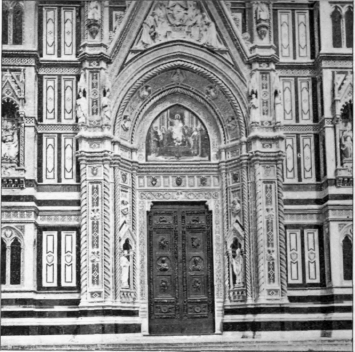
The Doorway.
With the exception of the cupola of St. Peter's, the dimensions of which are a trifle larger, this is the most majestic dome that man has ever reared. Other great domes, like those of the Pantheon at Rome, and Santa Sophia at Constantinople, were designed principally for their interior effect; but the creation of Brunelleschi, while grand within, is even more imposing from without. One hardly realizes at first its gigantic size, so perfect is its symmetry, and so harmonious with the rest of the cathedral are its vast proportions; but the marble lantern on its summit, which looks like a small chapel on a mountain crest, is really more than seventy feet in height, and would itself form, on the level earth, a building of considerable size. A sentence uttered by Michelangelo in reference to this dome, more than a century after its completion, forms an appropriate pendant for his famous eulogy of Ghiberti's gates. Every one knows how greatly he admired this work of Brunelleschi, and how, on leaving Tuscany for Rome, there to become the architect of St. Peter's, he looked back tenderly at the serene and noble outline of this crown of Florence, and exclaimed:

The Cathedral Dome.
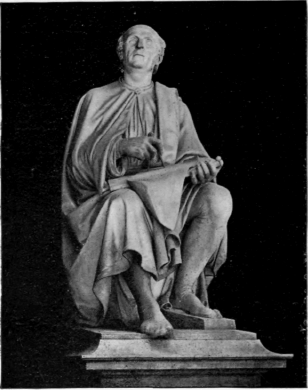
Brunelleschi.
"Io faro la sorella Piu grande gia, ma non piu bella".
"I will make her sister Larger indeed, but not more beautiful".
Although the Florentine cathedral was opened for religious worship, and was consecrated by the Pope in person on the 25th of May, 1436, its beautiful facade was not completed until 1887. The unveiling of this was an occasion of great rejoicing throughout Italy. Deputations from all the principal Italian cities were in attendance, and the impressive ceremony was presided over by the King and Queen. An immense curtain had been drawn from the base to the summit of the facade and, finally, at a signal given by the King, who with his royal consort was seated on a platform opposite the cathedral, this was slowly lowered. The result was far more effective than it would have been had the curtain been raised; for, as the snow-white screen descended, the impression was produced of a beautiful marble temple emerging from a cloud. For several minutes the multitude of spectators stood in perfect silence, completely spellbound by an overpowering sense of beauty; then, from ten thousand voices, came a storm of cheers and acclamations, and Queen Margherita was so deeply moved that, bowing her head, she burst into tears.
Continue to:


My Books

