


Florence. Part 12
Description
This section is from the book "Florence - John L. Stoddard's Lectures", by John L. Stoddard. Also available from Amazon: John L. Stoddard's Lectures 13 Volume Set.
Florence. Part 12
In harmony with the rest of the edifice, the entire front of the Duomo rises before the spectator like a splendid screen of marble marquetry, adorned with sculptured flowers, fruits, and garlands, among which stands its population of white-robed prophets, saints, and angels poised upon delicately chiseled pinnacles, ensconced in niches lined with rich mosaic, or clinging still more closely to the walls in bas-reliefs.
There was a political, as well as historical, significance in the completion of this facade. When Victor Emmanuel had been proclaimed King of united Italy, the Florentines received a promise that their city should become, eventually, the capital of the nation. The promise was fulfilled and, from 1865 till 1871, the Pitti Palace was the residence of the King, and Florence was the capital of Italy. As a result, its citizens made many changes, and incurred expenses which they would never have assumed had they supposed that, six years later, the Court would be removed to Rome; and it was to recompense them for their losses and bitter disappointment, that the Florentines were then assured the chief edifice of their city should no longer remain unfinished.
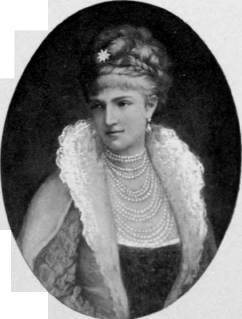
Queen Margherita.

The Front Ok The Cathedral.
It is not surprising, therefore, that the Florentines who assisted at the crowning act in the construction of the Duomo were hardly less enthusiastic than those who laid its corner-stone. All the sculptors and artists who labored to produce it undertook it as a work of love, and many of them accepted for their services nothing but their actual expenses. Nor was this disinterestedness limited to the army of laborers. Much of the variegated marble used in the construction of the splendid work was a gift, even the cost of its transportation being paid by the contributors. For, as Browning said,
"Open my heart, and you will see Graven inside of it, Italy".
So in the heart of Florence lies her idolized Duomo.

The Duomo, And The Campanile.
The Campanile of Giotto, which rises close beside the Florentine Duomo, is universally conceded to be one of the most perfect and beautiful structures in the world.
It is difficult to speak of it without the appearance of exaggeration, and equally impossible to overstate its beauty. Although quadrangular, massive, and nearly three hundred feet in height, it is yet as delicate and graceful as a stately flower. Rising in five stories, each loftier than the one beneath it, it is entirely composed of variegated marble, and its whole surface is adorned with exquisitely pointed windows, slender columns, elaborate statues and reliefs, together with innumerable minor sculptured decorations. It is not strange, then, that citizens of Florence, when they can find no adequate expression for some lovely object, will say, as if they thus attained the climax of comparison, "It is as beautiful as the Campanile".

The Campanile.
The career of Giotto, the Florentine sculptor, painter, and architect is, perhaps, the most striking proof of the fact that in an age of intellectual fertility genius appears to spring miraculously from a hitherto uncultivated soil. The painter Cimabue found him, a boy of ten years, drawing upon a piece of slate one of the sheep which he was tending, and, struck with his dawning talent, took him as a pupil. The result was marvelous. Giotto not only originated and executed a great variety of beautiful frescos, but it was he who covered much of the exterior of the cathedral with its splendid mantle, and built its unrivaled bell-tower, - a model for all time.

Giotto.

The Ponte Vecchio.
The Baptistery, Campanile, and Cathedral form an architectural trio worthy of the Golden Age of Florence. None of them would suffice without the others; but together they reveal to us the best artistic and religious aspirations of her citizens: the Baptistery, at whose sacred font the dawning life of every Florentine receives its consecration; the Duomo, whose gigantic roof arches above him as he kneels in prayer; and the ethereal Campa-nile, pointing heavenward as if reminding him of immortality. These three together symbolize the trilogy of human history, birth, life, and death.
Continue to:


My Books

