


Florence. Part 13
Description
This section is from the book "Florence - John L. Stoddard's Lectures", by John L. Stoddard. Also available from Amazon: John L. Stoddard's Lectures 13 Volume Set.
Florence. Part 13
The Ponte Vecchio is not only the oldest of the six bridges which cross the Arno, it is also the most picturesque. Unlike all other bridges I have ever seen, it has two thoroughfares (one above the other) and a line of small windows in the upper story denotes a section of the long and winding passageway, built to connect the Palace of the Uffizi on one side of the river with the Pitti Palace on the other. Even the lower story is, also, enclosed save in the centre, where a pretty portico, with three graceful arches, affords delightful views up and down the stream. Clinging to the sides of the old structure, as they have done for centuries, are numerous shops of jewelers and goldsmiths, in one of which, three hundred years ago, worked Benvenuto Cellini. The sight of this old bridge is sufficient to recall most of the great events in Florentine history; for it was built, in 1362, by Taddeo Gaddi; and, doubtless, every famous citizen of Florence, in the intervening centuries, often crossed it and, leaning on the parapet of its loggia, gazed upon substantially the same view that greets the visitor to-day. Nor has literature failed to impart to it the charm of romance; for, in George Eliot's novel, "Romola," it was from the arches of this Ponte Vecchio that Tito, to escape the mob, leaped into the river, to swim with the descending current to the open country, where, as he landed in exhaustion, he met the fate he had deserved, - death by the hands of the old man he had betrayed. One of the glories of Florence is the Pitti Palace, the residence of the King and Queen when Florence was the capital of united Italy. How thoroughly characteristic of old Florence, with its feuds and factions, was the idea to which this building owes its origin! Four hundred years ago a Florentine noble by the name of Luca Pitti was envious of the splendid dwelling of his rival, the Strozzi. Accordingly he summoned Brunelleschi, whose construction of the cathedral's dome had given him a rank among the first of architects, and begged him to create for him a palace, the mere courtyard of which should be large enough to contain the entire residence of the Strozzi.
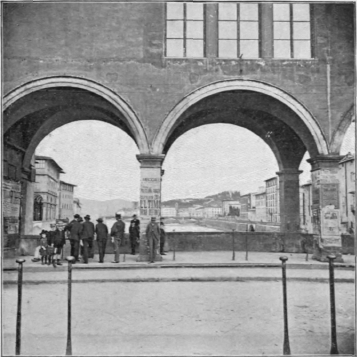
Arches Of The Ponte Vecchio.
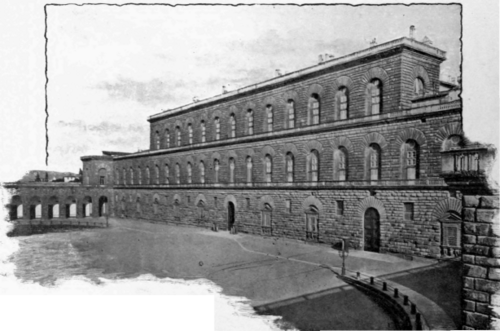
The Pitti Palace.
The next day Brunelleschi's plan was offered and accepted, for he had designed an edifice with a courtyard, the dimensions of which exceeded that of the Strozzi mansion by three feet on each side. Pitti, however, ruined himself in the attempt to build it, and his magnificent abode passed finally into other hands, while that of the Strozzi is owned by their descendants to the present day.
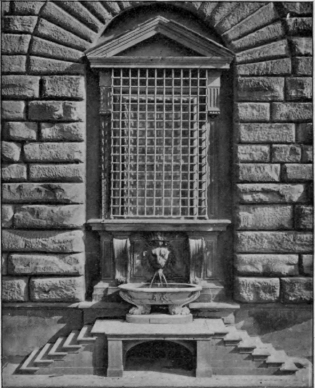
A Window In The Pitti Palace.
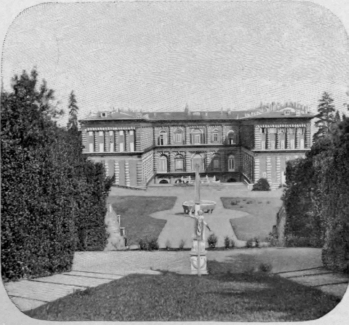
The Pitti Palace, From The Rear.
The Pitti Palace is, nevertheless, a marvelous proof of the solidity and strength of the architecture of that age; for, during more than four hundred years, none of its massive blocks of unhewn stone has had to be replaced, and there is no apparent reason why it may not last four centuries more. It is appropriate that a building which has so successfully defied the touch of Time should be a treasure-house of Art. Few European palaces can equal it in its number of fine paintings, - to copy some of which an artist must make application five years in advance, so numerous are the petitioners for the privilege. If every other gallery in the Old World, save this, should be destroyed, Europe would still be rich. Moreover, the decorations of the halls containing these pictures make them worthy receptacles for the works themselves. The lofty ceilings are covered with paintings framed in gold, and even the cornices are adorned with statues. On entering the Pitti, as you walk upon the exquisitely inlaid floors, put out your hand, and it may touch a table of mosaic, malachite, or lapis-lazuli, the cost of which was possibly a hundred thousand dollars; sit down to rest, and you will find yourself upon a chair of satin, silk brocade, or velvet; look around you in bewilderment, and you will see a multitude of walls on which, from gorgeous roof to sculptured marble dado, hang the world's great masterpieces. Even the doors through which you pass have frames of variegated marble, and you could make one visit here and feel yourself repaid without examining a single picture. It is easy, therefore, to believe the legend that when a prince of the Medici family lay dying in this palace, and an old priest endeavored to console him by telling him of mansions in the skies, the dying man exclaimed, "My father, however glorious they may be, I would be perfectly satisfied could I but remain in the Pitti".
Continue to:


My Books

