


Florence. Part 19
Description
This section is from the book "Florence - John L. Stoddard's Lectures", by John L. Stoddard. Also available from Amazon: John L. Stoddard's Lectures 13 Volume Set.
Florence. Part 19

Interior Of The Church Of La Certosa.
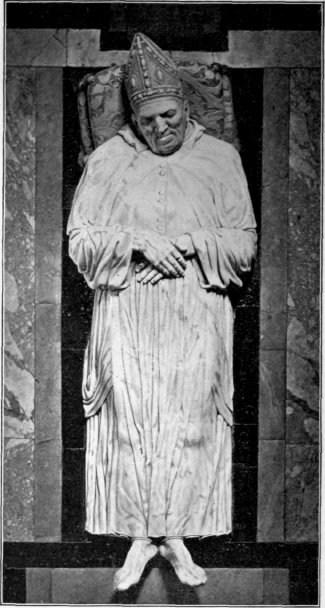
Pleasant Dreams.
Upon the hill of Bellosguardo, overlooking Florence and the valley of the Arno, stands a structure, which, although unpretending and weather-beaten, possesses an undying interest, as the place where Galileo read the secrets of the midnight sky. A servant, old enough apparently to have assisted at the astronomer's observations, answered our ring at the gate, and led us through a court which echoed loudly to our footsteps, as if protesting at the intrusion. A moment later we entered the humble room where the illustrious scientist had lived and labored. His writing-table stood in its accustomed place, his marble bust looked down upon us from the corner, and near it was the stairway leading to the roof on which he spent so many hours gazing heavenward. Upon the wall, also, a marble tablet reminded us that the eyes of Galileo, which had so often scanned the glories of the sky, were veiled to earth some years before his death, and that he lived here totally blind, -an affliction in its way as terrible to him as deafness was to Beethoven. It was during the time that he was thus deprived of vision that, at the age of seventy-four, he received the visit of Milton, who, as a young man of thirty, little anticipated then that he would one day suffer identically the same misfortune. There are few sadder contrasts than those presented in the life of Galileo. His use of the pendulum as a means of measuring time, his promulgation of the three laws of motion, his wonderful invention of the telescope, his adoption of the Copernican system of astronomy, and his announcement to the world of the four satellites of Jupiter, the solar spots, and the fact that the Milky Way, spanning the heavens with its arch of worlds, was in reality the luminous pathway of innumerable suns, drew to him crowds of pupils from all parts of Europe. But, alas! we recollect that while these teachings crowned him with a deathless fame, they temporarily made for him more foes than friends, till he was finally forced to abjure as false some of his great discoveries. Whether or not we accept as true the legend that, on rising from his recantation of the doctrine of our planet's motion round the sun, he spoke the famous words, "E pur si muove!" (It does move though!) we know it was his melancholy fate to die without beholding the triumph of those truths, which he yet felt convinced must finally prevail, as they now do, forming the very rudiments of our children's education.
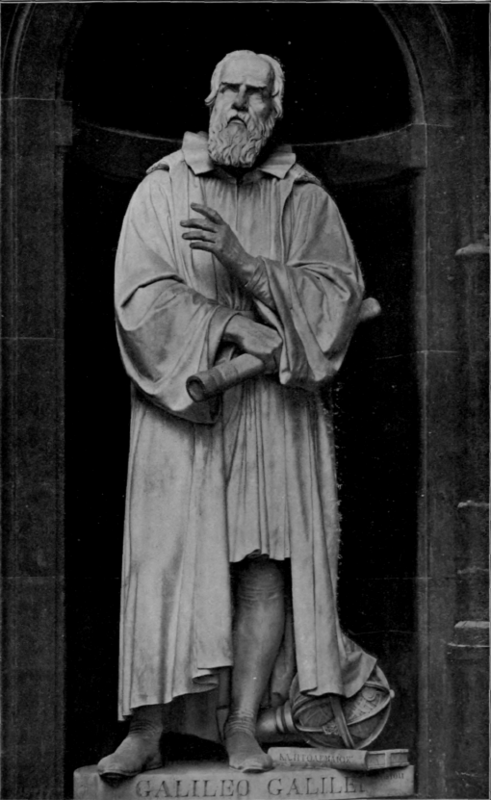
Galileo.

House Of Galileo.
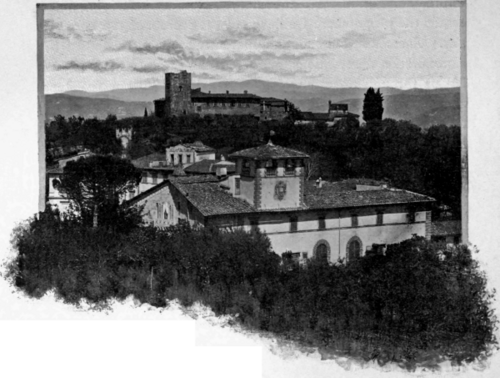
Galileo's tower.
Every visitor to Florence walks or drives by an admirable carriage road to the height of San Miniato, which is sur-mounted by a famous church founded in honor of St. Minias, who suffered martyrdom on this hill in the third century of the Christian era. Near by is a sharp projection in a massive wall half overgrown with ivy. It is a part of the old rampart constructed, in 1529, by Michelangelo, who was not only sculptor, painter, architect, and poet, but also a civil engineer of the Republic, and superintended here for months the defense of Florence against a foreign foe. In memory of this greatest of all Florentines, a spacious square has been constructed on the hill, and in the centre stands a fine bronze copy of his David. Michelangelo was particularly fond of the view of Florence from this height, and I was told that, during her residence here, George Eliot, also, came frequently at sunset to gaze from San Miniato on the city of the Renaissance, and muse upon its glorious history.
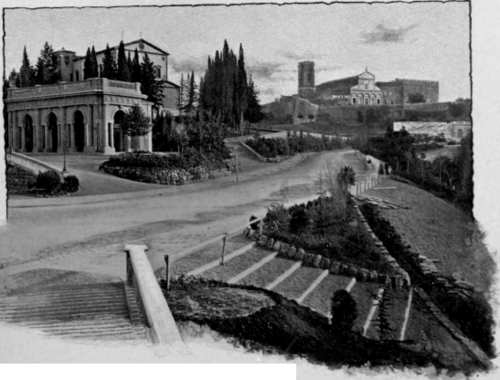
The Road To San Miniato.
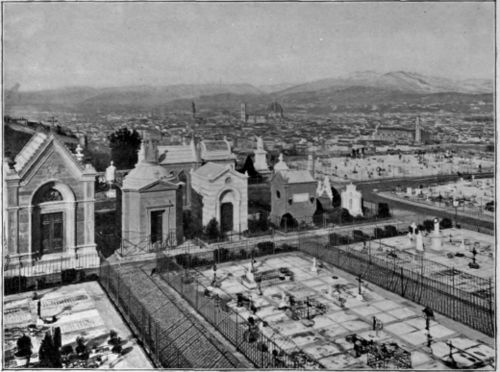
The Cemetery Of San M1N1Ato.
Upon the terraces near the church, above the City of the Living, lies a City of the Dead. I know of nothing in the world quite like this Florentine Campo Santo; for, elevated in the sight of all, it seems symbolical of an intermediate step, - a halting-place midway between earth and heaven. Here, in rectangular enclosures, exquisitely cared for, are many tombs; some of them stately marble structures, but most of them plain graves, each covered with a marble tombstone bearing an inscription. From these a cross or shaft occasionally rises, but no monotonous regularity is discernible. Broad paths wind in and out among these gardens of the dead, and, standing here and looking down upon the noble city filled with its inspiring memories, this cemetery seemed to me the spot above all others in the world where, if I were a Florentine, I should desire to rest.
Continue to:


My Books

