


Florence. Part 5
Description
This section is from the book "Florence - John L. Stoddard's Lectures", by John L. Stoddard. Also available from Amazon: John L. Stoddard's Lectures 13 Volume Set.
Florence. Part 5
The apartment of greatest value in the Uffizi is a small octagonal room called the Tribune. No single room of any gallery in the world contains so many masterpieces as this. Its walls are hung with works of Titian, Raphael, Michelangelo, Paul Veronese, Fra Bartolom-meo, Domenichino, Guido Reni, and Correggio; and alter-nating with their wealth of color are five of the most famous gems of ancient sculpture, including the Interlocked Wrestlers and the Venus di Medici. Moreover, the room itself is worthy of its contents; since, with its cupola encrusted with mother-of-pearl, its gilded ceiling, mural decorations, and mosaic pavement, the apartment alone cost nearly one hundred thousand dollars.

The Venus DI Medici.

The Niobe Room.
The traveler's first impression on beholding the Medici Venus is, usually, that of disappointment. The surface of the statue is, of course, imperfect; for, when discovered, it was broken into eleven pieces, and had undoubtedly been buried in the earth for centuries beneath the ruined mass of Hadrian's Villa. These broken portions, it is true, have been well adjusted; but nothing can conceal the lines of jointure, or hide the slight discolorations caused by long exposure to the soil. Then, too, mankind has praised this work so lavishly, that it almost invites unfriendly criticism; for in respect to works of art, as well as to individuals, a host of people are made hostile critics from the motive which impelled the old Athenian to vote against Aristides, merely because he was tired of hearing him called "The Just." "Would you make me speak ill of my friend?" asks La Rochefoucauld; "then speak, yourself, too highly in his praise".
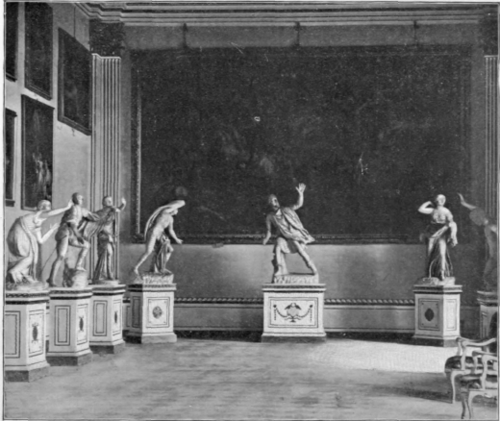
A Corner In The Niobe Room.
Repeated visits to this statue, however, gradually dispelled my disappointment, till I became at last a genuine admirer of its immortal beauty. The marks of restoration, it is true, are visible; but what a proof it is of the perfection of this Venus that, although mutilated, she could at once resume her sovereignty when her dissevered members had been united, and that she is still able to reveal the sculptor's thought expressed two thousand years ago! Oh, the sweetness and sadness of thinking of the millions who have gazed upon a work of art like this, and felt the same emotions that we feel, yet whom the senseless marble has outlived! The thousands of antiquity, who came to it, admired it and disappeared, leaving as little record in the world as last year's fallen leaves; and, then, the thousands of more recent times,-the artists, authors, poets, travelers, and friends whose work or love has influenced our lives, - all of whom rendered homage to this deity, and have since then in many instances passed away from earth, while the fair statue still remains and smiles upon us calmly in its sculptured loveliness, as it will doubtless smile on generations yet unborn. How many men and women, when they stand before it with the glow of health upon their cheeks, think of this figure with a kind of pity as being old! But it survives them all, although so frail that a fanatic's blow might ruin it, or even a missile thrown by a child's hand could mar its loveliness forever.
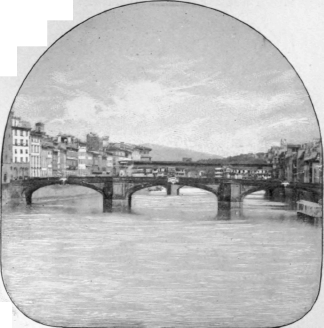
Trinity Bridge.
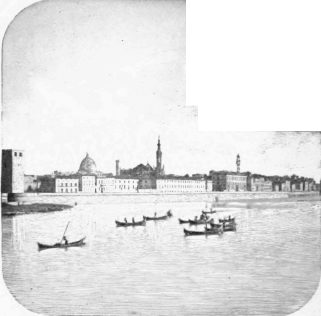
The Arno.
Reaching the terminus of the Uffizi Portico, I found myself on the Lung' Arno, a handsome street, which, as the name denotes, borders the river for a considerable distance. What the Seine is to Paris the Arno is to Florence. It divides the city into well-nigh equal parts, and sweeps along beneath historic bridges and between huge granite walls. The need of parapets to curb the torrent's violence was often felt in the early history of the city. In 1557, for example, the Arno rose to such a height that the contents of the shops were swept away by the invading water, and even the roofs of the houses on the Ponte Vecchio were carried off by the impetuous current. Yet, notwithstanding its occasional caprices, the Florentines love their river, which is to them a source of great prosperity, since it furnishes an easy means of transportation to the sea.
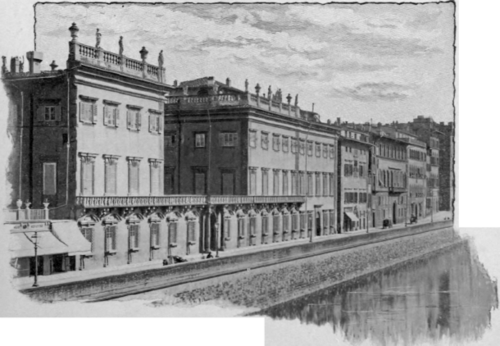
On The Lung' Arno.
Continue to:


My Books

