


Florence. Part 6
Description
This section is from the book "Florence - John L. Stoddard's Lectures", by John L. Stoddard. Also available from Amazon: John L. Stoddard's Lectures 13 Volume Set.
Florence. Part 6
It was the hour of noon when I arrived on the Lung' Arno, the very time when one would naturally expect to see some business traffic here; and yet its sidewalks were deserted. The reason was apparent; for the sun's rays were pouring so relentlessly upon the shadeless pavement, that the people had prudently retired into their houses or to the narrow streets. The hour of noon is, therefore, in hot weather the time of greatest silence in the Tuscan capital; for nothing but the ardent sun can dry to inarticulate repose the vocal chords of noisy Florentines.
Wherever shade prevails, however, Florence is usually a Bedlam. Street-venders call their wares with lusty lungs, and make the walls reverberate with their peculiar cries; and where most other people hum or whistle as they work, the merry Florentines prefer to sing. I once approached, on the Lung' Arno, a hackman who was so absorbed in rendering an air from "Il Trova-tore" that he continued, quite indifferent to my presence, till he had finished the refrain; then, disarming me with an engaging smile, he asked, "How could I cut short that fine aria, signore ?"
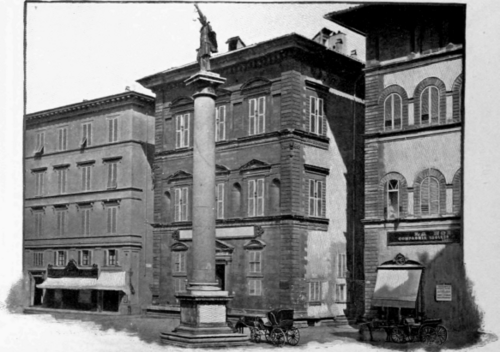
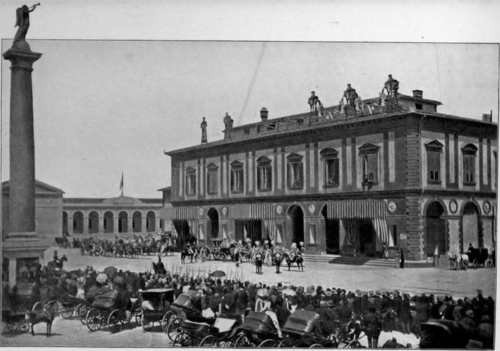
The Casino On A Gala Day.
Some years ago, an artist friend in Florence told me that a few nights before, three or four members of a theatre orchestra had amused themselves by playing a waltz on their violins and flutes as they walked homeward through the streets. A crowd of Florentines quickly assembled, and followed them dancing to the music. Where women could not be obtained as partners, the men danced with each other as far as the residence of the last musician. When he had, finally, disappeared within his house, the waltzers strolled back, arm in arm, singing the air to which they had been dancing.
I greatly admire the mediaeval palaces of Florence. They look magnificently stern and warlike in their panoply of rough-hewn stone, and are haunted by as many tragic memories as there are granite blocks in their massive walls. For in the days when Dante compared the Florentine Republic to a sick man, who is constantly changing his position without ever finding rest, these monumental palaces were domestic citadels, within which several generations of the rival families of Florence, with their armed retainers, could withstand a siege; when, either as Guelfs or Ghibellines, they carried on the endless feuds which stained the streets so frequently with blood. Their age alone would invest these structures with remarkable interest. Thus, the Strozzi Palace had been completed and occupied by Cosimo de' Medici before the discovery of America. Even its ornaments are reminders of the olden time; for, in the iron hoops, still visible beside the windows, banners waved by day and torches burned at night for centuries; and nearer to the base of the great structure are larger rings, to which the horses of visitors were fastened; for Florentine nobles then rode through the streets on horseback, not in carriages.
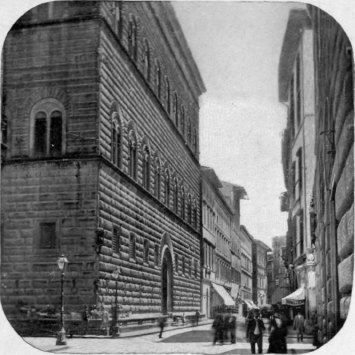
The Strozzi Palace.
Quite different from its mediaeval palaces, yet thoroughly characteristic of Florence, are some old frescoed structures near the Arno. Poor shabby dwellings they now are, reminding me of beggars clad in cast-off finery; and yet a charming fresco here and there smiles through the grime of years, as in the costume of a mendicant a piece or two may still remain unfaded and unstained. Sometimes, on the edge of evening, when their facades are gilded by the setting sun, they look like rare old tapestry, and hint of what they must have been; as a bright smile or look of tenderness on the oldest and most wrinkled face may give an instantaneous revelation of its former beauty. Who is it that says the only trump-card old people have left is cheerfulness?
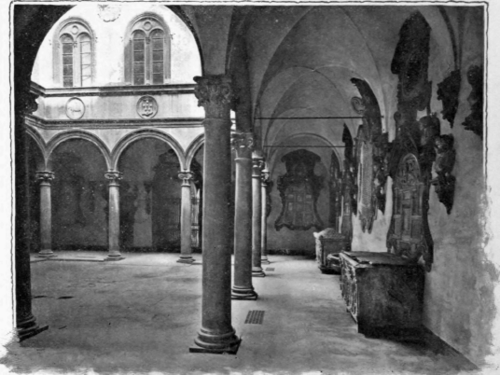
Courtyard Of The Palazzo R1Cardi.
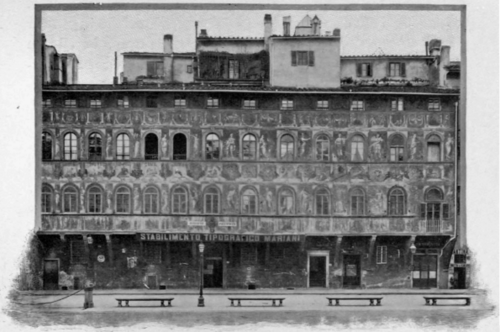
Old Frescoed Buildings.
A love for frescoed walls is common to northern Italy. I shall not soon forget a small hotel at which I stopped, on my way to Florence, almost within the shadow of the Alps. Its walls appeared to be alive with gaily colored gods, goddesses, men, women, children, and animals at which the peasants stared in open-mouthed admiration. It was dark when I arrived, and I saw nothing that night of the brilliant hues; but I can still remember how comical it seemed next morning, on looking out of my window, to see (so near that I could touch them with my hand) the enormous figures of two Alpine lovers, plighting their troth, in all the colors of the spectrum, on the exterior of my bedroom wall.
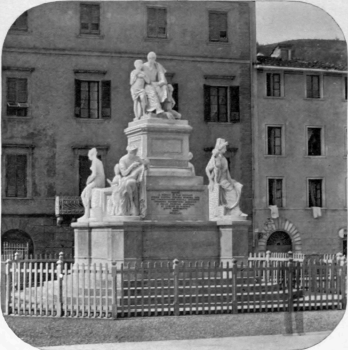
The Demidoff Monument.
Continue to:


My Books

