


South Tyrol. Part 24
Description
This section is from the book "South Tyrol - John L. Stoddard's Lectures", by John L. Stoddard. Also available from Amazon: John L. Stoddard's Lectures 13 Volume Set.
South Tyrol. Part 24
"Thus the bard of love departed;
And, fulfilling his desire,
On his tomb the birds were feasted
By the children of the choir.
Time has long effaced the inscriptions On the cloister's funeral stones, And tradition only tells us Where repose the poet's bones;
But around the vast cathedral, By sweet echoes multiplied, Still the birds repeat the legend And the name of Vogelweid".
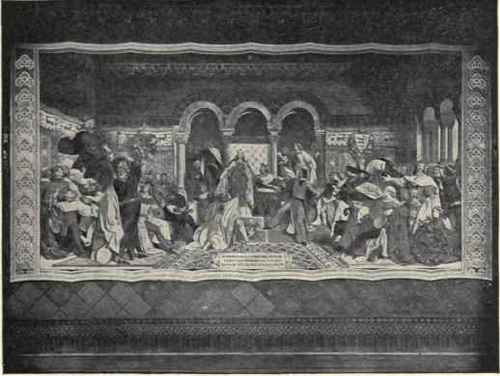
Tapestry In The Wartburg, Where The Contest Of The Minnesingers Took Place, 1207.
This reference to the Minnesingers is not called forth by an outlived custom of the past with no relation to the present time. Their influence on German life and character is still seen in the ever popular "Volkslieder" of the land. In my opinion, the fondness of the Germans for their "People's Songs" is one of the most beautiful and ennobling characteristics of the Fatherland. Who, for example, does not recognize the enormous influence which has been exerted for three hundred years by-Luther's glorious chorals? One hears them sung with admirable spirit in churches, schools, and family circles, and even by the university students on certain notable occasions. The well-known hymn, "Ein' feste Burg ist unser Gott," might be regarded as a national anthem, and it is certainly significant that even the orchestra at the pleasure resort of Baden-Baden, in its daily morning concert, invariably has for its first number one of the stately German chorals. Accustomed from their youth to them, the soldiers of the German army also know and sing these grand refrains, and one of them, "Nun danket alle Gott," was sung by the victorious German host after the battle of Sedan, with an effect which those who heard it describe as one of the most solemn and impressive experiences of their lives.
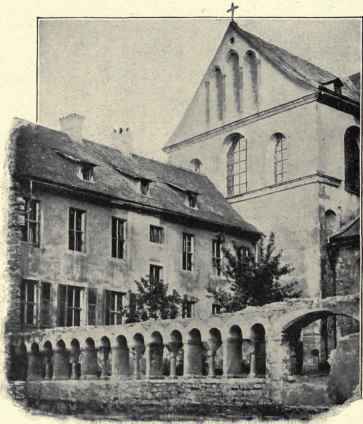
Cloisters Where Walther Was Buried.
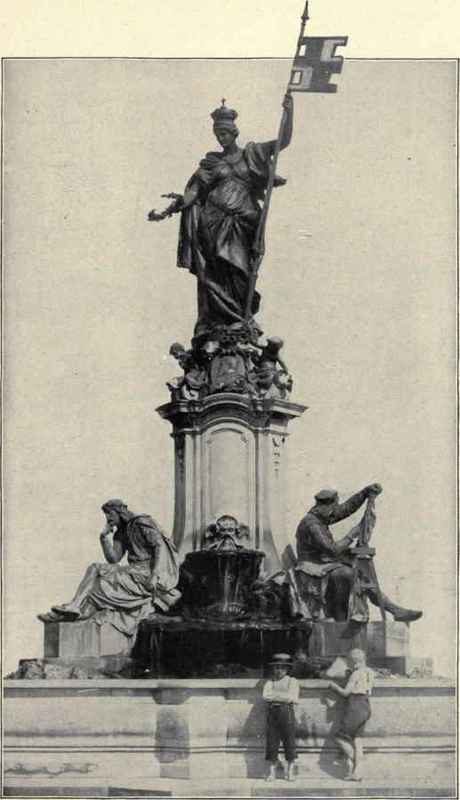
The Franconia Fountain, WÜRzburg.
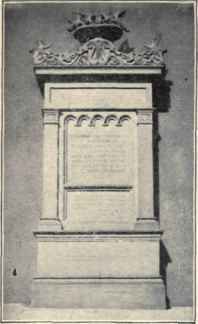
The Bird Memorial To Walther At WÜRzburg.
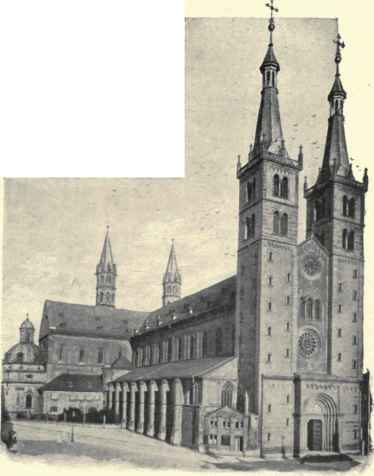
The Cathedral At WÜRzburg.
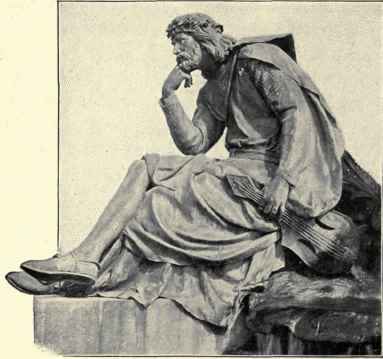
Statue Of Walther At WÜRzburg.
Two noble carriage roads in the neighborhood of Meran offer delightful excursions to the lover of Nature, and are superior in point of scenery to even the charming tour through Passeier Thal. One of these routes is of comparatively local, the other of a worldwide, fame. The first leads up the Mendel - that sharply cut, sheer mountain sentinel, which every visitor to Meran will recollect as standing, like a giant guardian, at the extremity of the Etsch Thal, and bearing a remarkable resemblance to the stern El Capitan of the Yosemite.
The second is the celebrated Stelvio Route, crossing the Alps from Tyrol to Lake Como. The Mendel has less glacial scenery than the Stelvio, for it attains but half the latter's height; but its ascent is thoroughly inspiring, presenting, as it does at every turn, romantic glimpses of the Etsch and Eisack valleys far below, and a magnificent distant view of the Dolomites, whose glittering summits cut the eastern sky for a length of nearly forty miles.
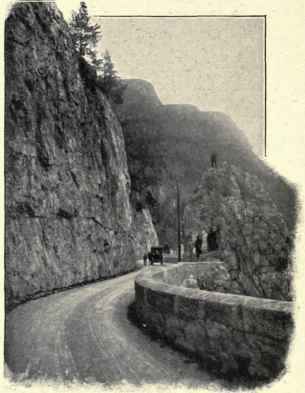
The Mendel Road.
This road is one of those Alpine highways which never fail, however often I pass over them, to kindle my enthusiasm. Despite our claim to be so far in advance of Europe in respect to practical utility and ease in traveling, Americans must cross the ocean to behold such roads as these. For, in comparison with thoroughfares like the Mendel and the Stelvio, most of the mountain roads in the United States (including, alas! those of our National Yellowstone Park) might be denominated mule trails. It may be said that all such European routes are made for military purposes. No doubt the governments do construct them with a view to the transportation of troops in time of war, where railways are not feasible; but meantime, decade after decade, the bulk of traffic on their smooth and stoneless surfaces is entirely civilian. The mails are carried over them, it is true, to a few Alpine villages, but otherwise they are apparently maintained in their superb condition for the use of travelers only, of whom the great majority are, in summer, tourists. Under these circumstances it is not strange that near the summit of the Mendel Pass, forty-five hundred feet above the sea, there should be situated in a sheltered nook, surrounded by pine forests, a popular resort, with two first-class hotels. This, although visited even in winter by guests desirous of an Alpine climate of considerable mildness and surpassingly pure air, is specially frequented by the residents of Botzen and Meran in spring and autumn, and in July and August, by a multitude of travelers, from all parts of Europe. . Indeed, so steadily is the tide of travel increasing here that an electric railroad to the summit has just been completed for the accommodation of those who find the carriage trip from Botzen thither in five hours inconvenient.
Continue to:


My Books

