


South Tyrol. Part 23
Description
This section is from the book "South Tyrol - John L. Stoddard's Lectures", by John L. Stoddard. Also available from Amazon: John L. Stoddard's Lectures 13 Volume Set.
South Tyrol. Part 23
The name Minnesinger - derived from the old word "Minne," signifying love - sufficiently indicates the usual subject of their compositions, which they were wont to sing to their own accompaniment on the viol. But they wrote also patriotic songs, the best of which are vibrant with the purest spirit of knighterrantry, and were well suited to the age of the Crusades, when the world rang with the renown of noble names and knightly deeds. This mediaeval poetry, which remained unrivaled in Teutonic lands until the time of Goethe, had its origin in Austria, and some of its most brilliant exponents came from the Tyrol. Thus it was an Austrian knight of unknown name who, early in the twelfth century, gathered into epic form the scattered ballads of the Nibelungenlied, - that Iliad of Germany whose adaptation to imperishable music was the memorable work of Wagner. Indeed, as is well known, one of the latter's most delightful operas is based upon the legendary-adventures of the Austrian Minnesinger, Tannhäuser.
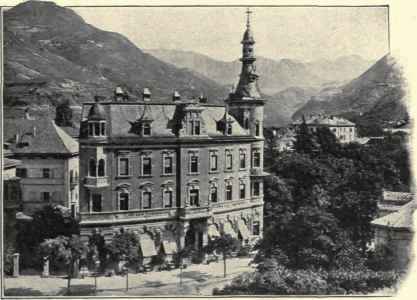
Hotel "Walther Von Der Vogelweide".
But it is the special glory of the Tyrōl that it also produced the man who is by common consent acknowledged to have been not only the most talented of all these Minnesingers, but the greatest lyric poet of the Middle Ages, - Walther von der Vogel-weide. This famous bard was born near Waidbruck, fifteen miles from Botzen, about the year 1170, or nearly a century before the birth of Dante. His title - Walther of the Bird-Meadow - has sometimes been attributed to his love for nature and his fondness for the songs of birds; but there is little doubt that it was derived from the Tyrolean estate of "Vogelweidhof," where, as most scholars now believe, Walther first saw the light. A memorial tablet attesting this fact was affixed to the house now occupying the spot, in October, 1874, amid an enthusiastic gathering of Tyrolese and foreigners, the record of whose speeches, music, banners, and processions at this "Waltherfest" bears witness to the pride and appreciation felt and shown by Austrians and Germans in honoring their illustrious dead. Subsequently, also, the city of Botzen, proud of the fact that this great mediaeval bard was born in its vicinity, not only named its principal square the "Walther Platz," but also embellished it with a handsome fountain, surmounted by a really noble statue of the poet.
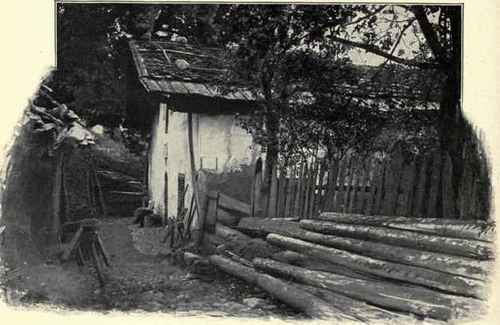
"Vogelweidhof," Birthplace Of Walther.
One hardly expects to find so fine a monument as this in a Tyrolean city of less than fourteen thousand inhabitants; but it exemplifies the fact that much of the work of modern German sculpture is of an exceedingly high order. I like to sit in one of the cafes adjoining the old square of Botzen, and study at my snowy neck, as if to drink of the clear water in the basin. It is a singular coincidence that, though I have looked upon this statue certainly a score of times, I have never yet failed to observe a live bird perched upon the poet's head; and probably every traveler who halts in Botzen will see - if not the same phenomenon - at least a few birds bathing in the fountain, and scores of pigeons tiptoeing about the square, as if the place were consecrated to their welfare. In fact, such is the gentle influence which the legend of this tender-hearted bard perpetuates after the lapse of more than seven hundred years, that pigeons are fed here by the public quite as often and as generously as in St. Mark's Square in Venice.
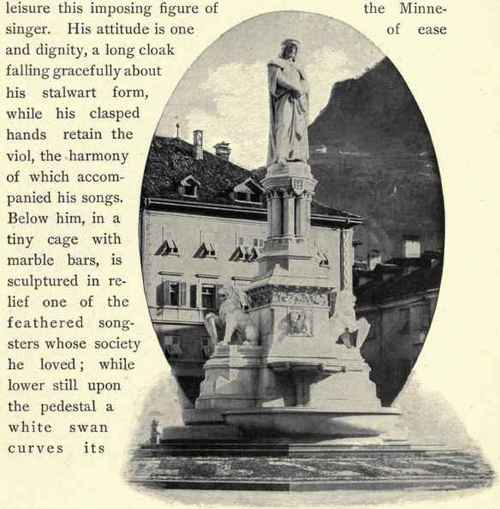
Statue Of Walther, Botzen.
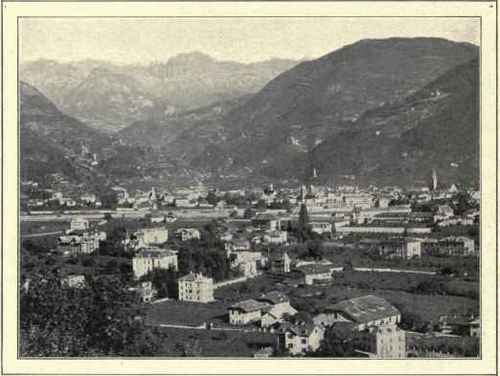
The City Of Botzen, South Tyrol.
Walther appears to have led the usual life of the Minnesingers, and went from court to court, and castle to castle, singing songs that greatly stirred the hearts of his enthusiastic listeners. His compositions were, however, not merely powerful in sentiment, but showed a metrical skill of the most delicate and elaborate kind. Thus, out of the one hundred and eighty-eight existing poems composed by him, at least one half are written in unique measures, and all are expressed in forms invented by himself. Many of his artistic triumphs were achieved at the brilliant court of Vienna; some of them also in the circle of poets and musicians gathered in Thuringia, at the Wartburg - that noble castle which was to play, three centuries later, so prominent a part in the life of Luther. Thus it is in the Wartburg that Wagner, in his opera of Tannhäuser, represents Walther as winning the prize in the Minnesingers' famous competition for supremacy. Walther's last days were spent at Würzburg, in Franconian Bavaria, where the emperor Frederick had given him an estate; and on his death, in 1235, he was buried under a linden tree in the cloisters of the Würzburg cathedral - a spot selected by the poet as being eminently peaceful and always open to the sunshine and the birds. This last condition was important; for such was Walther's-love for Nature's feathered minstrels that in his will he bequeathed a sum of money to furnish food and water daily to the birds, so that the space above his cloistered grave might always be melodious with the voices of the "poets of the air." So sweet a legend could not fail to touch the heart of Longfellow; and every reader will recall with pleasure his charming poem on this subject, in which occur the lines:
Continue to:


My Books

