


South Tyrol. Part 17
Description
This section is from the book "South Tyrol - John L. Stoddard's Lectures", by John L. Stoddard. Also available from Amazon: John L. Stoddard's Lectures 13 Volume Set.
South Tyrol. Part 17
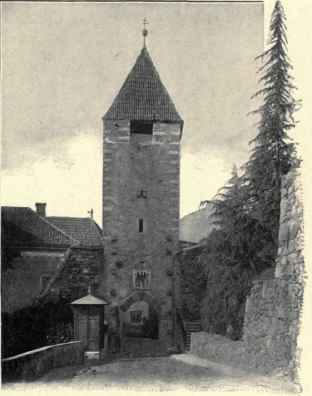
The Passeier Thor.
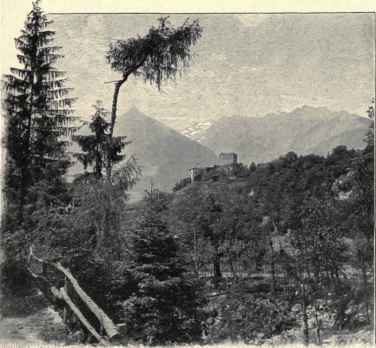
A View In Obermais.
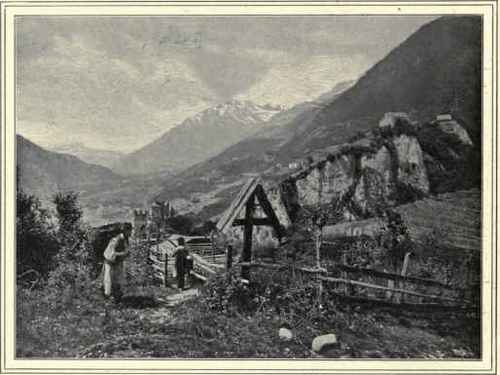
Schloss Tyrol And The Vintschgau Valley.
The word "Tyrol" can, however, be traced back to the Latin "Teriolis," - the name of a Roman fortress existing, contemporaneously with the settlement Maia, in the immediate vicinity of this castle. The importance of this Teriolis is proved by the fact that in an enumeration of the notable places of the Roman Empire at the time of the emperor Theodosius I. - 408-450 a.d. - it is mentioned as being the residence of a tribune and a prefect of the third legion. Indeed, a few steps north of Schloss Tyrol, there still stands, to the height of thirty feet, part of a massive watch-tower, originally built here by the Romans early in the history of their conquest. It was but natural that such experienced warriors should avail themselves of this strategic point; for it commands such long perspectives to the south and west, that one could easily discern from it the smoke by day, or flame by night, of any beacon-fire kindled on a similar tower on the road to Switzerland, and could have readily passed the signal on to a third fortress, visible far to the south near Botzen.

Schloss Tyrol And The Old Watch Tower.
The usual route to Schloss Tyrol leads over the Küchelberg, either by a winding carriage road, or by a steeper footpath, through the little village of Dorf Tyrol. Between this hamlet and the tongue of land on which the castle stands, yawns an abyss, along the brink of which the tourist must make his way on foot, astonished at his strange environment. Although some sort of a ravine must always have existed here, a landslide, which occurred three hundred and fifty years ago, enormously increased its depth and breadth, and tore away so much of the western bank, that a considerable portion of the castle, containing sixteen rooms, fell with it into the raging torrent. At present, therefore, the venerable building rises almost from the edge of a precipice, and offers an imposing aspect to the visitor, as he approaches it by the narrow path, which leads him round the head of the gorge, and thence along the heavily wooded mountain side. To this experience is added the necessity of walking through a rather low-roofed tunnel, built by the emperor Leopold, in 1681, to make the route secure from avalanches.
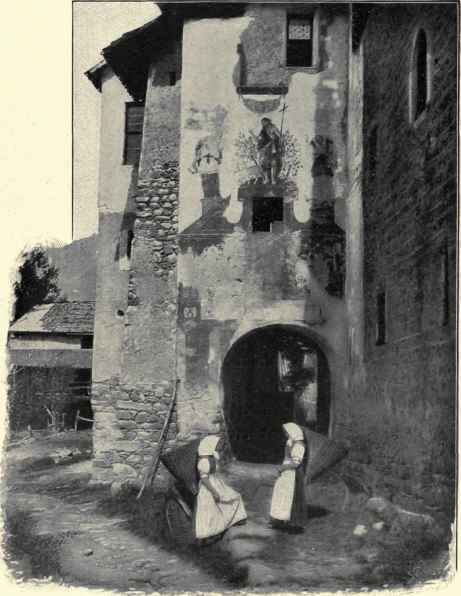
A Gate In Dorf TyrŌL.
When one has finally reached the castle, he feels perhaps a little disappointed that, in itself, it has not more to illustrate its long, eventful record. But after the vicissitudes it has experienced, the principal cause for wonder is that it still exists. In 1806, for example, the Bavarians seemed determined to destroy this national monument, together with everything else beloved by the Tyrolese, and intimately connected with their history. At all events, they took from it practically everything that was not nailed and riveted, and finally sold the grand ancestral pile for a trifling sum to the highest bidder. At present, therefore, part of the entrance gate, an interesting chapel, built in 1331, and two stone doorways, whose quaint sculptures wear the scars of many centuries, are about all that can be shown to us by the cicerone. Yet, even apart from its magnificent view which would itself repay a long and arduous journey, the prominence and importance of this castle might well make any one feel privileged to stand within its walls. We have already seen that it gave its name to the Tyrōl; and during many centuries the feeling of the people in regard to it was shown by their familiar saying, "Only the lord of Schloss Tyrōl is also lord of the land." It was, in fact, the central point of the whole territory: the place where all State ceremonies were enacted; the residence of its princes; in a word, the very heart of the country whose vigorous pulsations sent life and force to every portion of its rugged frame.
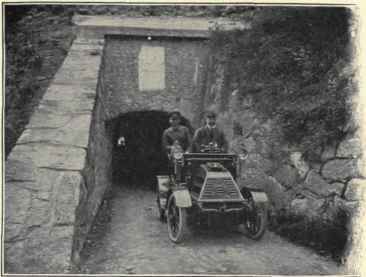
The Tunnel Near Schloss Tyrol.
Continue to:


My Books

