


South Tyrol. Part 18
Description
This section is from the book "South Tyrol - John L. Stoddard's Lectures", by John L. Stoddard. Also available from Amazon: John L. Stoddard's Lectures 13 Volume Set.
South Tyrol. Part 18
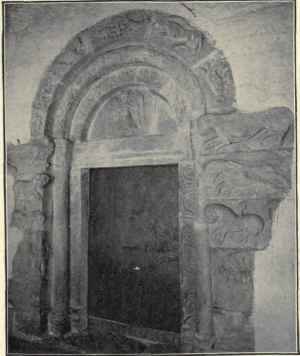
Doorway Of The Chapel, Schloss Tyrol.

The Old Chapel Of Schloss TyrŌL.
But the significance of this building is not limited to the Tyrol. It is in some respects the most interesting castle in the whole Austrian Empire, since it is one of the cradles of the reigning family. The original home of the Hapsburgs, on the male side, is the ruined schloss near Brugg, Switzerland, built in the eleventh century; but neither the country in which it stands, nor the château itself, is now in the possession of Austria. On the female side, however, the present Austrian dynasty comes from the family of Görz-Tyrōl, whose residence was this majestic stronghold just above Meran. Moreover, as is fitting, this is now the property of the emperor. For when, in 1816, the Tyrol was restored to Austria, the people of Meran redeemed their castle from the man who had bought it of the Bavarians, and gave it, as a token of their love and loyalty, to Kaiser Franz I., who came here to receive the gift. The beautifully written and handsomely bound document, in which the transfer of the property was made, as well as the accompanying key to the castle gate, may still be seen among the treasures of the State at Innsbruck.
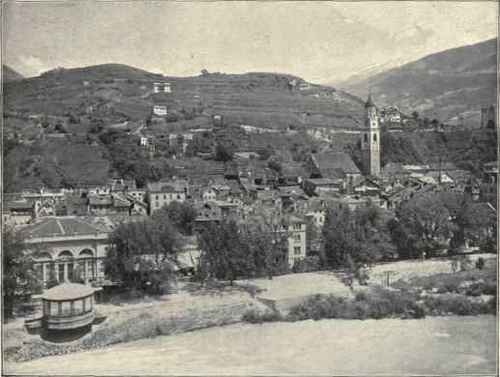
Vineyards On The KÜChelberg.
As Sigmund and Eleanor are the personages who most interest us in connection with the Princes' Castle in Meran, so the most striking figure in the history of Schloss Tyrol is Margaret Maultasch, who held her brilliant court here in the period of its greatest splendor, from 1335 to 1363. This princess has been called the Tyrolese Marie Stuart. Certainly not, however, in respect to beauty, for her thick lips and prominent jaw gave to her the unenviable name of "Maultasch," or the "pocket-mouthed." The comparison seems rather to have been made on account of certain reckless, passionate proclivities, which are sometimes without sufficient reason ascribed to the fair Scottish queen. Like Mary, for example, Margaret of Tyrol is said to have murdered her second husband; but neither charge has ever been substantiated. Numerous legends, too, exist which would ally her rather to a Catherine II., or a Messalina; but most of these are fables. Certain it is, however, that her two peculiar marriages, as well as some of her political acts, exerted a more powerful influence on the destiny of her country than those of any other Tyrolese ruler; and it is to Margaret's own deliberate gift of the Tyrol to her Hapsburg relatives, in 1363, that Austria owes its possession of this land for more than half a thousand years. One characteristic act of this impulsive and determined woman is worth relating. Her life with her first husband, John of Luxemburg, was so unhappy that she adopted drastic measures to get rid of him, without, however, resorting to poison or the dagger. One fine November morning, in 1340, John rode away from Schloss Tyrol to hunt as usual, without a suspicion of his coming fate. But that autumn evening, ready for his supper, he found the drawbridge raised, and the portal locked and barred. To his amazed inquiry as to what this meant, the answer came that the castle, of which until then he had supposed himself to be the master, was closed to him forever. In vain he raged, swore, threatened, and implored. It was no jest, and Margaret, true to the character denoted by her lower jaw, would not, and did not, change her mind. He had no friends in Meran to whom he could appeal, for all the Tyrolese detested him, and the few personal followers whom he had brought here with him had likewise been expelled during his absence at the chase. Accordingly, he was compelled to leave the country, and carry back to his father's court the shame of his humiliating banishment.
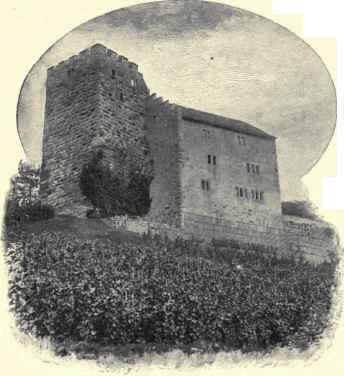
The Cradle Of The Hapsburgs, Near Brugg, Switzerland.
"Alas, alack! When he came back"
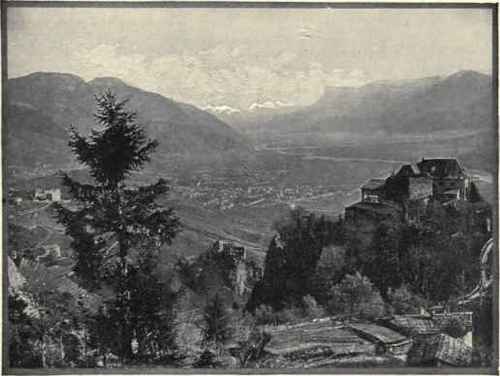
View Toward Italy, From Schloss TyrŌL.
A woman of Margaret's spirit naturally did not hesitate now to wed the man she loved, despite the warnings of the Church and even a papal bull of excommunication. In the following February, therefore, she married her second husband, Ludwig of Brandenburg. This union, which in after years the Church consented to acknowledge, seems to have been a reasonably happy one; but, as a matter of course, it led to a bloody war with the relatives of the outcast John, who were determined to avenge the insult which his wife had given them, and incidentally to obtain some Tyrolese territory as indemnity. In 1347, therefore, John's brother, Karl of Bohemia, suddenly appeared before Schloss Tyrol, and laid siege to it; but Margaret and her husband fought so gallantly in its defense, that the invader was compelled to withdraw his troops, and subsequently suffered, farther down the valley, a severe defeat. Unfortunately, however, in this instance, as usual, the poor and innocent had to pay most dearly for the faults and follies of their masters. Not only was the fine old castle on the Zenoberg, where Margaret as a child had lived, and also another residence of hers known as Schloss Maultasch, destroyed by the Bohemians, but Botzen and Meran, with all the villages lying between them, were sacked and laid in ashes. Sites of such beauty and fertility, however, recover quickly from misfortunes; and it was at this time, when much of Meran was being restored, that its parish church was built, which still exists in an admirable state of preservation, and boasts of the loftiest spire in Tyrol.
Continue to:


My Books

