


South Tyrol. Part 19
Description
This section is from the book "South Tyrol - John L. Stoddard's Lectures", by John L. Stoddard. Also available from Amazon: John L. Stoddard's Lectures 13 Volume Set.
South Tyrol. Part 19
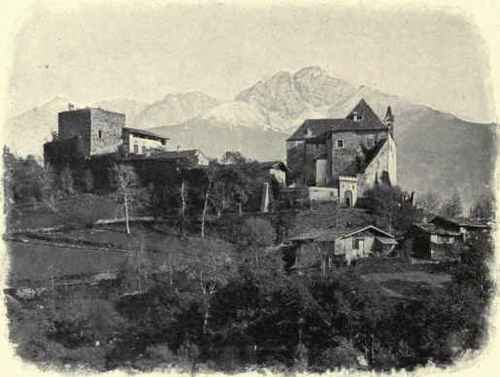
Schloss TyrŌL, From The West.
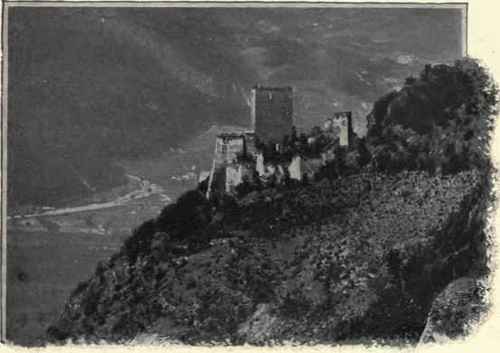
Ruins Of Schloss Maultasch.
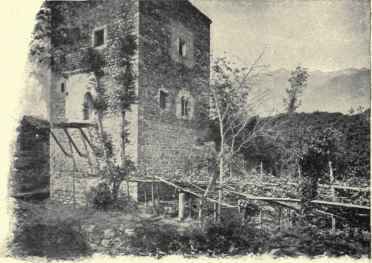
Remains Of The Castle On The Zenoberg.
When Margaret's husband died in 1361, and in less than a year thereafter her only son, who had succeeded him, also passed away, the spirit of the princess was completely broken. Sad and disheartened, she refused to govern any longer, and abdicated in favor of her young, ambitious, and clever cousin, Rudolph IV. of Hapsburg, then Duke of Austria, who thus, in 1363, became the sovereign of this land, which ever since has held its place as one of the most precious jewels in the Austrian crown.
The castles which surround Meran still stand in proud reserve on their respective heights, scorning companionship, and seemingly suspicious of one another in their isolation. The towers of many of them have foundations laid in Roman times, and all of them are rich in architectural and historic features, out of which a romance could be written. Schloss Auer, seamed and grisly with age; the ruined piles of Brunnenburg and Dürrenstein, subservient formerly to Schloss Tyrōl; Schloss Fragsburg, crowning the plateau which dominates the entire plain; and Katzenstein, which nestles at its feet, like a beloved but lowly favorite; Schloss Lebenburg, across the valley, haughty in its solitary grandeur; Schloss Goyen, shadowed by the giant Ifinger; Schloss Planta, with its ivy-mantled tower; Schloss Rametz, whose high, crenelated walls and ivied terraces rise out of vineyards famous for their wine; Schloss Winkel, whose huge mass of masonry has formed a prominent part of Obermais for centuries; Schloss Rothenstein, the property of one of the imperial family; and Schloss Rubein, whose ancient tower overlooks a garden of enchanting beauty, - these are a few of the interesting structures here which were already old before the earliest flower of civilization blossomed in the wilderness stretching from Atlantic to Pacific in the vast continent beyond the seas. The limits of this volume forbid detailed description of these castles, but one at least claims more than passing mention. It is Schloss Forst, which has for seven centuries, practically in its present form, guarded the entrance to the Vintschgau valley. This castle can be reached by carriage in about twenty minutes from Meran along the well-made road that has replaced the Via Claudia Augusta, built by Drusus two millenniums ago. It stands upon a little hill, apparently fashioned by Nature for the special purpose of supporting it; for so well suited are the proportions of the building to its foundations, that they suggest a statue and its pedestal. The picturesque and original architecture of this ancient stronghold finds its culmination in the crenelated tower, whose square teeth rim the battlement and indent the sky at a height of about one hundred feet above its massive base. This central pile of masonry, whose walls are more than seven feet thick, seems capable of lasting for as many centuries as it has survived already. How many these have been is still a matter of dispute; but it is claimed that the foundations of the tower are of Roman origin, and it is not unlikely that a fortress was erected here as a defensive outpost of the Station Maia. Stern and severe it now appears, together with the similarly fashioned northern side of the castle; but these are pleasantly relieved by a semicircular front, which, curving southward like an immense bow window, brings several fine rooms into the warmth and splendor of Tyrolean sunshine. Beside this stands a partially enclosed, hexagonal tower, surmounted by a conical roof of bright red tiles, and almost covered with a mass of vines; while closely adjoining it, at a point commanding a delightful view, an ivied loggia clings like a swallow's nest to the gray wall. From the street gate a footpath winds around the hill on one side, a driveway on the other, their meeting place being at the castle's massive portal on the summit.

Apse Of The Parish Church, Meran.
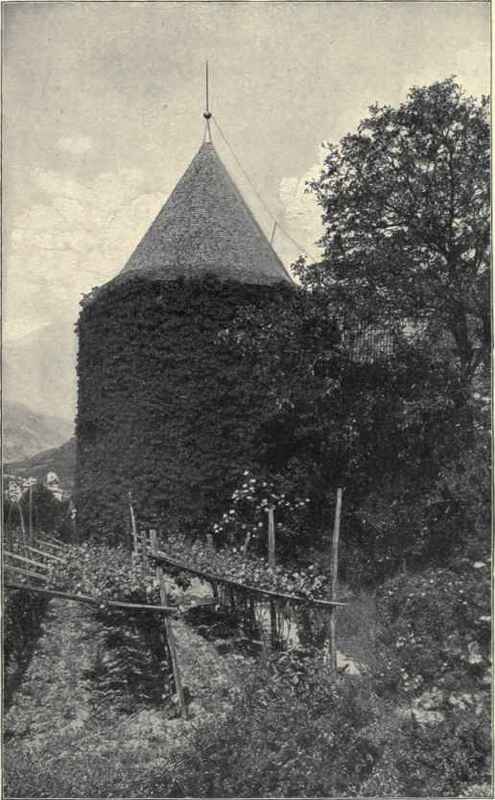
Schloss Planta, Obermais.
Continue to:


My Books

