


South Tyrol. Part 16
Description
This section is from the book "South Tyrol - John L. Stoddard's Lectures", by John L. Stoddard. Also available from Amazon: John L. Stoddard's Lectures 13 Volume Set.
South Tyrol. Part 16

Monument To Hofer On Berg Isel.
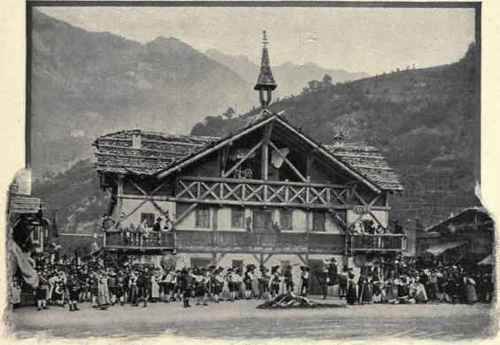
The Open-Air Theatre In Meran.
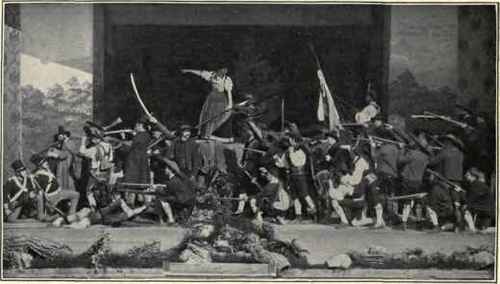
The Battle Scene In The Play "Andreas Hofer".
What could be more instructive and inspiring than national history thus taught? As the play proceeds, one can perceive the lesson gradually stamping itself upon the faces of both auditors and actors; and we are certain that the steadfast men who gather on the stage in answer to the waving of the flag, would rally just as loyally beneath its folds of white and red, if once again the children, playing in the neighboring meadow, should - as they did in 1809 - rush to the town to spread the news that the French soldiers were at hand. These peasants, armed with antique muskets, scythes, and pitchforks, are doubtless just such men as Andreas Hofer led to victory; and the brave, wholesome looking girls who urge their brothers, lovers, and young husbands on to valiant deeds, are capable to-day of no less self-renunciation and enthusiasm. The vines that drape the Küchelberg in graceful terraces have bloomed and ripened into fruit nearly a hundred times since the rich soil from which they spring drank greedily the blood of Austria's invaders; but ruddy as the juice within their purpling clusters still flows the lifeblood of the Tyrolese; and when the curtain of the drama falls, and the impressive strains of Austria's national hymn ring out upon the air, the entire multitude rises reverently to its feet, as is invariably the case whenever that simple but soul-moving composition of Haydn is played. One cannot wonder, therefore, that in the crowd which thus disperses, thrilled with the sentiments awakened by the brilliant page of history that has been unrolled before them, hundreds of loyal lips repeat, in unison with the melody, the words: -
"Gott erhalte, Gott beschutze, Unsern Kaiser, unser Land !"

The Hero Captured. (From The Play).
In driving back into the city, we pass beneath the massive Vintschgau Gate, through which the Paul Revere of the Tyrol galloped to bring the signal of revolt to the expectant people in the western valleys. It is but one of several portals of the old, mediaeval town, one of which, known as the Passeier Thor, is decorated with the favorite emblem of the country, - the eagle of Tyrol, which differs from all other representations of the bird of freedom in being of a brilliant red, surmounting either a silver shield or a battlemented wall. The famous lines referring to it are dear to every Tyrolese heart, and may be thus translated: -
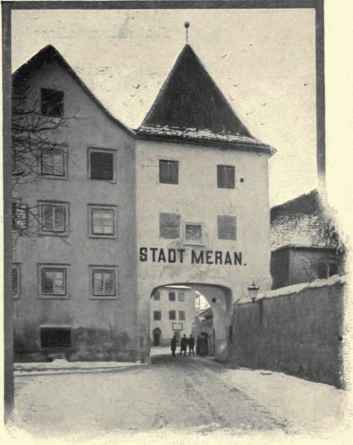
The Vintschgau Gate.
The Red Tyrolean Eagle
Eagle, Tyrolean eagle, Why are thy plumes so red? "In part because I rest On Order's lordly crest; There share I with the snow The sunset's crimson glow".
Eagle, Tyrolean eagle, Why are thy plumes so red? "From drinking of the wine Of Etschland's peerless vine; Its juice so redly shines, That it incarnadines".
Eagle, Tyrolean eagle, Why are thy plumes so red ? "My plumage hath been dyed In blood my foes supplied; Oft on my breast hath lain That deeply purple stain".
Eagle, Tyrolean eagle, Why are thy plumes so red? "From suns that fiercely shine, From draughts of ruddy wine, From blood my foes have shed, - From these am I so red".
Like jewels in the coronet of silvered peaks encircling Meran, glitter no less than thirty-five interesting and historic castles. Near or remote, they add a striking element of picturesque-ness to the landscape, and stimulate our curiosity to learn the secrets guarded by their massive walls. The first of these in beauty of position and historical importance is Schloss Tyrol. Its situation is superb. Set high' upon the valley's northern wall of mountains, it dominates not only the entire plain, through which the glacial Etsch sweeps southward into Italy, but also has an uninterrupted view for a long distance westward up the Vintschgau Thal toward Switzerland. Hence, more than any other point in the vicinity of Meran, it is the favorite of Phœbus. On the old castle's yellow walls, which seem to have been richly tinted by the floods of sunshine they have constantly absorbed, fall the first solar rays that shoot across the valley from the east; and all day long its broad, high, southward-facing front is bathed in warmth and light; while in the winter afternoons, long after Meran lies in shadow, the snow-encircled Vintschgau Thal is like a monster window, framed in crystal, through which the glory of the universe comes streaming eastward, making this precious shrine of Tyrolese art and history so luminous, that one could easily fancy it a golden casket, in which the treasures of past centuries are concealed. If, out of all the castles, towers, and convents of Tyrol, one building only had to be chosen, as the characteristic structure of the country, it would undoubtedly be this. For it has given its name to the entire land in which it stands, as well as to the "Counts of Tyrol," who enter on the stage of history about the middle of the twelfth century as owners of this stronghold and as rulers of the country.
Continue to:


My Books

