


Malta. Part 6
Description
This section is from the book "Malta - John L. Stoddard's Lectures", by John L. Stoddard. Also available from Amazon: John L. Stoddard's Lectures 13 Volume Set.
Malta. Part 6
On settling in Malta, the Knights well knew that it would not be long before the Turks, against whom they still waged incessant war, would try to force them out of their new home, as they had driven them successively from Jerusalem, Acre, and the "Garden of the Levant." Accordingly, they at once began here the elaborate fortifications which still excite the wonder of the world. These were, however, far from complete when, in May, 1565, the Turks appeared upon the scene, and ushered in the famous four months' siege of Malta, which in respect to courage, hand-to-hand combats, loss of life and desperate endurance will always rank among the most remarkable events in military history. Only the salient points of this great conflict can be mentioned here. If thoroughly described, the story would require a volume. John de la Valette, for whom, as has been said, the present Maltese capital was subsequently built and named, was then Grand Master. Though seventy years of age, he was a splendid specimen of a gallant soldier and experienced general, the idol of his troops, and the hero of a hundred battles. So vigorous was he in his virile threescore years and ten, that he often fought in the front ranks with his men, wielding his battle-ax with an effect as deadly as that produced by any of his followers. The numbers of the combatants were unequal. La Valette had at his disposal only about nine thousand fighting men, seven hundred of whom were members of the Order. The Turks, commanded by the veteran, Mustapha, numbered forty thousand. In skill and courage, too, the Moslems certainly were not inferior to their opponents; for it must be remembered that the Christians fought in this case from behind strong fortifications, and were protected by their suits of armor, while the Mohammedans sprang to the assault with only turbans for their helmets, and, for their corselets, loosely folded robes. Under these circumstances the very numbers of the invaders often placed them at a disadvantage, since in the serried ranks of those who rushed en masse into the breach, the battle-axes made appalling gaps, encountering only flesh and blood; while the Turks' spears and swords struck harmlessly against steel casques and coats of mail.
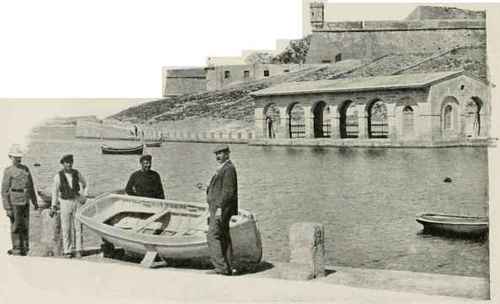
A Strategic Point.
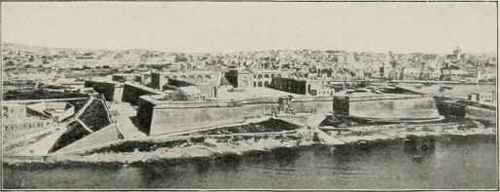
Fort Manoel, Valetta.
The first and principal point of attack in this momentous siege was Fort St. Elmo, which then, as now, stood at the entrance of the harbor. This was for four weeks stormed by the Moslems, regularly every day, in desperate, hand-to-hand assaults, after a fierce artillery fire which would have certainly destroyed it, had it not been to a great extent composed of the solid rock of the hillside.
The garrison of this stronghold was isolated from the rest of the Christian forces, and finally, through the losses which it steadily experienced, was reduced to sixty men. An expert swimmer thereupon managed to elude the Turks, and report the desperate condition of affairs to La Valette. The Grand Master responded by immediately dispatching boats to their assistance, but it was utterly impossible for them to break through the cordon of the enemy, and rescue the exhausted heroes. The latter, therefore, recognizing the fact that they could not escape, resolved to sell their lives as dearly as possible. First, they repaired to the little chapel of the fortress, and there partook of the sacrament. Then they went forth to die. No one held back. Even those, who from wounds or sickness were too weak to stand, were placed in chairs upon the walls, their faces toward the foe. Thus for four hours they kept the Turks at bay. At last, however, the irresistible numbers of the enemy prevailed; and, mounting over the parapet like a tidal wave, completely swept the brave defenders out of existence. Then Mustapha caused the heads of the heroic Knights to be exhibited to their fellow-Christians on the ends of poles, and their bodies, with the figure of the cross gashed rudely on their breasts, to be attached to planks, and thrown into the harbor. Infuriated by these deeds, the Knights in the other fortresses retaliated by firing from their mortars the gory heads of Turkish prisoners.
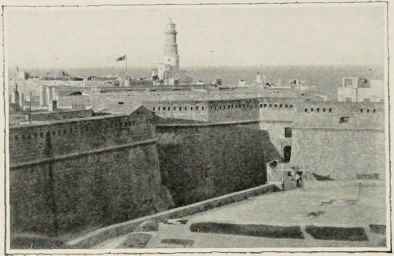
Fort St. Elmo.
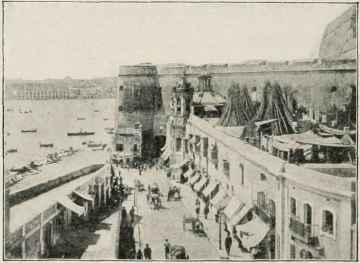
Fort Lascaris.
Continue to:


My Books

