


2. The Second Essential Of Practice is to Keep All Colonies at Approximately Uniform Strength
Description
This section is from the book "Honey Getting", by Edward Lloyd Sechrist. Also available from Amazon: Honey Getting.
2. The Second Essential Of Practice is to Keep All Colonies at Approximately Uniform Strength
The Advantage of Uniformity in Colonies*
Uniformity of colonies cannot be stressed too much. It is a factor of utmost importance in honey getting because by uniformity, much bee labor can be substituted for man labor. Not only is much less labor required of the operator where all colonies are uniform, but the work may be systematized, done more quickly and with the use of fewer skilled helpers.
With uniform colonies, the work at an apiary may be reduced to a routine of similar operations for each colony: therefore one expert operator with one or more helpers, can do much work in a short time. If all colonies in an apiary are uniform, even an unskilled man will soon learn to know, as soon as a colony is opened, just what is to be done; but if, because of lack of uniformity, helpers must wait for detailed instructions from the expert operator, much time is wasted.
In any clear brood nest system, uniformity of colonies is the first essential to maximum honey production at lowest cost. Statistics show that the operator with all his colonies uniform, and up to standard honey-storing strength at the right time, succeeds in getting a much larger crop than his neighbor who has, when the honeyflow begins, colonies of all sizes, occupying from one up to four or five hive bodies. Though a few good colonies in such an apiary may give high individual yields, the many low producers spoil the average.
The exact procedure to be followed for uniformity of colonies depends on whether American foulbrood is absent or more or less prevalent. If the operator does not eradicate this disease from his apiaries, he cannot safely shift combs of brood or honey from one colony to another. American foulbrood, however, can be eradicated.
Securing Uniformity
Good combs, good queens, sufficient stores for spring brood rearing, and a constantly clear brood nest are essential in securing uniformity of colonies. There must be room to rear, to provision, and to house a goodly population.
*Appendix - 6.
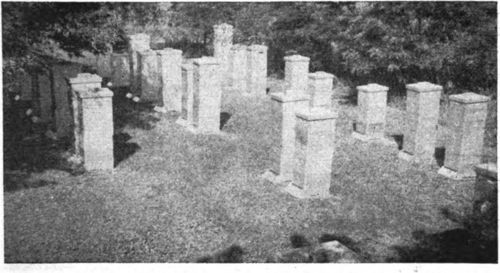
Through uniformity of colonies bee labor is substituted for man labor. This is the first essential to maximum honey production at lowest cost. (Polhemus apiary, Iowa).
In efficient practice, only colonies which will reach a strength that the operator pre-determines as his standard honeystoring strength are assisted. On the other hand, he does not permit any colonies to become strong enough to swarm or to exceed the most effective honeystoring strength. All colonies in "standard spring condition" are brought to "standard honey-storing strength. "
To accomplish this, brood is "pulled" (combs taken out) from too strong colonies and used in strengthening weaker ones (though not the weakest) and in forming nuclei; or colonies are divided and built up to standard. Not enough brood is taken from any colony to prevent its reaching standard honey-storing strength at the beginning of the honey-flow, but no colony is allowed to reach this strength too early. All colonies are to be strong enough for effective storing when the flow begins.
Use of the clear brood nest method results in uniformity that is seldom or never possible where the queen is permitted free run of several brood chambers but where no brood nest is kept clear for her. Uniformity is possible when all queens have plenty of room in which to lay and when the quality of queens is controlled through replacement, if they have undesirable qualities. Uniformity is not obtained when queens are replaced once a year irrespective of their quality unless the operator ruthlessly weeds out and unites all colonies that do not come up to the standard. Seldom will an operator do this unless it is an essential part of his system of management.
Colonies are made uniform and brought to standard honey-storing strength (as described under the First Essential, Securing and Maintaining a Clear Brood Nest); by dividing colonies and making increase; making nuclei as discussed under the section on using nuclei; and by strengthening with young bees from populous colonies by shaking the bees off one or more combs in front of, and allowing the young bees to run into, the entrances of weaker colonies.
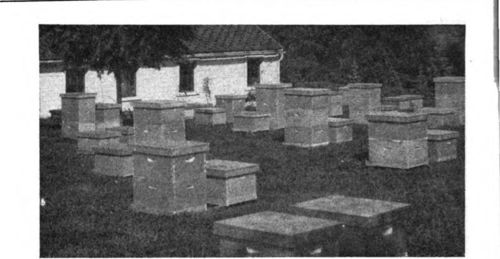
Lack of uniformity in colonies decreases the honey crop and increases the cost of production.
If colonies have been worked for uniformity, a mere glance at the entrance, and perhaps another glance at the top of the frames, enables the expert to determine if the colony varies from the standard and thus requires attention. If the colony appears to be standard, routine operations for the visit are performed by his helpers while he devotes his time to management. When only a few colonies in an apiary vary from the standard, work will go on rapidly.
When a critical visitor at an apiary finds a colony one or two stories high, the next one three or four, and an occasional skyscraper, he at once suspects some flaw in management. But when, during a honeyflow, every colony, unless it be a nucleus or recent increase, is of uniform strength and Supering, and when all colonies are working about the same, it is evident that the operator knows his location and his bees, and has prepared for honey-getting by securing uniformly strong colonies, so essential for good production.
Continue to:


My Books

