


Standard Honey-Storing
Description
This section is from the book "Honey Getting", by Edward Lloyd Sechrist. Also available from Amazon: Honey Getting.
Standard Honey-Storing
STRENGTH at the beginning of the honey flow.
STANDARD HONEY-STORING STRENGTH means that a colony has such a population and is in such a condition that, under the system of management used by the operator, it will store an adequate amount of honey at low cost. Both STANDARD SPRING CONDITION and STANDARD HONEY STORING STRENGTH will vary with local conditions and with the system of management used, and must be determined by each operator for himself.
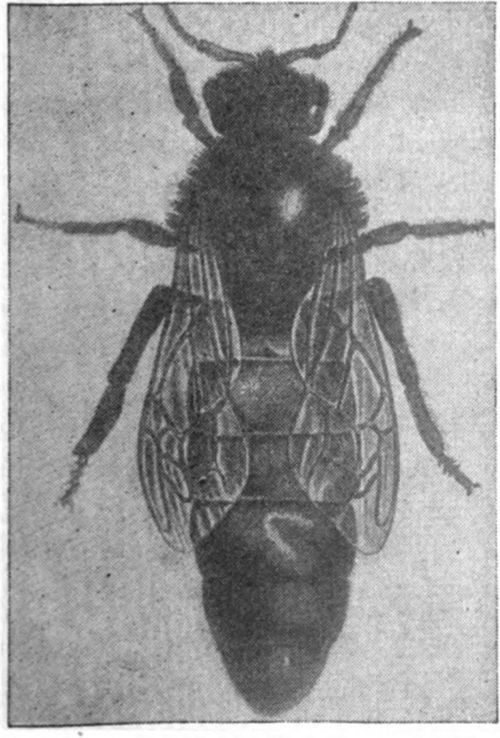
For adequate population, a good queen is essential.
1. Adequate Colony Population and Standard Honey-Storing Strength
In the apiaries of beginners and commercial beekeepers many colonies begin work in the supers only after the best of the honeyflow is past, and strong colonies often do nothing during a good flow because the storing instinct is not dominant.
Every spring manipulation should aim at getting the greatest number of vigorous workers at the right time, and at keeping the working force of the colony together and contentedly at work during the honeyflow. Particularly in localities having long honeyflows, it may be necessary in order to keep the honey-storing instinct dominant throughout the honeyflow, to divide an enormous colony of bees or otherwise reduce its strength; or, if colonies become weak, to build up the population.
STRENGTH means more than bee population. Workers must be of the right age, brood must be adequate to continue the population, the queen good, and the morale of the colony right for honey storing. Standard honey-storing strength is that hive population, both of field and hive bees, which, affected by all the limiting factors present, will give a good crop of honey without swarming. The storing impulse will dominate and continue through the honeyflow. A compact brood nest carrying 10 to 12 frames of brood is a good basis for such a colony.
Each location will have a number of limiting factors, of which any one may, at a certain time, appear to be the only factor disturbing storing and causing swarming. Actually several limiting factors will be influencing colony behavior even though but one may attract attention. Among these factors are the personality of the operator and his system of management, minor and major nectar flora, weather conditions, date at which the honeyflow begins, its length and intensity, and the character and quantity of storage space provided (although this last factor is intimately connected with management and honeyflow. )
Colony condition is important, this including the number of bees of different ages, quantity of brood in the hive, age and character of queen. Another limiting factor, which is really a part of apiary management, is disturbance to the colony by injudicious work with it, by an uncomfortable hive, or by surroundings which tend to break the routine of honey-storing and develop the swarming impulse.
To get the honey-storing strength which the apiarist has decided he needs for best results in honey-getting, the colony must have a good queen and enough bees, together with sufficient stores and egg laying space during the time it is needed. This may involve certain manipulations to insure plenty of worker cells in the brood nest early in the season, with less space when the population is to be decreased. Such manipulations should consume a minimum of man labor.
Although management for securing workers for the honeyflow begins during the previous late summer and early autumn, this will not now be considered, further than to state that it includes two main factors: 1) favorable conditions for producing bees for the winter colony, and 2) conserving these bees during the broodless period and in the beginning of brood rearing.
The broodless period may be several months in a cold climate, or less than a month in some parts of California. In some parts of the tropics, where there is no absolute dearth of nectar and no very dry or cold season, there is no broodless period, brood in four to six frames always being found in a normal colony.
In the work of building up the colony to honey-storing strength after the adversities of winter, it is the function of the beekeeper to see that each colony is headed by a queen that will produce the needed force of bees at the time of the beginning of the main honeyflow, and to supply any deficiency in food, in protection, and in room for rearing brood. Such attention should result in uniform colonies. Most failures to have all colonies uniform and profitably populous are due to negligence in anticipating and supplying the needs of the colony. A colony in standard spring condition, if properly cared for, will produce a colony which, if weather and location be good, will store surplus honey if the beekeeper performs his second duty of keeping the storing instinct dominant.
During spring, bee energy must not be wasted but used effectively in brood rearing. The time when brood is to be reared, and the amount of it, is important because of the differences in honey-flows. Often there is only one short, rapid honeyflow that furnishes much surplus; or there may be a series of short flows, each furnishing some surplus. Other localities furnish a continuous, moderate flow for months. Each type of location must have intelligent attention to get a good crop of honey.
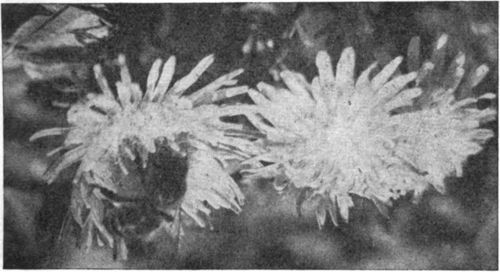
A honeybee, knee deep in dandelion.
When brood rearing begins in the spring, consumption of stores is greatly increased, and when the period of maximum brood rearing is reached, this consumption is enormous; and many colonies, particularly strong ones, are in danger of running short of both honey and pollen. Nearly a comb of honey and much pollen is required to rear a comb brood. Colonies may be so retarded by a shortage of stores, even though they do not die, that they cannot attain profitable strength. All colonies not abundantly supplied with stores in the fall should have early spring attention.
Spring starvation often occurs where there is no early flow, such as dandelion, or where, after an early flow has started extensive brood rearing, a dearth of nectar comes, lasting a few weeks or a month; then, with insufficient honey or pollen, colonies become so weak that recovery in time to store a good surplus is impossible.
All through spring, each colony should have ten to fifteen pounds of honey in excess of daily needs. Otherwise the risk is great that brood rearing will proceed slowly at some time when the beekeeper is not aware of it, even though the colony does not seem starved.
Continue to:


My Books

