


Standard Honey-Storing. Part 2
Description
This section is from the book "Honey Getting", by Edward Lloyd Sechrist. Also available from Amazon: Honey Getting.
Standard Honey-Storing. Part 2
Many colonies starve in their effort to rear brood - starve even with a few pounds of honey in the hive. This often occurs if the honey is very heavy in body or if it has been crystallized during the winter. If conditions are such that the bees cannot carry to the hive enough water to dilute this honey, they may starve even with plenty of honey in the hives. Feeding water or very thin syrup at such times may save them from starvation.
If feeding is necessary, most extensive producers prefer to give each needy colony several combs of sealed stores if their apiaries are free from American foulbrood, or ten to fifteen pounds of sugar syrup at one feeding, although under some conditions it may be best to stimulate brood rearing by giving a small amount of feed at a time. Sometimes such stimulative feeding is profitable during the weeks just before the honeyflow. Where there is plenty of fresh nectar and pollen, stimulative feeding is not needed. As pollen is essential to brood rearing, the fall management should be such that considerable pollen is carried over winter in the combs unless it is certain there will be plenty available in the spring.
Some who winter bees in cellars find it profitable, after they have been set out, to give some protection to insure continuous brood rearing during cold snaps. * Brood rearing requires a temperature of about 93 degrees F. while the best winter temperature within the hive is 57 degrees. Because the colony must expend so much food and effort in keeping up, during cool weather, the high temperature required for brood rearing, it may need protection more in spring than winter. This is the case in regions where much bad weather occurs after the bees have begun to rear brood, and in open locations where bees have no shelter from wind. An apiary location well protected against cold winds is of great importance in the spring.
Good Combs Important
Perhaps the most important factor in honey production is to have, in the brood chamber, combs that approach perfection. This is not generally understood, and it is not uncommon to find, even in the apiaries of commercial beekeepers, hives in which the brood capacity is cut in half because of poor combs in the brood nest.
*Appendix - 4
These poor combs are not usually drone combs but worker combs, buckled, sagged, or otherwise injured, containing many cells in which no brood is reared, these misshapen cells being used for honey and pollen storage. When a beekeeper, at a time when bees are breeding up rapidly, finds combs in the brood nest that have an inch or two of honey just under the top bar, he can be pretty certain the combs are faulty and should have no place in the brood chamber. If the queen is good, every comb in the brood nest should have brood solid to the top bar during the main breeding season.
Much better results are secured by having a clear brood nest in good combs in one hive body than by having the same amount of brood space scattered through the combs of two hive bodies.
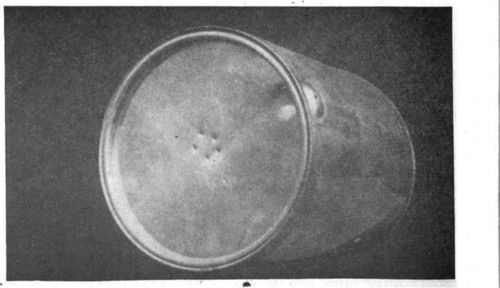
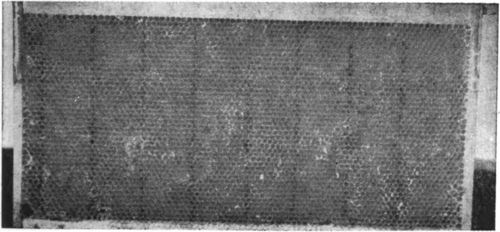
A poor prospect for a good comb.
Poor combs should be sorted out at a time when the combs are empty of honey, as it is not easy to be sure when an old comb full of honey should be discarded. Poor combs are often placed in supers, and they are good enough for that purpose; but beekeepers are just ordinary human beings who, when selecting combs of honey for winter stores, find it impossible or impracticable to separate good combs from poor ones. Many poor combs which were once set aside to be used only in supers will, in the course of a year or two turn up in brood chambers where they may remain all summer creating barriers of honey within the brood nest, decreasing the size of colony and the yield of honey, and increasing the danger of swarming.
The only safe thing to do, after a poor comb has been sorted out, is to melt it up for wax before it can, through accident or carelessness, find its way into the brood nest again. Making this a yearly practice will result in one of the greatest savings any beekeeper can make.
If there is any uncertainty as to whether a comb has sagged, hold it up to the eye and sight along the row of cells, or lay a ruler on the comb. When perceptible sagging, or buckling along the bottom bar is observed, the comb is not good enough to be in the brood chamber, and may be expected to slow up brood rearing and cause swarming. If a queen, busy laying eggs, must leave part of a comb unoccupied because it is not fit for rearing worker brood, her work is hindered and fewer bees are reared.
Once brood rearing is underway it should, except in certain localities, receive no check until after the honeyflow has begun; but where the main honey-flow comes very late, it may be well to keep brood rearing at a minimum during several months.
A good motto for the beekeeper is: "Melt all poor combs yearly. "
2. Location In An Area Having Adequate Nectar Production
Unless an abundant supply of nectar is available, no system of management will be successful in getting much honey. Where agricultural conditions change rapidly, the area of nectar-producing plants available at any location may need to be checked yearly; and, if found insufficient, apiaries may have to be moved.
3. Prompt Starting of Work in the Supers at the Beginning of the Honeyflow*
To insure prompt beginning of work in the supers, it is necessary that the brood nest be so located with respect to the supers that the bees can follow their natural instinct to store honey in the closest proximity to the brood nest. It should extend from side to side of the brood chamber, immediately below the supers, the brood reaching to the top bars of the frames with no space in which honey can be stored without possibility of removing it with ease. To secure such a brood nest, all combs in the brood chamber, be it one story or two. should be excellent worker combs.
*Appendix - 5.
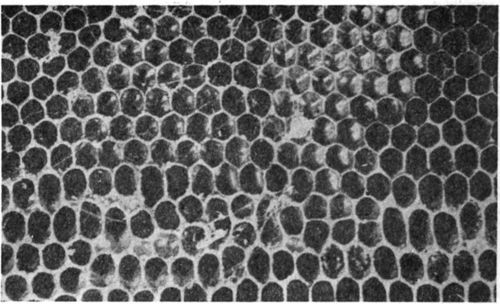
Good! But only for the wax it may contain.
4. Continuation Of Work In The Supers Without Interruption
For continuance of work in the supers, the colony must have what may well be called a CLEAR BROOD NEST, that is, one in which plenty of worker cells are available for the deposition of eggs.
It must also have sufficient properly located space for storing surplus. The colony must not lose its storing effectiveness because of swarming.
5. Continuous Replacement Of Bees That Die
To insure an effective force of workers when needed, the queen must lay enough eggs to produce as many mature bees as can be used profitably during the honey harvest. Requeening each season is often profitable, and requeening during a long honey harvest, as when there are several important honeyflows, may be necessary.
6. Condition Of The Colony At The End Of The Season
As the honey season closes fewer eggs are laid and honey is stored in the brood combs. Maximum brood rearing should not continue when the resultant bees will no longer be required for honey production, although enough brood should be reared at the proper time to insure the colony an adequate winter population. A good queen and adequate stores, as may naturally result from a fall honeyflow, together with sufficient comb space, all at the proper time, are necessary to insure a colony that will winter well and be in standard condition the next spring.
Continue to:


My Books

