


Chapter II. Six Essential Factors In Profitable Honey Getting And How To Provide Them
Description
This section is from the book "Honey Getting", by Edward Lloyd Sechrist. Also available from Amazon: Honey Getting.
Chapter II. Six Essential Factors In Profitable Honey Getting And How To Provide Them
To get surplus honey profitably, the natural bee colony, which stores some honey and then swarms, must be transformed into a colony or colonies which will continue to store honey without attempting to swarm.
To accomplish this, the usable brood nest must be large enough for the queen to lay as many eggs as are needed to build up the colony to standard honeystoring strength at the right time, and this brood must be immediately under the supers in which the honey is to be stored.
The six essential factors for honey getting are 1) adequate colony population and good combs; 2) location in a good nectar producing area; 3) prompt beginning of work in the supers; 4) continuation of this work without interruption; 5) continuous replacement of bees that die during the honey flow; and 6) such strength at the end of the season that the colonies will reach the next honey season in the desired condition.
It may be noted that the words "adequate" a: because no person except the operator himself is for any given location or any operator's system details for himself, using his best judgment and experience.
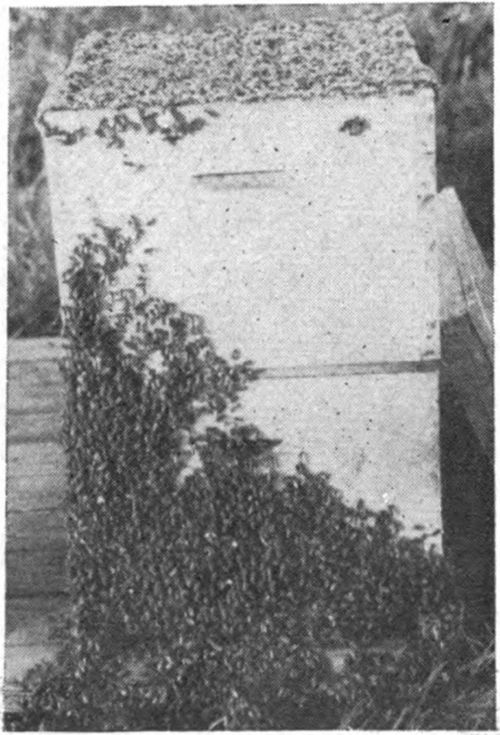
"Give us more room to work! We don't want to swarm. "
To obtain ADEQUATE POPULATION for a honey-getting colony, a good queen producing vigorous bees is essential, together with plenty of stores and sufficient egg-laying space during the time it is needed. For prompt and continuous work in the supers, a large brood chamber immediately below them is essential. The brood nest must have plenty of worker cells for rearing as many bees as are needed; swarming must be controlled, and sufficient space for storing surplus honey must be provided. After the honey season is over, maximum brood rearing should not continue, but enough brood should be reared to insure an adequate winter population.
Whatever system is followed for honey-getting, the basic idea is that the USABLE BROOD NEST MUST BE AS LARGE AS IS NEEDED for the queen to lay as many eggs as are needed to build up a colony which is in STANDARD SPRING CONDITION to STANDARD HONEY-STORING STRENGTH AT JUST THE RIGHT TIME, neither too early nor too late; and that this brood nest must be immediately under and "sufficient" are used rather frequently. This is able to say just what is "adequate" or "sufficient of management. The operator must decide such the supers in which honey is to be stored. Nothing is more important than to have brood combs which approach perfection.
Standard Spring Condition is defined as that combination of quality of queen, colony population, condition of combs, amount of stores, and all other natural and mechanical conditions which, with a standard method of management, will produce a colony of
Continue to:


My Books

