


Typical Beekeeping Regions. Continued
Description
This section is from the book "Honey Getting", by Edward Lloyd Sechrist. Also available from Amazon: Honey Getting.
Typical Beekeeping Regions. Continued
7. In some southern and tropical regions where few herbaceous plants are cultivated, nectar comes almost wholly from shrubs, trees, and wild vines. In humid hot countries, low growing herbaceous plants tend to be crowded out or limited in area by the ranker growing shrubs and trees which overshadow them and by coarse vines which clamber over and choke them; while in more arid parts only trees and bulbous plants are deeply rooted and can live through long and frequent drouths. What small herbs do grow are ephemeral, and uncertain in blooming, depending on erratic rainfall, and can never become major nectar-sources.
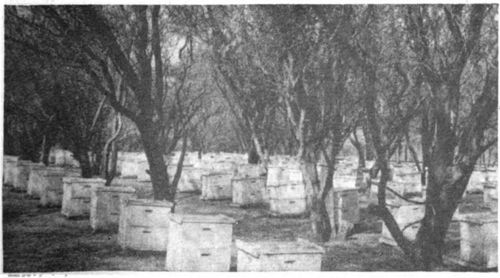
An Algaroba forest in Hawaii. These are Prosopis juliflora, almost like the mesquite.
In the tropics, almost every tree blossoms and furnishes some nectar, often more than once in a season, but the various species are so intermingled, so seldom are there large, compact areas of one kind, and so many of them produce inferior honeys that a really good honey locality in the tropics is a rarity, although bees thrive, and honey can be produced in a small way almost anywhere.
Although phenomenal yields have been secured in the tropics, yet year by year, a good average is not maintained, and in few places may a large number of colonies be kept in one location. Usually there is a long slow flow of inferior nectar, sufficient for the bees themselves but neither in quality or abundance equal to the nectar-flows characteristic of large areas of cultivated plants in the temperate zone.
Although few finer honeys can be found than logwood, campanilla, algaro-ba and orange, most tropical honeys are inferior because these good honeys usually become blended with more abundantly produced nectar of low quality.
Summing up: -The successful production of a fine grade of honey in the wilder areas of warm countries is made difficult by three things:
1. The preponderance of wild over cultivated plants.
2. The fact that most nectar-producing plants are trees and not herbs and are not under man's control.
3. The great diversity in quality of nectars secreted at the same time.
A study of these various regions emphasizes the influence of locality on beekeeping practice.
To make a success, year after year, in regions having irregular honey flows, requires expert management, and a better knowledge of the underlying principles than is common among the best of beekeepers.
Colonies cannot be too strong, if they are strong at the right time. But to have them strong at the wrong time leads to disaster. It pays to have a big colony, full of brood and bees, ready to take advantage of whatever offers. It is simply an example of "to him that hath shall be given. " Oettl's Golden Rule should always be kept in mind. He said: "To keep your colonies strong is the essence of all profitable beekeeping. If you cannot succeed in doing this, the more money you invest in bees, the heavier will be your losses. "
While a maximum population of young bees at the time of the honeyflow is always necessary, one must know all the peculiarities of his locality or he may miss securing half the money he should get. When one has a big colony, he has something on which to work.
With good queens and good care, building up a colony during a honey-flow is easy; but to build up a colony at a time when nectar and pollen are not coming in freely with promise of more to follow, is excessively difficult; yet, in many localities, that is exactly what must be done.
We have now considered the factors affecting the profitable production of honey, namely: The varying conditions to which beekeeping is subject in all parts of the world, and their effect on bee behavior.
In the following chapters we shall consider the importance of a system of management that will insure all colonies being of honey-storing strength at the beginning of the honey flow without allowing the colony to be divided by swarming, or weakened otherwise, and the conservation of the colony at all other times so it will become strong again at the proper time the next season. These are the three commandments.
We shall apply the principles of management to practical honey getting so that an apiarist in any region may become a Bee Master, able to work out for himself a method of management which will give him adequate control of colony activity with the least possible human labor.

Control, of Colonies by Supplemental Heat in a Bee House.
Continue to:


My Books

