


3. The Use of a Two-Story Brood Chamber Throughout the Year Except During a Honeyflow
Description
This section is from the book "Honey Getting", by Edward Lloyd Sechrist. Also available from Amazon: Honey Getting.
3. The Use of a Two-Story Brood Chamber Throughout the Year Except During a Honeyflow
When this system is worked properly, the queen is allowed free range, in the spring, of at least two Langstroth hive bodies, perhaps three, the two lower stories being the two brood chambers, containing ten frames each, in which the colony has wintered. The third story and other later added supers may contain eight or nine frames each, or may be shallow supers.
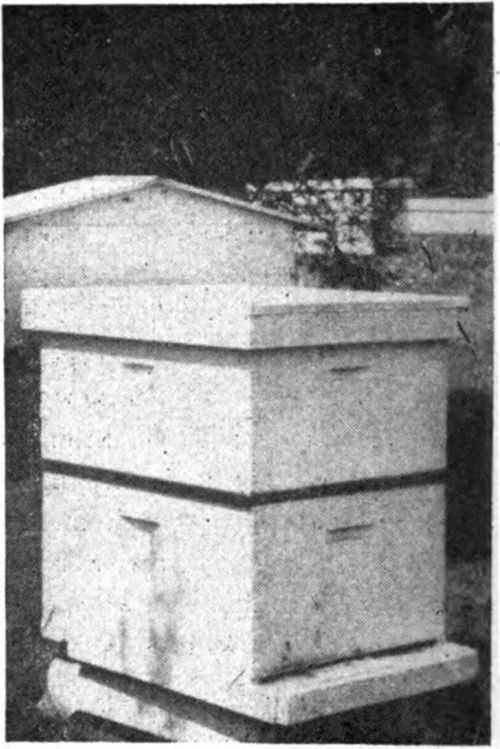
In system No. 3, the supers are also placed above an excluder after the queen is placed in the lower brood chamber.
Before the honeyflow begins, the colony will be of standard honey-storing strength, both chambers well filled with brood if the queen is good and has not been hindered in using both of them because of imperfections in. the combs. As soon as supers are added the queen probably will desert the lower brood chamber and lay in a super. After all the brood in this lower chamber has been sealed, but before any colonies have swarmed, the queen is put down into it and a queen excluder put on it. If the queen cannot readily be found, bees from the upper brood chamber, together with the queen, may be shaken into the lower one. This lower brood chamber which contains now only some sealed brood and perhaps some honey and pollen, provides the queen with a new clear brood nest, and, under proper conditions, prevents swarming and places the colony in excellent condition for storing honey.
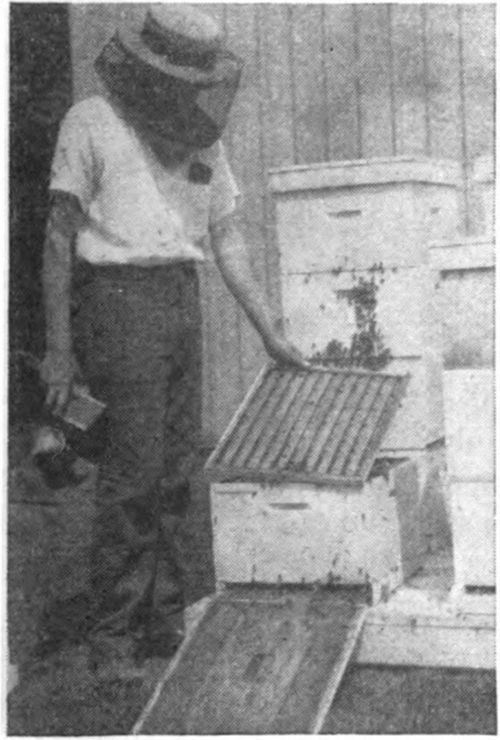
In the clear brood nest system No. 3, the queen, just before swarming time, is put into the lower brood nest, below an excluder.
Immediately above the queen excluder are then placed whatever extracting supers are needed at the time, and above these is placed the upper brood chamber containing the brood. It is good practice to remove, ten days later, all the queen cells from this brood; but it is sometimes possible to mate a young queen from this story of brood if an entrance, such as an auger hole, is provided and a second queen excluder, or an inner cover with a bit of excluder over the bee escape hole is placed beneath it. After the new queen has established a brood nest in this upper story, it may be set off with a bottom board and cover on a new stand, and used either for increase or for requeening the parent colony later in the season. This hive body is usually so crowded with honey that the young queen has little room to lay, so that the new colony remains a nucleus all summer, which is the desired condition unless it is to be used as increase, when more room is given for egg laying. Frequently, however, such queens may be inferior because from inferior stock or from larvae that were too old. Instead of depending on the bees in the upper story to rear their own queen cells, it is better to give these top stories of brood a ripe queen cell after cutting out all the cells that have been started on their own brood.
Many beekeepers do not cut out these queen cells in the top story, and provide no exit for the virgin queens, but this is not the best practice. When thus shut up, above a queen excluder, the young queens sometimes die or are killed, but they frequently remain alive a long time, then escape at some time when the cover is removed, returning either into the parent colony or some other and sometimes superseding the good queen in it. This would not be so bad if the young queen were of good stock and could be depended on to be a good one, but a virgin that has been shut up some time before mating seldom amounts to much. If she does not become a drone layer the same season, she may be useless or missing the next spring.
When comb honey is produced, several comb honey supers are placed above the lower brood chamber into which the queen has been put. No queen excluder need be used, but an inner cover, with a long slot at each side next the wall of the hive, is placed on top of the comb honey supers and just beneath the upper brood chamber which contains most of the brood. This board protects the sections from travel stain and yet permits the bees to pass freely enough. If a young queen is reared in the upper brood chamber she goes down and out the entrance to mate. Returning, she remains in the lower brood chamber, and supersedes the old queen. Then the upper brood chamber from which, by this time, all the brood will have emerged, becomes filled with winter stores.
In the standard ten frame hive, the hive body which was previously the upper brood chamber, still contains the ten choice old brood combs and not the eight or nine thick combs as used in the extracting supers; and this is the hive body which, unless it has been used for making increase, is left with the bees after removal of the supers, again becoming the upper brood chamber of the two-story hive in which the bees are wintered.
This putting up of brood and putting the queen in the lower brood chamber below an excluder is often called "De-mareeing"-it having been popularized by Mr. Demaree. If the season is such that swarming is persistent, this Dema-reeing may be repeated, and the queen given a clear brood nest the second time.
Demareeing must be done with due regard to the season, the weather, and the honeyflow conditions. If an error is made in putting up brood, much of it may be lost, the morale of the colony injured, and much of the expected honey crop lost.
Continue to:


My Books

