


The Practical Application, Shifting Bee Pasture
Description
This section is from the book "A Living From Bees", by Frank C. Pellett. Also available from Amazon: A Living From Bees.
The Practical Application, Shifting Bee Pasture
The Practical Application
From the above it will readily be seen that we need far more information concerning the requirements of plants. A beekeeper is likely to waste his time in trying to establish sweet clover in a region where buckwheat or heather are at their best. Likewise an attempt to establish heather on alkaline soils is likely to result in disappointment. The sourwood tree is one of the finest sources of honey in the southeastern states, yet it will not succeed except on acid soils. Not only must we learn the soil requirements of the plants in which we are interested, but we must learn what combination of temperature, humidity, altitude, and moisture will favor the heaviest honeyflows.
It is very probable that the regions where a plant gives the best returns to the beekeeper, will be the place where it is of greatest value for other purposes. This being the case it should not be difficult to improve the bee pasture of a neighborhood by introducing into the agriculture, the plants which give the largest yields of nectar. Sweet clover is proving to be the best legume so far discovered for the Plains Region where it is most valuable for the bees.
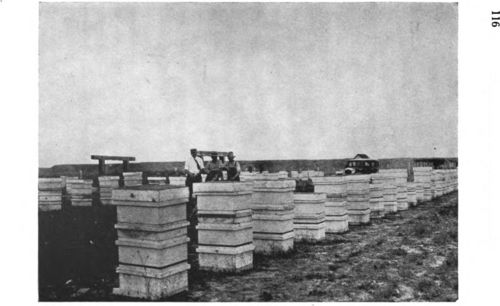
Apiary in sweet clover region, Montana
Shifting Bee Pasture
In these days since honey production has been built on the lines of mass production, bee pasture is becoming an increasingly serious problem. The bees By over a large area to find pasture and for this reason the source of his livelihood is beyond the control of the beekeeper. He can go where large areas of suitable crops are cultivated, but if the farmers of the neighborhood decide to change their line of operations, he is helpless and can only move again to some other spot which appears favorable.
In the days of our fathers, apiaries were small, and sufficient forage was available for a few colonies of bees almost anywhere. The thousand colony beeman of today must find a location where suitable honey plants are cultivated in large acreage to enable him to carry on profitably. Too often a change in farming practice makes it necessary to move and there is little stability in locations for a big producer.
The writer has seen three major changes in the bee pasture in the community with which he is best acquainted. In boyhood days, his grandfather was a beekeeper at a time when much of the original wild flora still remained and honey came from many different sources. As the wild plants were removed, the white Dutch or pasture clover came in and provided rather dependable surplus for about thirty years. In 1918 this source failed and although there was some white clover honey on several occasions afterward, it never again yielded so profitable a crop. The location remained very poor until the dry years in the 1930's compelled the farmers to adopt sweet clover. Since that time, big crops are again available to the local beekeepers.
Similar results with variations in time and plants could be cited in hundreds of widely scattered places all over the nation. Forty years ago the bee magazines were filled with stories of the activities of the beemen on the eastern slope of the Rockies in Colorado and in the Uvalde Region of Texas. Trainloads of honey were shipped from both localities whereas now but few large scale operators remain in either. In Colorado, the change came when alfalfa gave place to sugar beets as a farm crop and in Texas the clearing of the wild huajillo and catsclaw removed the sources of the beeman's prosperity.
For many years the buckwheat region of New York was a famous honey producing area, supporting many prosperous beekeepers. When buckwheat lost its place as the leading farm crop of the area, the beeman found himself in difficulty. Whereas formerly five hundred to seven hundred or more colonies were kept in single bee yard, there are few spots which support more than one hundred profitably now.
In recent years, the greatest expansion in the history of beekeeping has followed the spread of sweet clover throughout the Mississippi Valley and the
Plains Region. Unfortunately there are few places offering a good supporting flow to provide insurance in case of failure of the sweet clover. Even in this favored area there is evidence that the prosperity may be only temporary. At the time when acreage is expanding in some neighborhoods and far more sweet clover is available than ever before, farmers are plowing it under in others. Recently a letter came to the writer's desk from a beekeeper who stated that when he started operations in his present location there were 500 acres of sweet clover grown for seed within flying range of his apiary, while now there is not even one acre.
Some beemen have already been compelled to move one or more times in the sweet clover area because farmers turned under the sweet clover instead of permitting it to bloom, or because they replaced it with some other crop which offers but little pasture for the bees. Mid-west beekeeping is supported almost entirely by the one crop, sweet clover. If that fails, it will be disastrous indeed for many large scale operators. In view of the great risk which the industry runs in placing so much dependence upon one crop, it may be wise to take stock of the situation and see what can be done to provide insurance against the day of adversity.
Aside from the change in farm practice that may substitute some other crop for sweet clover in the farm rotation, there is also the problem of insect pests and disease to consider. In some localities the sweet clover weevil has destroyed the stand of young plants to such an extent as to seriously reduce the available forage. Two diseases also threaten the plant. There are localities where a few years ago sweet clover offered ample bee pasture where little if any remains and it seems quite probably that similar conditions may in time prevail over a much wider area.
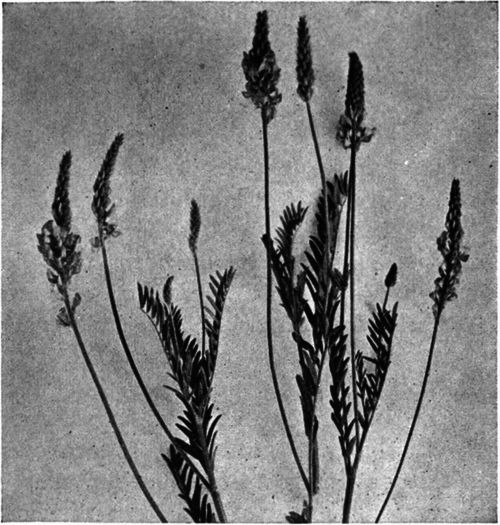
Sainfoin is the source of much fine honey in France.
To guard against possible future disaster, the beeman may well give attention to other crops suited to his locality which provide good bee pasture and call them to the attention of farmers in the vicinity. It was the beeman who introduced sweet clover to American agriculture and it took many years and much persuasion to do it. The same is possible with other crops with similar effort.
Sainfoin is a good farm crop which succeeds on some soils where alfalfa and the clovers fail. As a source of honey, it has few equals and it is from this plant that most of the surplus honey in the markets of France is harvested. It has the advantage of blooming ahead of sweet clover so that if both are present, there is a double chance for a crop.
Numerous other legumes are under observation in the American Bee Journal honey plant garden and some of them deserve to be tried under a wide range of conditions to determine their value to the farmer as well as the beekeeper. Among them may be found something which will provide some insurance against failure in case of the removal of the one plant on which most of us depend at the present time.
There are many minor crops which may prove profitable locally including those which provide essential oils or other products for the drug trade. Some which are not suited to a wide range of environmental conditions may solve the problem in the regions to which they are suited.
Continue to:


My Books

