


Things Which Puzzle The Beginner With Bees
Description
This section is from the book "A Living From Bees", by Frank C. Pellett. Also available from Amazon: A Living From Bees.
Things Which Puzzle The Beginner With Bees
Several letters have come to me from those who state that they wish to make a start at beekeeping, but are doubtful as to just how to go about it. They want specific directions as to the proper things to do in order to avoid expensive mistakes.
In the hope of being helpful to such persons, it may be wise to repeat some of the things which have already been said. One who has no knowledge of bees will find many puzzling things in the discussions.
Nothing is equal to a personal visit with someone who is engaged in honey production. An hour with such a person who will explain the various items of equipment and their use will make it much easier to make further advance by reading. It is particularly important to understand the terms used. On one occasion I had a great deal of difficulty with a new stenographer who had no understanding of what she was writing about when taking my dictation about bees. She made so many ludicrous mistakes because the words were strange to her that we decided that she must see for herself the various objects. After spending an hour examining hives, supers, smokers, comb foundation and the various other items common to beekeeping, her difficulties largely disappeared. Once she understood, her work was much easier.
The one who is strange to any field thus is greatly handicapped when trying to become familiar with it through reading. If no friendly beekeeper is within reach, the next best thing is to send for catalogs of the bee supply manufacturers, the bulletins of the agricultural colleges and buy or borrow the bee books from the public library. Before trying to read them consecutively, study the pictures and try to understand what they represent. Few writers realize the difficulties of the reader who is a stranger to the subject under discussion.
No matter how much one reads, he will still be under the necessity of learning most of the lessons after he has bought the bees. The bees have done so much for me that I am very enthusiastic about them. When I took my family to the farm many years ago, one of the first purchases was several hives of bees. Those bees did well from the start and at the end of the first season, there were several hundred pounds of honey to sell. In spite of the fact that they were not very intelligently cared for at the start, they returned the entire purchase price with something left over.
The following spring an old beekeeper who was leaving the state offered more hives with extra equipment for less than the cost of the hives. That proved to be about the best investment which I ever made, for those bees and their increase very nearly supported the family for many years. Of course, we had our house and garden, as well as hens and cows to provide the greater part of the food supply. The bees were increased in numbers and more and better equipment was secured, but they paid their own way and paid for clothes and music and magazines and many other things which go to make life comfortable. Always after that first season, when something was needed, there was honey to be sold to buy it.
I read endlessly in those first years of beekeeping. There were so many different opinions, so many ways of doing things and so many different kinds of equipment, that it was hard to understand the best way for me. Some of my experiments proved expensive because I did not learn the best way first. I built up a good outfit in eight frame Langstroth hives and later decided that the ten frame hive would be better. It cost a good deal to dispose of the first outfit and replace it with the other. After a few years of experience, I became convinced that a still larger hive was preferable and established an out yard in Dadant equipment.
If all beekeepers could agree as to what is the best hive, there need be no such experience for the beginner would follow the current trend. What was best for my particular condition might not be the best for another and the beginner has not sufficient understanding of his problems to know. It is for that reason that the beginner will find it to his advantage to go slowly at the start.
So much has been written about swarm control that the beginner is befuddled to know what it is all about. The novice should not bother his head about swarm control. Simply keep the bees in the best way he knows and if they swarm, why let them swarm and give them a new hive. Nature's way of increase is the best for the beginner.
Artificial increase may do very well for the experienced beeman who knows when and why it is safe to undertake it. It too often happens that the novice makes too many divisions, makes them at the wrong time or fails to build them up properly and loses the greater part of them. Natural swarming is the most interesting thing about beekeeping.
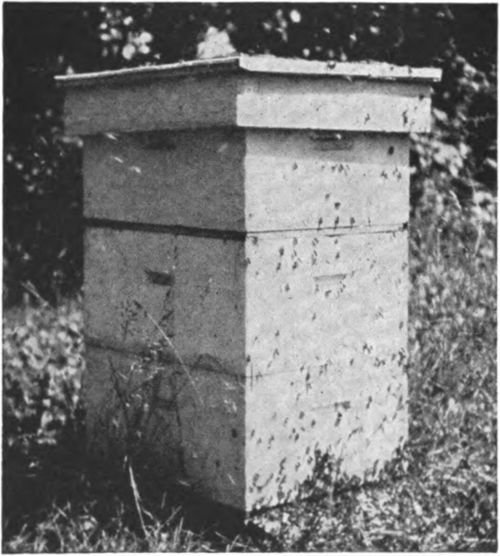
Flight activity of a strong colony.
The less the beginner tampers with his bees by trying to make artificial manipulations, the more honey he is likely to secure. In the millions of years that the bees have lived upon the earth, they have learned how to look out for themselves pretty successfully. If the beginner will give them a good hive and put on supers as needed, he is likely to get some honey while he is learning the how and why of modern management. If they have plenty of room, they are likely to provide stores sufficient for their needs and if they have honey on hand, they will rear brood in season and harvest the crop when the time comes.
Of course, there will be an occasional failing queen, or disease may be present, or there may be a season of dearth, which will be disastrous. The beginner with only one colony may find himself with an empty hive as I did when I paid ten dollars for my first colony many years ago. If there had been several hives, the chances are that the others would have prospered and that I might have replaced the dead colony in the empty hive with a swarm and not felt the loss.
One fatal mistake which many beginners make is to remove too much honey and leave the bees short of stores. It is difficult to appreciate how much honey a normal colony of bees will consume in the entire season. While the bees gather much of this honey as used during the harvest season, they must have ample reserves for use in the months when no honey is to be had in the field. Old time writers greatly under-estimated the amount of honey which might properly be left with the bees. I soon learned to know that it was not safe to leave the bees with less than fifty pounds at the close of summer.
The worst fault of the small hive is the temptation to leave the bees with insufficient supplies. With the large hive a greater portion can be stored in the brood chamber where it is readily available and not so easily taken by the owner. With ample stores, the bees will usually carry on quite successfully with little attention during most of the year.
Continue to:


My Books

