


Chapter X. Handling And Leading Horses
Description
This section is from the book "Stable Management And Exercise", by M. Horace Hayes. Also available from Amazon: Stable Management And Exercise.
Chapter X. Handling And Leading Horses
Influence of the Voice on Horses - Good Temper in Horses - Going up to a Horse - Lifting up a Fore Foot - Lifting up a Hind Foot - Holding up a Fore Leg - Holding up a Hind Leg - Holding a Quiet Horse - Leading a Horse into or out of a Stable - Taking a Horse out of a Narrow Stall - Leading a Horse out of a Stable on Fire - Leading a Horse while Riding another Animal - Leading a Horse through Congested Traffic.
THE proper handling of horses is quite as important a part of stable management as feeding and watering for instance; for faulty handling produces in the animal bad temper, which impairs his usefulness as much as ill health, and is far more dangerous to the groom or owner. I have said so much in Illustrated Horse-breaking about the general handling of horses, that I need not here go into it further than to lightly touch on its main principles. In that book, I have discussed somewhat fully the correction of stable vices, which is a subject that comes more within the province of breaking, than of stable management.
As the voice is the great means by which a horse can distinguish his human friends from his human foes, and can understand our wishes; we should always speak to him when going up to him, and as a rule when wanting him to perform any particular movement, as for instance, coming forward, going back, or moving to one side. As he readily recognises change of tone, but not of words; we should reserve a particular tone for each of our different orders, the number of which should be kept as small as practicable, so that ambiguity may be avoided; and we should avoid wearying the attention of the animal by needlessly speaking to him. In fact, we should reserve the use of our voice for occasions on which it is needed to produce a definite effect. A groom who, while he is with an animal, keeps continually speaking to him in a monotonous tone of voice, shows by doing so, that he knows very little about horses.
Experience tells us that to preserve the invaluable quality of good temper in a horse, it is necessary that those who handle, ride or drive him, should possess his confidence, which they cannot do, unless he understands their orders and knows that they will treat him justly. Hence, there should be no teasing a horse, or "venting one's spite" on him. If an animal is difficult to handle, especially about the ears, we may be quite certain that he is or has been in brutal or incapable hands. Difficulty in bridling is another tell-tale fault.
I have found that when going up to an uncertain horse which is held or tied up in the open, it is safest to approach him in the direction of the fore leg of the side upon which we are placed, and a little in front of a line drawn at right angles to the axis of his body, say, at an angle of about 70° to the direction in which he is standing. Approaching him from his front, or from behind, is apt either to alarm him or to provoke his resentment. Having reached his shoulder, near or off as the case may be, we may place a hand or cane on his crest, and scratch his mane, which is a piece of attention he will generally appreciate. When approaching an uncertain horse in the stable, it is well to make him "move over" (turn his hind quarters away from one).
In lifting up a fore foot, I make a half turn to the rear, run my hand (the left when on the near side, and the right when on the off) down the back of the fore-arm, grasp the leg just above the knee with the fingers and thumb, turn the elbow in, and press it against the upper part of the forearm so as to make the animal put the weight on the other leg; lift up the leg, and catch the foot, when it is high enough, with the other hand. This is a much easier plan than the usual one of catching hold of the pastern, and is certainly safer with strange animals. If a horse is hairy about the fetlocks, the easiest way to lift the leg is by catching hold of the hair of that part. In lifting up a hind foot of a strange animal, it is usually best to run the hand down the hind quarters; catch hold of the ham-string (tendo Achillis); and seize the pastern backhanded with the other hand. If the animal is "confidential," we may lift a hind leg by running the hand down the limb, and taking hold of the cannon bone with the fingers pointing to the rear. Many badly-trained grooms in England practise the slovenly habit of lifting up either the off fore or the off hind, while standing on the near side of a horse. Such a lazy country-bumpkin proceeding is opposed to one of the first principles of good horsemanship, which enacts that a horse should be the same, as regards mouth and manners, on both sides of his body, which he cannot be, if he is habitually turned, bent and handled only on the near side. In olden days, the custom of mounting from the near side, and of using the left as the bridle-hand became established, because the large majority of riders wore swords, which would get in the way of the horsemen, if the act of mounting was performed from the off side. In civil life we have retained the habit of mounting from the near side; probably because right-handed people are generally left-footed, in which case it would be easier for them to place the left foot in the stirrup iron, than the right. The picking up of an off foot from the near side is a manifest absurdity; because it is more difficult to perform; it is more dangerous, especially in the case of lifting up the off hind; it is less effective, in the event of the person who lifts up the foot wishing to clean or examine the foot; and it places him at a disadvantage in trying to hold up the foot, if the horse makes an attempt to free his leg. We need hardly wonder that the large majority of horses in this country swerve to the left when they refuse a fence, and that thrush is much more common in the off feet than in the near.

Fig. 51. Leading a horse into a stable.
If in order to hold up a fore leg, a man passes his hand "under the fetlock or pastern, as is frequently done, the horse, by bearing a portion of his weight on the man's hand, can greatly inconvenience him, and can easily kick with either hind leg. The foot of an unshod horse should on the contrary be held by the spread-out fingers and thumb grasping the front part of the hoof. The shod foot may be held up by the front part of the hoof, under which the fingers pass, while the thumb presses down on the sole. In either of these cases, the animal will avoid placing weight on the man's hand; for by doing so, the joints of the foot would become bent in a painful manner " (Illustrated Horse-breaking).
When wishing to hold up a hind leg for any considerable time, as for instance, in order to dress it for thrush, we should, if on the near side, place the leg on the left thigh, while holding the ham-string with the left hand, and the pastern with the right hand.
"The best way to hold a fairly docile horse while standing at his near side, is to draw the snaffle reins over his head, take them at the centre in the full of the left hand, and catch both reins near the rings of the snaffle with the right hand, having the little finger between them. While holding the reins in this way, we have good command over the horse when leading him. If we wish to hold him for examination or for gear to be put on him, we may place ourselves in front of him, catch the off rein with the left hand and the near rein with the right hand, close to the rings of the snaffle; and hold the horse's head up" (Illustrated Horse-breaking).
The best way of leading a horse into or out of a stable, in the event of his being shy of going through a door-way, or if the passage is narrow, is to place oneself in front of the animal; hold him as in Fig. 51; and lead him forward while stepping backwards.
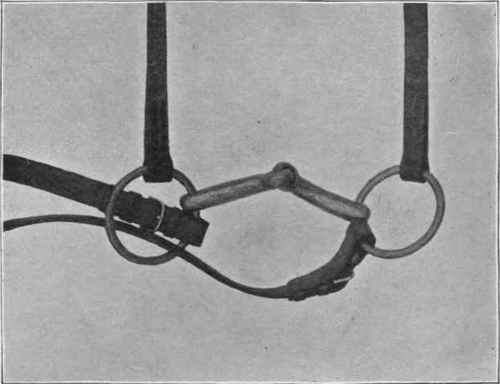
Fig. 52. Adjustment of Snaffle for leading a horse, when mounted.
In taking a horse out of a narrow stall, and especially if he is saddled or is at all stiff in his back, he should be backed out, and not turned round. The practice of saddling a horse in a stall with his head to the manger (instead of putting him on the pillar reins) and then turning him round, is a fruitful cause, particularly with side-saddles, of forcing the points of the tree apart, and thus spoiling the saddle. The greater liability of side-saddles to become ruined in this manner, is due to the fact that points of their trees are much longer than those of cross-saddles, and consequently they are more liable to become forced apart in this way. As horses grow old, the ligaments which connect the vertebrae of the back, loins, and croup, show a marked tendency to turn into bone, in which event, the involved portion of the spinal column not only loses the slight lateral play it once had, but also becomes very liable to injury from strain or concussion, as we may see by the comparative frequency of fractures of the back in old horses from casting for operations.
To lead a horse out of a stable on fire is often a difficult matter, on account of the strange reluctance to quit a burning building which horses generally show. After refusing to be led by the head-collar, they sometimes obey when a bridle is put on them. The most effective means of enforcing compliance is blindfolding them, which we may do by throwing a rug over their heads. The stifling effect of smoke can be greatly mitigated by placing a wet handkerchief or other wet thin material over one's nose and mouth, and to a less extent, by using it for this purpose in a dry condition. We might employ the same means for filtering the air breathed by a horse in similar circumstances.
The usual custom when leading a horse while riding another animal, is for the man to keep on the right side of the road; because in this case the led horse, being almost always on the off side of the ridden one, will not be liable to swing round and get hurt by passing traffic. It is evident that this rule could not be carried out in busy cities. In congested traffic, like that of London, it would be out of the question for a man to ride one horse and lead another; in fact, the only safe way of leading a horse in such circumstances, would be to lead him on foot, to keep on his off side, and to obey the ordinary rule of the road for carriages.
To lead a horse with a snaffle when mounted, we pass both reins through the near snaffle ring (Fig. 52), if the led horse is to be on our off side; and vice versa. If the led horse wears a double bridle and both reins are on his neck, we place the snaffle reins outside the bit reins, draw them over the animal's head, and pass them through the near or off snaffle ring, as the case may be. If the reins are off the horse's neck, we place the curb reins on his neck, and adjust the snaffle reins as before described. When leading a horse with a double bridle, it is generally advisable to shorten the curb reins by means of a running knot, as may be required; so that they may not hang down, and get caught by one of the animal's fore legs, for instance.
Continue to:


My Books

