


Lesson XII. Modeling The Nose, Eyebrows And Shadow Cheek. Part 3
Description
This section is from the book "Complete Self-Instructing Library Of Practical Photography", by J. B. Schriever. Also available from Amazon: Complete Self-Instructing Library Of Practical Photography.
Lesson XII. Modeling The Nose, Eyebrows And Shadow Cheek. Part 3
303. Crow's Feet
Crow's Feet. At the outer corner of the eyes in
persons of matured age, as well as in some young individuals, lines running in a fan-like shape will often be found. These lines are usually called " crow's feet," and as they are very characteristic of the individual they should never be entirely eliminated in aged subjects; yet when they exist in young faces it will be necessary, to please the subject, to remove them, or at least modify them considerably, evening up and smoothing them so they will be less prominent. The best rule to follow, however, is to remove those lines which are shorter and less prominent, and merely lighten the stronger and more pronounced ones. Illustration No. 18 shows these crow's feet as they exist in an aged person.
304. Aged Persons
Aged Persons. In the negative of the subject for Illustration No. 17 the lines have been modified, yet all likeness is retained, while in the face of Illustration No. 18 the lines have not been modeled at all. The age and features of the subject must, of course be considered when working on these lines, yet in many instances they may be considerably modified, evened and smoothed up so that they will be less pronounced. When these lines are premature, however, they may be removed entirely.
305. The arched form of the eyebrow should, of course, be curved. Any stray or odd hairs, especially those which lead upward, should be removed, but the less penciling done on the eye and eyebrows the better. The beginner should attempt but very little work on this feature.
306. In some instances you will find a subject where the eyebrows meet above the nose. As this is considered very offensive, the eyebrows here must be removed, great care being exercised in shaping and arching the remainder of the eyebrows. The extent to which these operations should be carried depends largely upon the age and sex of the subject.
307. Frowning
Frowning. Where the eyebrows are lowered, thus throwing a considerable amount of shadow over the space between the eyebrow and the eyelid, as in the case of frowning subjects, a more pleasing expression can be produced by building up and adding illumination or light
to this part, the lead being applied very lightly. False lines and wrinkles will also exist in such cases, and you must eliminate them entirely. Over-hanging eyebrows can also be improved by arching them a trifle, and either cutting off or curving the corners. The penciling out of a few hairs will sometimes have the desired effect. Altering of character will be taken up in a following lesson under that particular heading.
308. If you wish to subdue a smile (the eyelid being raised), you must lower this lid a trifle, thus producing a more serious expression. This you do by penciling and building on a slight extension to the eyelid. In bright expressions the eyelid is very high, leaving a wide open eye; but in cases of calm and sober expressions it will be quite low. When working on such expressions while performing this lesson, attempt to soften the lines only. As a rule, but few strokes will be required, and these, possibly, only light ones. The more pleasing effects are obtained by soft, even blending - no sharp corners or decided lines anywhere.
309. The suggestions above mentioned should be studied very carefully, and whenever these cases present themselves, do as much of the work as can be accomplished with the pencil alone, such as building up high-lights and subduing shadows, etc. The accentuating of shadows and cutting away of objectionable high-lights must be done with the etching knife, instructions for the use of which will be found in the following Chapters on " Etching and Modeling."
310. The eyes sometimes will appear sleepy and dull. This can be remedied by arching the upper lid which will give brightness. Until you have had considerable experience, however, do not try to change the shape of the opening of the lids. You may soften the high-lights by reducing the shadows, but as soon as you attempt any alteration of the shape of the lids you are working on treacherous ground, as the character and expression will change immediately with such alteration.

Illustration No. 17. Aged Person Whose Face Required Retouching.
See Paragraph 304.
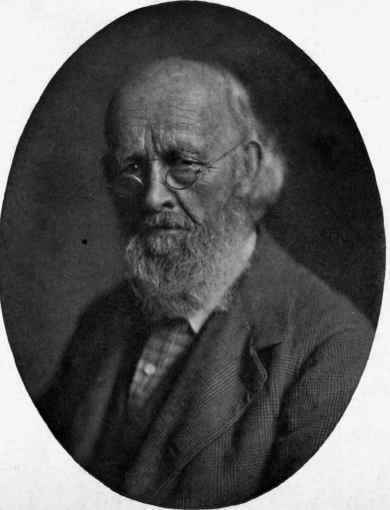
Illustration No. 18. Aged Person Whose Face Did not Need Retouching.
See Paragraph 304.
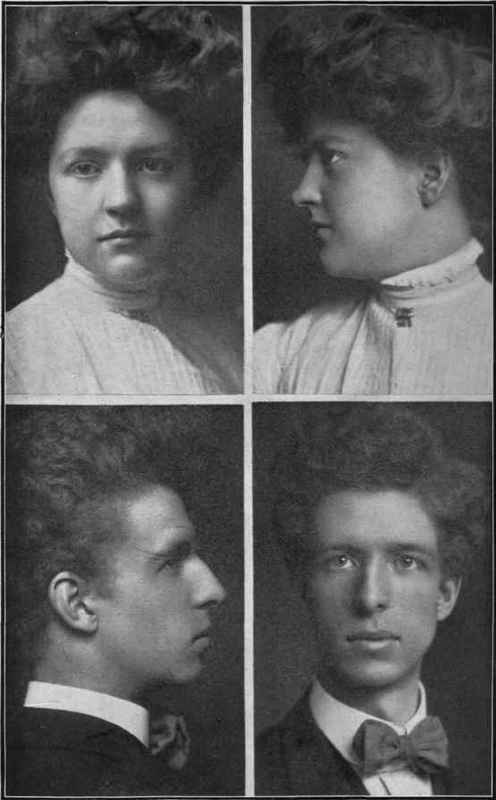
Illustration No. 19 Examples of Fully Retouched Negatives - Profile and Front Views.
See Paragraph 311.
311. The pencil must be kept particularly sharp and pointed when you work on the eyes, and, while the HH lead will generally do the work, you may find it necessary to use a B or BB lead on the heavy shadows. Examine the unre-touched print in Illustration No. 13 very carefully, and notice the improvement in the eyes in Illustration No. 19. Before attempting to apply any work at all on the eyes, when practicing on your negatives, be sure that you have good proof-prints from the negatives to use as guides so you may watch each step of the work and see the improvement made.
Continue to:


My Books

