


Fire Escape. Part 4
Description
This section is from the book "The Engineer's And Mechanic's Encyclopaedia", by Luke Hebert. Also available from Amazon: Engineer's And Mechanic's Encyclopaedia.
Fire Escape. Part 4
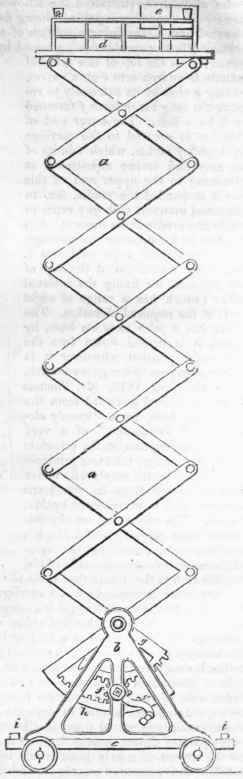
In the year 1813, Mr. Thomas Roberts received a reward from the Society of Arts, for a " speedy elevator and fire-escape," of a very complex description, on the principle of the lazy-tongs; the same principle has since been employed under various modifications by numerous persons, and most recently by Mr. Doyle. The engraving on the following page represents Mr. Doyle's machine; a a exhibiting the combination of levers on one side of the machine; b is the frame that holds the lower pair of levers, and wherein the moving force is applied; c the carriage on four wheels, drawn by a handle not shown in the engraving; d is a stage or platform at the top of the machine, on which a fireman or other individual is raised to rescue the persons from the house on fire; at e there is a folding-bridge or gangway, to be projected into the window of a room; at f is a toothed pinion; g is a toothed quadrant, welded to the lowest lever-bar on one side, with its teeth taking into those on the upper side of the pinion; at A; is another quadrant, the teeth of which take into the lower side of the pinion; motion being given to the pinion by the winch, the two quadrants are moved in opposite directions, and the series of levers are simultaneously operated upon in like manner, opening and shutting like so many pairs of shears, thereby drawing them all up closely together, or expanding to the extent of nearly their whole length.
In the accompanying cut the machine is represented as only expanded to half the height it is capable of being extended. On the other side of the machine, there is, of course, a similar set of levers; they are connected to those already described, by cross horizontal bars, the ends of which form the pivot joints on which the levers turn. The opposite side of the lower part of the machine is also a counterpart of that represented, and the power is connected by a common axis to the opposite pinion. Although the principle of the movement is, perhaps, the best that could be devised for the purpose, the practical difficulties of executing such a machine on a large scale, have, we are informed, been found insurmountable, an attempt to construct one having failed.

Mr. Gregory, some few years since, patented a "portable derrick fire-escape," which consisted of three square wooden pillars, sliding one within the other, mounted on a convenient carriage; the uppermost carried a pulley for raising a cradle, etc. The pulley was elevated by a windlass and rope connected with the pillars in the same manner as employed for raising his ladders.
Mr. Rose, of Manchester, constructed a fire-escape composed of an upright frame, fronted on a four-wheeled carriage; a second frame sliding within the former, carried at its top a small railed platform or gallery, in which people were received from the windows of houses; or it was occupied by a fireman with the branch of an engine, which enabled him more effectually to throw the stream of water upon the fire in lofty buildings. The sliding frame was raised by two chains attached to its lowest end, and carried over pulleys at the top of the first frame, to a windlass in the body of the machine; a ladder formed a communication between the body of the machine and the platform when it was in its lowest position.
Besides the escapes already noticed, there is yet another kind, which may be very properly designated "domestic fire-escapes," as they are intended solely for the use of the family in whose house they are placed. Some of the best of this class are those in form of a chair, sofa, or other convenient article of furniture, and stand in the recess of a window, outside of which they are soon placed, and constitute excellent fire-escapes, with every convenience necessary for a safe descent. Mr. Witty received a reward from the Society of Arts for an admirable escape of this kind. These machines, however, do not generally obtain, for the mass of the people are too indifferent to this subject to provide themselves with escapes, but rather choose to trust to the chance of obtaining external aid. Various expedients have been resorted to, and different plans may be adopted to effect an escape from fire, according to circumstances. Egress can sometimes be made at the top of a house, either by a door, or by an opening made in the roof with a poker for the purpose.
Sheets and blankets tied together and fastened to the bed-post, or the bed-cords, attached in the same way, afford the means of descending; the feather-bed, etc. thrown out, serve to break the fall when jumping from the window as the last alternative. With a little contrivance, women and children may be lowered by means of the bed-clothes. Upon these occasions, all depends upon the persons in danger retaining so much presence of mind as will enable them to avail themselves of the best means in their power; and it often happens that pressing danger develops a great deal more ingenuity and intrepidity in individuals, than they have previously taken credit for.
Continue to:


My Books

