


From Cruiser To Racing Machine
Description
This section is from the book "Scientific American Reference Book. A Manual for the Office, Household and Shop", by Albert A. Hopkins, A. Russell Bond. Also available from Amazon: Scientific American Reference Book.
From Cruiser To Racing Machine
What might be called the scientific period of yacht designing in this country begins at about the period of the races of "Puritan" against "Genesta," in 1885. The growth to the exaggerated proportions of hull and sail plan shown in our accompanying diagram, is the logical and inevitable outcome a little less than these lengths, their rating will be diminished accordingly. Outside of this restriction you may do just anything you please in modeling your hulls. They may be built of any material; they may be broad or narrow, shallow or deep; light and leak-able as a wicker basket, or tight and of a rule of measurement altogether too broad and loose in its specifications. The only elements taxed in this rule are length on the water-line when on an even keel, and total sail area. To the competing designers the rule has said, "When your yachts are placed under the measurer's tape, if 90-footers they must not be over 90 feet long on the water-line, or if 70-footers not over 70 feet. If you choose to make them heavy as an ironclad. As to the spread of sail, you may crack on just as much as you please; always with the understanding, however, that the more you carry the greater will be your racing measurement."
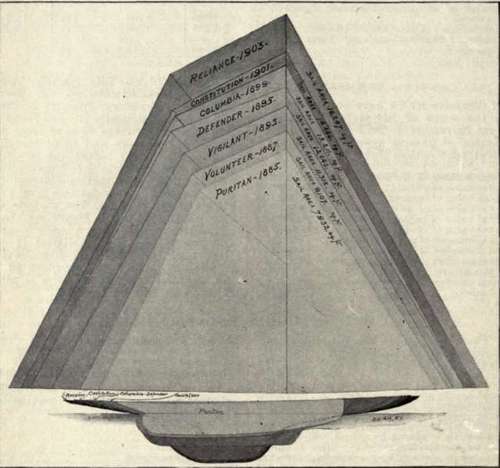
Growth Of The American Cup Defender From Cruiser To Racing Machine.
Now at the time of the "Puritan"-"Genesta" races, our yacht designers were beginning to emerge from the rule-of-thumb methods that characterized the days of the center-board sloop and schooner, and were beginning, thanks to the victorious career of one or two imported deep-keel English cutters, to appreciate the value of outside lead as an element of sail-carrying power. Hence, the "Puritan" carried a large proportion of her 48 tons of lead ballast on the keel, and although she was marked by the shoalness of body and limited draft of the prevailing centerboard type, she was an extremely able sea boat, fast and comfortable, a wooden vessel of first-class construction, with a reasonable spread of sail which she was well able to carry in a blow, as was proved in that memorable race of twenty miles to leeward and back in half a gale of wind in which she won by a narrow margin over "Genesta." At the close of her racing career "Puritan" was changed from sloop to schooner rig, and to-day she is doing service as a snug and com-
The Development Of The 90-Foot Racing Yacht. | |||||||||||||
Yachts. | Water-line Length. | Base of Fore Triangle. | Hoist from. Boom to Topmast Sheave. | Boom. | Gaff. | Spinnaker Boom. | Total Sail Area. | ||||||
ft. | in. | ft. | in. | ft. | in. | ft. | in. | ft. | in. | ft. | in. | sq. ft. | |
Puritan | 81 | 1 1/2 | 62 | 0 | 104 | 0 | 76 | 6 | 47 | 0 | 62 | 0 | 7,370 |
Mayflower | 85 | 7 | 67 | 0 | 111 | 0 | 80 | 0 | 50 | 0 | 67 | 0 | 8,824 |
85 | 10 | 67 | 0 | 111 | 0 | 84 | 0 | 51 | 6 | 67 | 0 | 9,107 | |
Vigilant | 86 | 2 | 69 | 0 | 122 | 0 | 98 | 0 | 57 | 0 | 69 | 0 | 11,312 |
Defender | 88 | 5 3/8 | 73 | 3 | 129 | 5 | 106 | 0 | 64 | 10 | 73 | 4 | 12,640 |
Columbia....... | 89 | 7 1/8 | 73 | 3 | 138 | 5 | 107 | 0 | 64 | 10 | 73 | 4 | 13,211 |
Constitution | 89 | 9 | 78 | 0 | 142 | 0 | 110 | 0 | 72 | 0 | 78 | 0 | 14,400 |
Reliance........ | 90 | 0 | 84 | 0 | 155 | 0 | 115 | 0 | 72 | 0 | 84 | 0 | 16,247 |
fortable cruiser. "Mayflower," the next cup defender, was an improved "Puritan," with 5 feet more length on the water-line and 8,824 square feet of sail; she was built of wood, and subsequently to her defense of the cup she was turned into a comfortable cruiser. Her sail area is so nearly the same as that of her successor, "Volunteer," that to avoid crowding our drawing her sail-plan does not appear. "Volunteer" was designed by Burgess, the designer of "Puritan" and "Mayflower." She was the first of our large sloops to be built of steel. She was about 5 feet longer on the water-line than "Puritan" and carried a much larger sail-plan, the boom being 84 feet as against 76 1-2 feet of "Puritan," and the hoist to the topmast sheave being 111 feet as against 104 feet in the earlier boat. "Volunteer" also was a perfectly sound and wholesome vessel. Although her rig was a large one, she was well able to carry it; and like her predecessor she was changed after the cup races to a schooner, and is to-day in service as a successful cruiser. After a lapse of six years the New York Yacht Club was called upon once more to defend the cup, and on this occasion they went to Herreshoff, from whom they obtained two yachts, one of which, the "Colonia," was a keel boat, drawing 14 feet of water, built of steel, and carrying about 11,000 square feet of sail. She was a failure, for the reason that, like the "Navaho, another Herreshoff 90-footer of the same year, she was a poor boat on the wind.
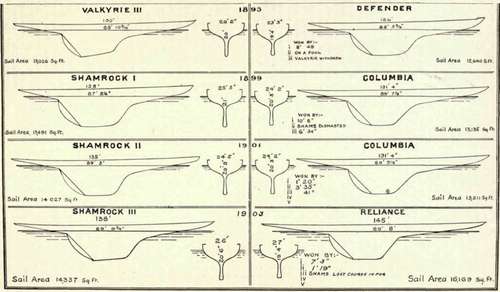
The other yacht built for cup defense by Herreshoff was the "Vigilant," and in her we see the engineer attacking the problem of yacht design from his own particular point of view. Tobin bronze is used for the plating, hollow spars are experimented with, and high-grade steel wire rope, blocks and other gear of extreme lightness, make their appearance in the spar and sail-plans. As a consequence, although the "Vigilant" was only a few inches longer on the water-line than the "Volunteer," she carried over 2,000 square feet more sail. The boom was lengthened out to nigh upon 100 feet, while the hoist went up to 132 feet; and the sail spread to 11,312 square feet. "Vigilant" was to be the last of the centerboard yachts; for although she beat "Valkyrie II." in the series of races, she was beaten badly to windward by that boat in a stiff breeze; and subsequently, during a season in English waters, was beaten eleven times out of eighteen by the deep-keel cutter "Britannia," a sister boat to "Valkyrie II." That season's experience sealed the fate of the centerboard and when the next challenge came, the Herreshoffs, entrusted with the contract of building a yacht to beat her, turned out to meet her the deep-keel cutter-sloop "Defender." "Vigilant" was the last of the cup-defenders that was good for anything but cup defense. She has been changed into a yawl, and has proved to be an excellent cruiser under her reduced rig. In "Defender" we see the engineer still at work, reducing scantling and lightening up on construction even to the smallest detail. "Defender" was built of manganese bronze in the underbody, and aluminium in the topsides and framing. She carried a hollow steel mast, boom and gaff. As a consequence, although she was a smaller boat than "Vigilant," having some 3 feet less beam, so great was the lightening of her weights, and the increase in stability due to lower ballast, that she carried over 1,000 feet more sail than the larger yacht, spreading 12,640 square feet. The main boom reached far over the taffrail, being 106 feet in length over all. The hoist was 7 1-2 feet greater and the forward measurement from mast to end of bowsprit had increased to over 73 feet.
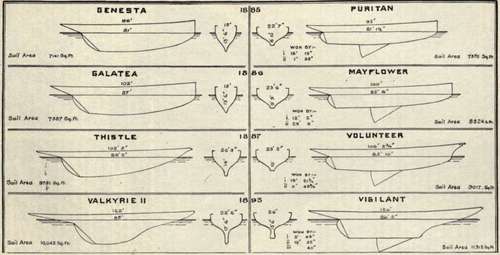
Development Of The International Racing Yacht From 1885 To 1903.
Continue to:


My Books

