


Mileage Of Lines And Wires, Number Of Offices, And Traffic Of The Western Union Telegraph Company
Description
This section is from the book "Scientific American Reference Book. A Manual for the Office, Household and Shop", by Albert A. Hopkins, A. Russell Bond. Also available from Amazon: Scientific American Reference Book.
Mileage Of Lines And Wires, Number Of Offices, And Traffic Of The Western Union Telegraph Company
Ending 30 - | Miles of Line. | Miles of Wire. | Number of Messages Sent. | Receipts. | Profits. | Average per Message. | |||
Toll. | Cost. | ||||||||
Dollars. | Dollars. | Dollars. | Cents. | Cents. | |||||
1868.. . | 50,183 | 97,594 | 3,219 | 6,404,595 | 7,004,560 | 4,362,849 | 2,641,711 | 104.7 | 63.4 |
1878. . . | 81,002 | 206,202 | 8,014 | 23,918,894 | 9,861,355 | 6,309,813 | 3,551,543 | 38.9 | 25.0 |
1888. . | 171,375 | 616,248 | 17,241 | 51,463,955 | 19,711,164 | 14,640,592 | 5,070,572 | 31.2 | 23.2 |
1898... | 189,847 | 874,420 | 22,210 | 62,173,749 | 23,915,733 | 17,825,582 | 6,090,151 | 30.1 | 24.7 |
1903. . . | 196,517 | 1,089,212 | 23,120 | *69,790,866 | 29,167,687 | 20,953,215 | 8,214,472 | 31.4 | 25.6 |
*Not including messages (probably 10,000,000) sent over leased wires or under railroad contracts.
The greatly increased mileage since 1880 is principally due to the fact that in 1881 the Western Union Telegraph Company absorbed by purchase all the lines of the American Union and the Atlantic and Pacific Telegraph Companies, the former having previously in operation over 12,000 miles of line and the latter 8,706 miles. Capital stock of the Western Union, $100,000,-000.
The Morse Telegraph Code. (Used In The United States.)
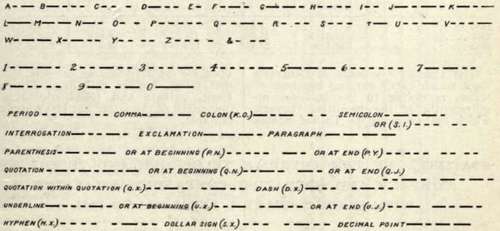
The International Telegraph Code. (The Cable Code.)

The Western Union has exclusive contracts with several international cable companies, operating eight Atlantic cables, and guarantees 5 per cent annual dividends on the stock of the American Telegraph and Cable Company; amount $14,000,000. Besides the above, there are new lines of telegraph which have complied with the United States telegraph act of 1866, and are operating wires with or without connection with railway companies in many parts of the country. - Statistical Abstract of the United States.
Continue to:


My Books

