
![previous page: 1. Acer [Tourn.] L. Sp. Pl. 1055. 1753](../../../images/nav/page_prev.gif)

![next page: 1. Acer [Tourn.] L. Sp. Pl. 1055. 1753. Part 3](../../../images/nav/page_next.gif)
1. Acer [Tourn.] L. Sp. Pl. 1055. 1753. Part 2
Description
This section is from the book "An Illustrated Flora Of The Northern United States, Canada And The British Possessions Vol2", by Nathaniel Lord Britton, Addison Brown. Also available from Amazon: An Illustrated Flora of the Northern United States, Canada and the British Possessions. 3 Volume Set..
1. Acer [Tourn.] L. Sp. Pl. 1055. 1753. Part 2
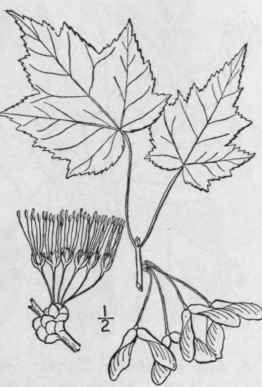
2. Acer Rùbrum L. Red, Scarlet Or Water Maple. Swamp Maple
Fig. 2805
Acer rubrum L. Sp. Pl. 1055. 1753.
A large tree with flaky or smoothish bark, maximum height about 120o feet and trunk diameter 3°-4i°. Twigs reddish; leaves 3'-4' long, cordate at the base, sharply 3-5-lobed, the lobes irregularly dentate, acute or acuminate, bright green above, pale and generally whitish beneath, often more or less pubescent; flowers red or yellowish, in sessile lateral clusters much preceding the leaves; petals narrowly oblong; stamens 3-6; fruiting pedicels elongating; samaras glabrous, slightly incurved, 9"-12" long, the wing 3-4" wide, broadest at or above the middle.
In swamps and low grounds, Nova Scotia to Manitoba, Nebraska, Florida and Texas. Wood hard, not strong; color light reddish brown; weight per cubic foot 38 lbs. Used for furniture, gun-stocks, etc. Foliage crimson in autumn. Ascends to 4000 ft. in Virginia. Consists of numerous races; the three following species appear to be distinct. White, soft, shoe-peg, or hard maple. March-April.
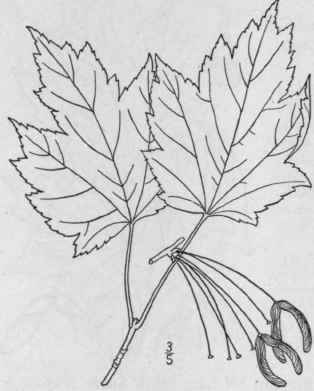
3. Acer Stenocàrpum Britton. Narrow-Fruited Maple
Fig. 2806
Acer stenocarpum Britton, N. A. Trees 647. 1908.
A small tree, with leaves similar to those of the Red Maple, thin, light green above, pale beneath, 3-lobed or 5-lobed. Flowers red, appearing before the leaves; samaras on very slender stalks 2'-3' long, linear, not widened above, about 10" long, 1 1/2"-2 1/2" wide, slightly curved, the seed-bearing part very strongly striate.
Flinty soil, Allenton, Missouri. April.
4. Acer Caroliniànum Walt. Carolina Maple
Fig. 2807
Acer carolinianum Walt. Fl. Car. 251. 1788. Acer rubrum tridcns Wood, Classbook 286. 1863.
A tree attaining nearly or quite the dimensions of the Red Maple, with grey, relatively smooth bark. Leaves rather firm in texture, dark green above, white-glaucous and more or less pubescent beneath, mostly 3-lobed and obovate or obovate-orbicular in outline, or 5-lobed and suborbicular, rarely ovate and without lobes, the margin serrate; fruit similar to that of the Red Maple, bright red or sometimes yellow.
Wet or moist soil, Massachusetts to Pennsylvania, Missouri, Florida and Texas. Feb.-April.


5. Acer Drummóndii H. & A. Drum-Mond's Or Hard Maple
Fig. 2808
Acer Drummondii H. & A.; Hook. Journ. Bot. 1: 200.
1834. Acer rubrum var. Drummondii Sarg. 10th Census U. S. 9: 50. 1884.
A large tree, similar to the preceding species. Leaves 3-6' long, thicker, 3-lobed, or sometimes 5-lobed, obtuse or cordate at the base, densely whitish tomentose beneath when young, the tomentum persisting, at least along the veins, the lobes short, broad, acute or acuminate; young twigs and petioles more or less tomentose; flowers in lateral sessile fascicles unfolding much before the leaves; petals present; fruiting pedicels 1'-2' long; samaras glabrous, more or less incurved, 1 1/2' -2 1/2 long, the wing 5"-10" broad at middle.
In swamps, southern Missouri to Georgia, Florida and Texas. Fruit brilliant scarlet, ripening in March or April.
Continue to:


My Books

