
![previous page: 12. Trifolium [Tourn.] L. Sp. Pl. 764. 1753. Part 2](../../../images/nav/page_prev.gif)

![next page: 12. Trifolium [Tourn.] L. Sp. Pl. 764. 1753. Part 4](../../../images/nav/page_next.gif)
12. Trifolium [Tourn.] L. Sp. Pl. 764. 1753. Part 3
Description
This section is from the book "An Illustrated Flora Of The Northern United States, Canada And The British Possessions Vol2", by Nathaniel Lord Britton, Addison Brown. Also available from Amazon: An Illustrated Flora of the Northern United States, Canada and the British Possessions. 3 Volume Set..
12. Trifolium [Tourn.] L. Sp. Pl. 764. 1753. Part 3
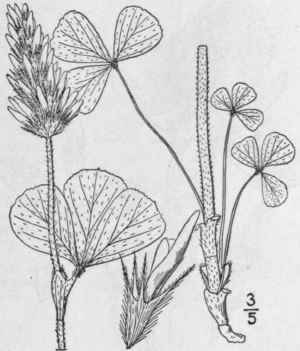
4. Trifolium Incarnatum L. Crimson, Carnation, French Or Italian Clover
Fig. 2477
Trifolium incarnatum L. Sp. Pl. 769. 1753
Annual, erect, softly pubescent, little branched, 6'-3° high. Leaves long-petioled; stipules broad, membranous, dentate, 4"-12" wide; leaflets all from the same point, very nearly sessile, obovate or obcordate, narrowed or cuneate at the base, denticulate, 6"-12" long; heads terminal, oblong or ovoid, l'-2 1/2' long; flowers sessile, 4"-6" long; calyx hairy; corolla crimson, equalling or exceeding the subulate plumose calyx-lobes.
In fields, waste places and ballast, Maine to New York, New Jersey and Virginia. Cultivated for der and for nitrogenizing the soil. Introduced from Europe. Called also Napoleons. Summer.
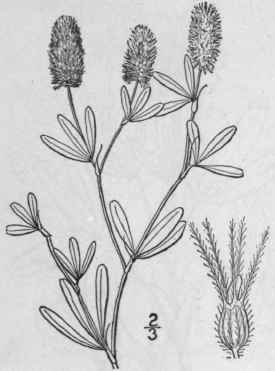
5. Trifolium Arvénse L. Rabbit-Foot, Old-Field Or Stone Clover
Fig. 2478
Trifolium arvense L. Sp. Pl. 769. 1753.
Annual, erect, freely branching, silky-pubescent, 6'-18' high. Leaves short-petioled; stipules narrow, 3"-5" long, subulate-tipped, entire or nearly so; leaflets all from the same point, linear or oblanceolate, denticulate above, obtuse and often emarginate, narrowed or cuneate at the base, 6"-12" long; heads terminal, peduncled, oblong or cylindric, 6"-12" long, very dense; flowers sessile; calyx very silky; corolla whitish, shorter than the subulate plumose calyx-lobes.
In fields and waste places, Quebec and Ontario to South Carolina, Florida, Tennessee and Missouri. Naturalized from Europe. Native also of northern Asia. Hare's-foot or pussy-clover. Calf-clover. Poverty-grass. Bottle-grass. Dogs and cats. Pussies. Pussy-cats. May-Sept.
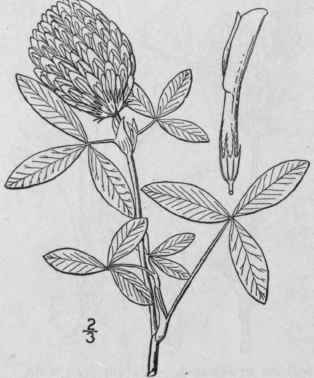
6. Trifolium Praténse L. Red, Purple Or Meadow Clover
Fig. 2479
Trifolium pratense L. Sp. Pl. 768. 1753.
Perennial, more or less pubescent, branching, decumbent or erect, 6'-2° high. Leaves long-petioled; stipules ovate, strongly veined, subulate-tipped, 6"-10" long; leaflets short-stalked, all from the same point, oval, oblong, or obovate, narrowed at base, hardly cuneate, obtuse and sometimes emarginate at the apex, often dark-spotted near the middle, finely denticulate, ¥-2' long; heads globose or somewhat ovoid, sessile (rarely peduncled), about 1' long; flowers red (rarely white), sessile, about 6" long, remaining erect in fruit; calyx hairy, its subulate teeth shorter than the corolla.
\
In fields and meadows, common throughout our area and in the southern States. Bermuda. Naturalized from Europe and widely cultivated for fodder. Native also of northern Asia. Leaflets commonly 3, sometimes 4-11. Marl- or cow-grass. Broad-leaved clover. Sugar-plums. Honeysuckle-clover, knap, suckles. April-Nov.

Continue to:


My Books

