
![previous page: 2. Cynóxylon Raf. Alsog. Amer. 59. 1838. [Benthamidia Spach, Hist. Veg. 8: 109. 1839.]](../../../images/nav/page_prev.gif)


3. Chamaepericlymenum Graebn.; Asch. & Graebn. Fl. Nord. Flachl
Description
This section is from the book "An Illustrated Flora Of The Northern United States, Canada And The British Possessions Vol2", by Nathaniel Lord Britton, Addison Brown. Also available from Amazon: An Illustrated Flora of the Northern United States, Canada and the British Possessions. 3 Volume Set..
3. Chamaepericlymenum Graebn.; Asch. & Graebn. Fl. Nord. Flachl
225, 539. 1898. [Cornella Rydb. Bull. Torr Club 33: 147. 1006.] Low, almost herbaceous plants, woody only at the base, with nearly horizontal rootstocks, and erect stems bearing a solitary head of small greenish-purple or violet flowers subtended by an involucre of 4 large white bracts, the leaves opposite or whorled. Calyx-limb minutely 4-toothed, the teeth with a deciduous spinule on the back near the apex. Petals 4, valvate. Stamens 4. Ovary 2-celled. Drupe globose, red. [Greek, low Periclymenum.]
Two species, of the northern hemisphere. Type species: Chamaepericlymenum suecicum (L.) Asch. & Graebn.
1. Chamaepericlymenum Canadénse (L.) Asch. & Graebn. Low Or Dwarf Cornel. Bunch-Berry Or -Plum
Fig. 3190
Cornus canadensis L. Sp. Pl. 117- 1753- C. unalaschensis Ledeb. Fl. Ross. 2: 378. 1844-46.
C. canadensis Rydb. Bull. Torr. Club 33: 147. 1906.
Herbaceous, woody only at the base; flowering stems erect, scaly, 3'-9' high. Rootstock nearly horizontal; leaves verticillate at the summit of the stem, or sometimes 1 or 2 pairs of opposite ones below, sessile, oval, ovate, or obovate, pinnately veined, glabrous or minutely appressed-pubescent, acute at each end, entire, 1'-3' long; peduncle slender, 1/2'-l 1/2' long; involucral bracts 4-6, white, petaloid, ovate, 4"-9" long; flowers greenish, capitate; petals ovate, one of them with a subulate appendage; fruit globose, bright red, about 3" in diameter; stone smooth, globose, slightly longer than broad.
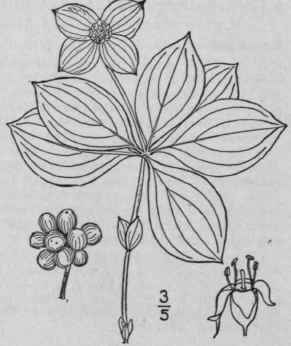
In low woods, Newfoundland to Alaska, New Jersey, West Virginia, Indiana, Minnesota, Colorado and California; also in eastern Asia. Rarely the upper leaves are opposite. May-July. Cracker-berry.
2. Chamaepericlymenum Suécicum (L.) Asch. & Graebn. Northern Dwarf Cornel. Lapland Cornel
Fig. 3191
Cornus suecica L. Sp. Pl 118. 1753.
Cornelia suecica Rydb. Bull. Torr. Club 33: 147. 1908. Chamaepericlymenum suecicum Asch. & Graebn. Fl. Nord. Flachl. 539. 1898.
Flowering stems 2'-10' high, sometimes branched above. Rootstock horizontal. Leaves 3-6 pairs, all opposite, sessile, ovate, or oval, acute or obtusish at the apex, mostly rounded at the base, entire, minutely appressed-pubescent above, the upper 1/2'-1 1/2' long, the lower smaller, the veins all- arising from near the base; involucral bracts usually 4, ovate, 3"-6" long, obtusish; flowers dark violet, capitate; fruit globose, red, 3"-4" in diameter; stone flattened, slightly channeled on each side, about as broad as long.
In cold, wet woods and wet cliffs, Newfoundland, Labrador and Quebec through Arctic America to Alaska. Also in Greenland, northern Europe and Asia. July-Aug.

4. NỲSSA L. Sp. Pl. 1058. 1753.
Trees or shrubs, with alternate petioled entire or dentate leaves. Flowers small, greenish, polygamo-dioecious, in capitate clusters, short racemes, or the fertile ones sometimes solitary, borne at the summit of slender axillary peduncles, appearing with the leaves. Staminate flowers numerous, the calyx small, 5-parted, the petals minute and fleshy, or none; stamens 5-15; filaments slender; disk entire or lobed; pistil none or rudimentary. Pistillate flowers 2-14, or solitary, bracted; calyx-limb 5-toothed, or truncate; petals minute and fleshy, or none; stamens several, or commonly abortive; ovary 1-celled, with 1 pendulous ovule; style slender, recurved, stigmatic along one side near the apex. Drupe ovoid or oval, the stone bony, compressed, ridged or terete, I-seeded. [Name of a water nymph.]
About 7 species, natives of eastern North America, eastern and central Asia. Besides the following, another occurs in the Southern States. Type species: Nyssa aquática L.
Leaves usually entire; pistillate flowers 2-14; fruit 3"-7" long. | ||
Leaves mostly acute or acuminate; stone little flattened. | 1. | N. sylvatica. |
Leaves mostly obtuse; stone much flattened. | 2. | N. biflora. |
Leaves usually dentate; pistillate flower solitary; fruit 8"-15" long. | 3. | N. aquatica. |
Continue to:


My Books

