


1. Althaea L. Sp. Pl. 686. 1753. Continued
Description
This section is from the book "An Illustrated Flora Of The Northern United States, Canada And The British Possessions Vol2", by Nathaniel Lord Britton, Addison Brown. Also available from Amazon: An Illustrated Flora of the Northern United States, Canada and the British Possessions. 3 Volume Set..
1. Althaea L. Sp. Pl. 686. 1753. Continued
X. Malva Sylvéstris L. High Mallow
Fig. 2848
Malva sylvestris L. Sp. Pl. 689. 1753.
Biennial, erect or ascending, branched, pubescent with loose spreading hairs, or glabrate. Leaves orbicular, or reniform, 1 1/2-4,' wide, with 5-9 shallow angular or rounded lobes, creraate-denate, truncate or cordate at the base; petioles 2'-6' long; flowers reddish-purple, 2-4 times as long as the calyx; carpels about 10, flat 1'-1 1/2' broad, in axillary clusters; pedicels slender; petals on the back, rugose-reticulate.
In waste places and along roadsides, sparingly adventive from Europe in the United States, Canada and Mexico, escaped from cultivation. Native also in Siberia. Summer. English names, common mallow, cheese-flower, cheese-cake, pick-cheese, round dock, maul. Country-mallow.

2. Malva rotundifòlia L. Low, Dwarf or Running Mallow. Cheeses. Fief. 2840.
M. rotundifolia L. Sp. Pl. 688. 1753. Annual or biennial, procumbent and spreading from a deep root, branched at the base, stems 4'-12' long. Leaves orbicular-reniform, 1'-3' wide, cordate, with 5-9 broad shallow dentate-crenate lobes; petioles slender, 3'-6' long; flowers clustered in the axils, pale blue, 4"-7" broad; pedicels 6"-15" long; petals about twice the length of the ovate acute calyx-lobes; carpels about 15, rounded on the back, pubescent.
In waste places, common nearly throughout our territory, and widely distributed as a weed in other temperate regions. Naturalized from Europe. Native also of western Asia. English names, dutch-cheese, doll or fairy cheeses, pellas. Blue, common or country mallow. Malice. May-Nov.
Malva parviflora L., another European weed, with smaller flowers, the similar carpels reticulated, widely distributed in the Southern and Western States, has been found in Missouri, and in ballast about cities on the Atlantic Coast.
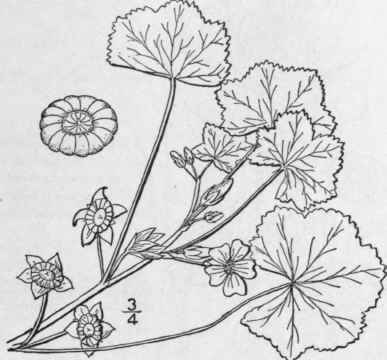

3. Malva Verticillàta L. Whorled Mallow. Curled Mallow
Fig. 2850
Malva verticillata L. Sp. Pl. 689. 1753. Malva crispa L. Sp. Pl. Ed. 2, 970. 1763. Malva verticillata crispa L. Sp. Pl. 689. 1753.
Annual, erect, glabrous or nearly so, 4°-6° high. Leaves nearly orbicular with 5-11 shallow, angular dentate lobes, their margins often wrinkled and crisped; petioles elongated; flowers white or whitish, sessile, clustered in the axils, about the size of those of M. rotundifolia; petals about twice the length of the calyx-lobes; carpels rugose-reticulated.
In waste places. Nova Scotia to Quebec, South Dakota and Pennsylvania. Adventive from Europe. Summer.
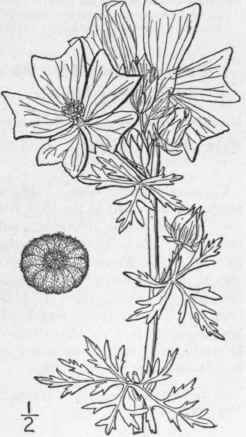
4. Malva Moschàta L. Musk Mallow. Musk-Plant. Musk
Fig. 2851
Malva moschata L. Sp. Pl. 690. 1753.
Perennial, erect, 1°-2° high, branching, pubescent with long hairs, or glabrate. Basal leaves orbicular, 3'-4' wide, with 5-9 short broad rounded dentate lobes; stem-leaves deeply divided into linear or cuneate, pin-natifid or cleft segments; flowers 1 1/2-2' broad, pink or white, racemosely clustered at the summits of the stem and branches; petals obcordate or emarginate, 5-8 times as long as the triangular-ovate acute calyx-lobes; carpels 15-20, densely hairy, rounded on the back.
In waste places and along roadsides, Nova Scotia to Ontario, British Columbia, New Jersey, Virginia, Wisconsin and Oregon. Naturalized from Europe. Plant with a faint odor of musk. Summer.
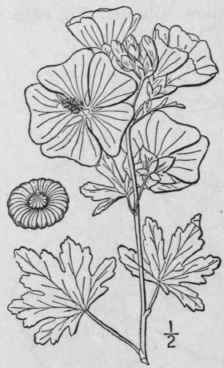
5. Malva Alcea L. European Or Vervain Mallow
Fig. 2852
Malva Alcea L. Sp. Pl. 689. 1753.
Similar to the preceding species, but the stem-leaves are only once 5-7-parted or cleft, the lobes dentate or incised; pubescence shorter and denser, stellate; flowers pink, purplish or white; petals obcordate; carpels glabrous, very finely rugose-reticulated.
In waste places, occasionally escaped from gardens, Vermont to Michigan, New York and Pennsylvania. Introduced from Europe. Summer.
Continue to:


My Books

