


1. Syrínga L. Sp. Pl. 9. 1753
Description
This section is from the book "An Illustrated Flora Of The Northern United States, Canada And The British Possessions Vol2", by Nathaniel Lord Britton, Addison Brown. Also available from Amazon: An Illustrated Flora of the Northern United States, Canada and the British Possessions. 3 Volume Set..
1. Syrínga L. Sp. Pl. 9. 1753
Shrubs with opposite entire (rarely pinnatifid) leaves, and completely gamopetalous flowers, in dense terminal panicles or thyrses. Calyx campanulate, mostly 4-toothed, persistent. Corolla salverform, the tube cylindric, the limb 4-lobed, the lobes induplicate-valvate. Stamens 2, inserted near the summit of the corolla-tube; filaments short or slender; anthers ovate or oblong. Ovary 2-celled; ovules 2 in each cavity, pendulous; style elongated; stigma 2-cleft. Capsule narrowly oblong, somewhat compressed, coriaceous, loculicidally 2-valved from above, the valves concave. Seeds pendulous, compressed, obliquely winged. [Greek, a pipe, or tube.]
About 12 species, natives of Asia and eastern Europe, the following typical.
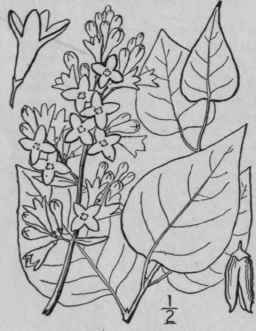
1. Syringa Vulgaris L. Lilac
Fig. 3313
Syringa vulgaris L. Sp. Pl. 9. 1753.
A glabrous shrub, 10°-25° high with terete branches. Leaves ovate, entire, deciduous, green on both sides, acuminate at the apex, truncate or subcordate at the base, 2'-5' long, 1'-3' wide; petioles 1/2'-1' long; flowers lilac or white, very numerous, 5"-7" long, 4"-,5" broad, in large terminal thyrses; calyx about 1" long; corolla-tube about 1" in diameter; ultimate pedicels short; capsule 8"-12" long, 2" thick.
Escaped from gardens to roadsides, Maine and New Hampshire to eastern New York and Pennsylvania. Native of eastern Europe. Pipe-tree. Pipe-privets. Blue-pipe. Blue-ash. Roman-willow. Flowers fragrant. April-May.
2. FRÀXINUS [Tourn.] L. Sp. Pl. 1057. 1753.
Trees, with opposite and in all our species odd-pinnate leaves, and small dioecious or polygamous (rarely perfect) greenish fasciculate or racemose-fasciculate flowers, appearing before or with the leaves from the axils of those of the previous season. Calyx small, 4-cleft, irregularly toothed, entire or none. Petals none or 2-4, separate, or united in pairs at the base, induplicate-valvate. Stamens 2 (rarely 3 or 4), inserted on the base of the petals or hypogynous; filaments short or elongated; anthers ovate, oblong or linear. Ovules 2 in each cavity of the ovary, pendulous; stigma 2-cleft. Fruit a flat samara, winged at the apex only or all around, usually I-seeded. Seed oblong, pendulous. [The ancient Latin name.]
About 50 species, mostly of the north temperate zone. Besides the following, about 12 others occur in the Southern and Western States. Type species: Fraxinus excelsior L.
Lateral leaflets stalked; calyx mostly present, at least in the fertile flowers. | ||
Body of the samara terete or nearly so, the wing chiefly terminal. | ||
Wing almost entirely terminal; leaves pale beneath. | ||
Twigs and leaves glabrous, or leaves pubescent beneath. | 1. | F. americana. |
Twigs and leaves densely pubescent. | 2. | F. biltmoreana. |
Wing manifestly extending down on the sides of the body. | ||
Wing of the samara long-linear, about 2" wide. | 3. | F. Darlingtonii |
Wing of the samara spatulate or oblong-spatulate, mostly 3"-s" wide. | ||
Samara-body terete, slender. | ||
Samaras broadly spatulate; leaves firm, entire. | F. Michauxii. |
Samaras narrowly spatulate; leaves thin, serrate or entire. | 5. | F. pennsylvanica. |
Samara-body compressed; leaflets entire. | 6. | F. profunda. |
Body of the samara flat, the wing extending all around it. | ||
Twigs terete; leaflets 5-7; samara elliptic or spatulate. | 7. | F. caroliniana. |
Twigs 4-sided; leaflets 7-11; samara oblong or cuneate. | 8. | F. quadrangulata. |
Lateral leaflets sessile: calyx none; samara winged all around. | 9. | F. nigra. |
Continue to:


My Books

