
![previous page: 13. Mitella [Tourn.] L. Sp. Pl. 406. 1753](../../../images/nav/page_prev.gif)


14. Chrysosplenium [Tourn.] L. Sp. Pl. 398. 1753
Description
This section is from the book "An Illustrated Flora Of The Northern United States, Canada And The British Possessions Vol2", by Nathaniel Lord Britton, Addison Brown. Also available from Amazon: An Illustrated Flora of the Northern United States, Canada and the British Possessions. 3 Volume Set..
14. Chrysosplenium [Tourn.] L. Sp. Pl. 398. 1753
Low decumbent or erect somewhat succulent mainly semi-aquatic herbs, with petioled opposite or alternate crenate leaves, with no stipules. Flowers minute, greenish, axillary or terminal, solitary or clustered, perfect. Calyx-tube urn-shaped or obconic, adnate to the ovary, its limb 4-5-lobed. Petals none. Stamens 8-10 (rarely 4-5), inserted on the margin of a disk; filaments short. Ovary 1-celled, flattish, 2-lobed; styles 2, short, recurved; ovules ∞. Capsule membranous, short, inversely cordate or 2-lobed, 2-valved above, few- or many-seeded. Seed-coat muricate or pilose. [Greek, golden spleen, from some reputed medicinal qualities.]
About 15 species, natives of the north temperate zone and southern South America. Besides the following, 2 others occur in northwestern America. Type species: Chrysosplenium opposi-tifolium L.
Lower leaves opposite; flowers mostly solitary. | 1. | C. americanum. |
Leaves all alternate; flowers corymbose. | 2. | C. alternifolium. |
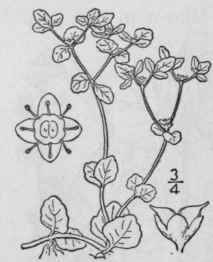
1. Chrysosplenium Americànum Schwein. Golden Saxifrage. Water Carpet
Fig. 2185
Chrysosplenium oppositifolium Walt. Fl. Car. 140. 1788. Not L. C. americanum Schwein.; Hook. Fl Bor. Am. 1: 242. 1832.
Stems slender, decumbent, forked above, glabrous or very nearly so, 3'-8' long. Lower leaves opposite, the upper often alternate, broadly ovate, orbicular or somewhat reniform, obtuse or truncate at the base, rounded at the apex, crenate or obscurely lobed, 2"-10" wide; flowers sessile, axillary, usually solitary, about 1" broad; calyx-lobes commonly 4, yellowish, or purplish within; stamens commonly 8; anthers orange-red.
In wet, shaded places, Nova Scotia to the Saskatchewan region, south, along the mountains to Georgia, and to Ohio, Michigan and Minnesota. March-June.
2. Chrysosplenium Iowense Rydb. Iowa Golden Saxifrage
Fig. 2186
Chrysosplenium iowense Rydb.; Britton, Man. 483. 1901.
Flowering stems erect, glabrous or pubescent, 2'-6' high, branched above. Leaves all alternate, the basal ones long-petioled, reniform, or cordate, often pubescent on the upper surface, 3"-18" wide, or crenate with 5-11 rather broad lobes; flowers mainly terminal, corymbose; calyx-lobes commonly 4, orange-yellow within; stamens usually 8.
On wet mossy slope, Decorah, Iowa. May-June. Confused with Chrysosplenium alternifolium of Europe, in our first edition.

Continue to:


My Books

