
![previous page: 26. Erysimum [Tourn.] L. Sp. Pl. 660. 1753](../../../images/nav/page_prev.gif)

![next page: 28. Conríngia [Heist.] Adans. Fam. Pl. 2: 418. 1763](../../../images/nav/page_next.gif)
27. Norta Adans. Fam. Pl. 2: 417. 1763
Description
This section is from the book "An Illustrated Flora Of The Northern United States, Canada And The British Possessions Vol2", by Nathaniel Lord Britton, Addison Brown. Also available from Amazon: An Illustrated Flora of the Northern United States, Canada and the British Possessions. 3 Volume Set..
27. Norta Adans. Fam. Pl. 2: 417. 1763
Biennial herbs, with alternate pinnatifid or dentate leaves and medium-sized yellow flowers. Pubescence, when present, of simple hairs. Sepals spreading. Pods narrowly linear, much elongated, terete or nearly so, divergent or ascending. Stigma 2-lobed. Seeds in 1 or 2 rows in each cell of the pod, oblong, not winged. Cotyledons incumbent. [Name unexplained.]
About 10 species, natives of the Old World. Type species: Sisymbrium strictissimum L.
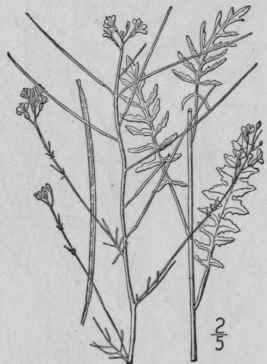
1. Norta Altissima (L.) Britton. Tall Sisymbrium
Fig. 2060
Sisymbrium altissimum L. Sp. Pl. 659. 1753. Sisymbrium Sinapistrum Crantz, Stirp. Aust. Ed. 2, 52.
1769. Sisymbrium pannonicum Jacq. Coll. 1: 70. 1786.
Erect, 2°-4° high, freely branching, glabrous or nearly so. Lowest leaves runcinate-pinnatifid, petioled, the lobes lanceolate, often auriculate; upper leaves smaller, shorter petioled or nearly sessile, very deeply pinnatifid, the lobes linear or lanceolate, dentate or entire, often with a narrow projection on the lower side near the base; uppermost leaves often reduced to linear nearly entire bracts; flowers yellowish, about 3" broad; pedicels 3"-4" long, spreading or ascending, thickened in fruit; pods very narrowly linear, stiff, divergent, 2'-4' long, 1/2" wide; valves with a prominent midrib.
In waste places, Nova Scotia to Ontario, British Columbia, Virginia, Missouri, Colorado, Utah and Oregon. Adventive from Europe. A bad weed in the Northwest. Summer.
Norta Irio (L.) Britton [Sisymbrium Irio L.] differs by runcinate-pinnatifid leaves, the terminal segment usually larger than the lateral ones, and soft ascending pods; it occurs occasionally in ballast and waste grounds.
Continue to:


My Books

