


26. Erysimum [Tourn.] L. Sp. Pl. 660. 1753
Description
This section is from the book "An Illustrated Flora Of The Northern United States, Canada And The British Possessions Vol2", by Nathaniel Lord Britton, Addison Brown. Also available from Amazon: An Illustrated Flora of the Northern United States, Canada and the British Possessions. 3 Volume Set..
26. Erysimum [Tourn.] L. Sp. Pl. 660. 1753
Annual or binennial, mostly tall and erect herbs, with simple entire lobed or pinnatifid leaves, and yellow flowers. Siliques linear-conic, terete, many-seeded. Valves mostly 3-nerved, dehiscent. Stigma with 2 short lobes. Seeds in 1 row in each cell of the pod, marginless. Cotyledons incumbent. [Greek name of some garden plant.]
A genus of few species, natives of the Old World, the following typical.
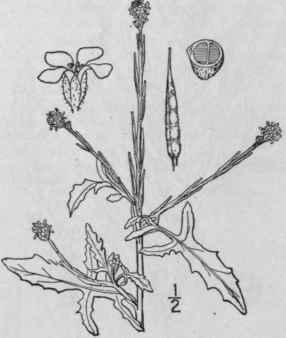
I. Erysimum Officinale L. Scop. Hedge Weed Or Mustard. Fig-. 2059
Erysimum officinale L. Sp. Pl. 660. 1753. Sisymbrium officinale Scop. Fl. Cam. Ed. 2, 2: 26.
1772. S. leiocarpum Jord. Diag. 1: 139. 1864.
Erect, more or less pubescent, or glabrous, 1°-3° high, with rigid spreading branches. Leaves runcinate-pinnatifid, the lower petioled, the upper nearly sessile; lobes 3-6 pairs and an odd one, oblong, ovate or lanceolate, dentate, crenate or nearly entire, acutish or obtuse, the lower ones often recurved; pedicels 1" long, erect in fruit; flowers yellow, 1 1/2" broad, pods 5"-7" long, linear, acuminate, glabrous or pubescent, closely ap-pressed to the stem; valves with a strong prominent midrib.
In waste places, common throughout our area, except the extreme northwest to the Pacific Coast. Also in Bermuda and in southern South America. Naturalized from Europe. Native also of northern Asia. May-Nov. California mustard. Bank-cress. Scrambling rocket.
Continue to:


My Books

