


29. Kentróphyta Nutt.; T. & G. Fl. N. A. 1: 353. 1838
Description
This section is from the book "An Illustrated Flora Of The Northern United States, Canada And The British Possessions Vol2", by Nathaniel Lord Britton, Addison Brown. Also available from Amazon: An Illustrated Flora of the Northern United States, Canada and the British Possessions. 3 Volume Set..
29. Kentróphyta Nutt.; T. & G. Fl. N. A. 1: 353. 1838
Low tufted perennial pubescent herbs, with pinnately 3-7-foliolate leaves, the linear persistent leaflets firm in texture, spinulose-tipped. Flowers 2 to 4 together in the axils or solitary, nearly sessile, yellow or yellowish. Calyx campanulate, the teeth nearly equal. Keel obtuse, shorter than the wings. Ovary few-ovuled. Pod short, ovate, 1-celled, somewhat coriaceous, with 1 or 2 seeds. [Greek, referring to the sharp-tipped leaflets.]
About 5 species, natives of central North America, the following typical.
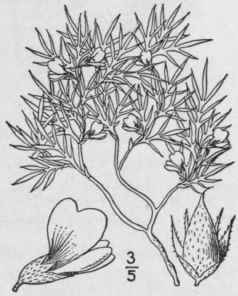
1. Kentrophyta Montàna Nutt. Prickly Milk Vetch
Fig. 2558
Kentrophyta montana Nutt.; T. & G. Fl. N. A. 1: 353. 1838. Kentrophyta viridis Nutt.; T. & G. Fl. N. A. 1: 353. 1838. Astragalus Kentrophyta A. Gray, Proc. Acad. Phil. 1863:
60. 1863. Homalobus montanus Britton, in Britt. & Brown, 111. Fl. 2:
306. 1897.
Densely tufted, intricately branched, 2'-10' high, finely canescent. Stipules linear-lanceolate, spiny-tipped, 2."-5" long; leaflets 3-7, linear, rigid, spiny, widely spreading, 3"-6" long, 1/2" wide; flowers 1-4 together in the axils, nearly sessile, yellowish-white or bluish-tinged, 2 -3" long; pod sessile or very short-stalked, 1-3-seeded, ovoid-oblong, acute, coriaceous, dehiscent, pubescent, 3"-4" long.
In dry, rocky places, South Dakota to Nebraska, New Mexico and Saskatchewan. June-Sept.
30. ORÓPHACA Britton, in Britton & Brown, 1ll. Fl. 2: 306. 1897.
Perennial, silvery or villous-pubescent low tufted herbs, with branched woody caudices, deep roots, membranous scarious stipules, sheathing and united below, and digitately 3-folio-late (rarely 5-foliolate) leaves, resembling those of Lupines. Flowers few, capitate or racemose, the clusters sessile or peduncled. Keel of the corolla blunt. Pod coriaceous, completely I-celled, ovoid or oval, few-seeded, villous, partly or wholly enclosed by the calyx. [Greek, mountain vetch.]
Three known species, the following, and one in Colorado and Wyoming. Type species: Oro-phaca caespitosa (Nutt.) Britton.
Flowers yellowish, 1-3 together in the axils. | ||
Corolla glabrous outside. | 1. | O. caespitosa. |
Corolla pubescent outside. | 2. | O. argophylla. |
3. | O. sericea. |
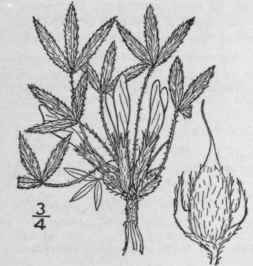
1. Orophaca Caespitósa (Nutt.) Britton. Sessile-Flowered Milk Vetch
Fig. 2559
Astragalus triphyllus Pursh, Fl. Am. Sept. 740. 1814. Not Pall. 1800. Phaca caespitosa Nutt. Gen. 2: 98. 1818. Orophaca caespitosa Britton, in Britt. & Brown, 1ll. Fl. 2:
306. 1897.
Silvery-canescent, densely tufted from a deep root, 2'-4' high. Stipules scarious, imbricated, glabrous, ovate-lanceolate, 3"-4" long; leaves digitately 3-5-foliolate, slender-petioled; leaflets oblong or oblanceolate, acute or obtusish at the apex, narrowed or cuneate at the base, 6"-8" long; flowers yellowish, 6"-8" long, sessile in the axils of the leaves; calyx-teeth half as long as the tube; corolla glabrous; pod I-celled, sessile, ovoid, acute or acuminate, coriaceous, dehiscent, villous-pubescent, enclosed by the calyx, 2"-3" long.
Plains and hills, Kansas, Nebraska and South Dakota to Montana and Saskatchewan. May-July.
2. Orophaca Argophýlla (Nutt.) Rydb. Silvery Milk Vetch
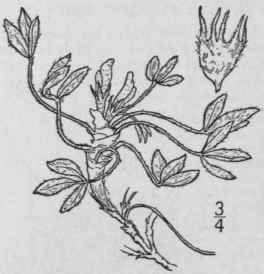
Fig. 2560
Phaca argophylla Nutt.; T. & G. Fl. N. A. 1: 342. 1838.
Astragalus hyalinus M. E. Jones, Proc. Cal. Acad. II. 5: 648. 1895.
Orophaca argophylla Rydb. in Britton, Man. Ed. 2, 1067. 1905.
Similar to the preceding species, but the leaflets relatively shorter and broader. Stipules scarious; corolla about 5" long, pubescent outside; calyx-teeth a little shorter than the tube.
In dry soil, Nebraska and Wyoming. May-July.
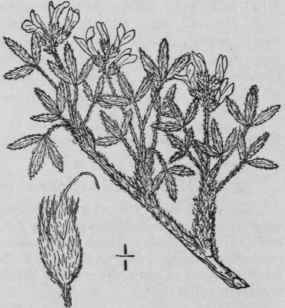
3. Orophaca Sericea (Nutt.) Britton. Hoary Milk Vetch
Fig. 2561
Phaca sericea Nutt.; T. & G. Fl. N. A. 1: 343. 1838.
Astragalus sericoleucus A. Gray, Am. Journ. Sci. (II.) 33: 410. 1862.
Orophaca sericea Britton, in Britt. & Brown, 1ll. Fl. 2: 307. 1897.
Villous-pubescent, densely tufted, and spreading on the ground from a deep root, the stems 3-4' long. Leaves short-petioled, 3-foliolate; leaflets oblong or oblanceolate, acute or obtusish at the apex, narrowed or cuneate at the base, 2"-5" long; peduncles slender, 2-6-flowered, equalling or exceeding the leaves; flowers bluish-purple, about 3" long; pod I-celled, sessile, ovoid-oblong, coriaceous, acute, villous-pubescent, about 3" long, partly enclosed by the calyx.
In dry, sandy or rocky places, Nebraska to Wyoming and Colorado. May-July.
Continue to:


My Books

