
![previous page: 30. Rosa [Tourn.] L. Sp. Pl.491. 1753. Part 3](../../../images/nav/page_prev.gif)

![next page: 30. Rosa [Tourn.] L. Sp. Pl.491. 1753. Part 5](../../../images/nav/page_next.gif)
30. Rosa [Tourn.] L. Sp. Pl.491. 1753. Part 4
Description
This section is from the book "An Illustrated Flora Of The Northern United States, Canada And The British Possessions Vol2", by Nathaniel Lord Britton, Addison Brown. Also available from Amazon: An Illustrated Flora of the Northern United States, Canada and the British Possessions. 3 Volume Set..
30. Rosa [Tourn.] L. Sp. Pl.491. 1753. Part 4
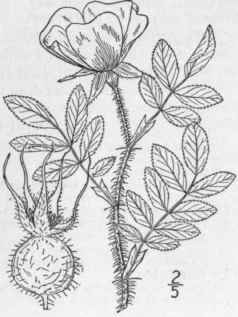
7. Rosa Carolina L. Swamp Or Wild Rose. Hip-Tree
Fig. 2313
Rosa Carolina L. Sp. Pl. 492. 1753.
Bushy, 1°-8° high, armed with rather distant stout commonly recurved spines. Prickles not very abundant, sometimes none; stipules very narrow; leaflets 5-9 (usually 7), varying considerably in outline, oval, oblong, ovate-lanceolate or even obovate, l' - 3' long, finely and simply serrate, generally short-stalked, acute or acutish at each end, pale or pubescent beneath; flowers corymbose or rarely solitary, 2'-3' broad; calyx-lobes lanceolate, acuminate or dilated above, rarely lobed, hispid-pubescent, spreading or reflexed, deciduous; styles distinct; fruit globose or depressed-globose, about 4" high, glandular-hispid.
In swamps and low grounds, Nova Scotia to Ontario, Minnesota, Missouri, Florida and Mississippi. June-Aug.

8. Rosa Virginiàna Mill. Low Or Pasture Rose
Fig. 2314
Rosa virginiana Mill. Gard. Dict. Ed. 8, no. 10. 1768. Rosa humilis Marsh. Arb. Am. 136. 1785. Rosa parviflora Ehrh. Beitr. 4: 21. 1789. Rosa lucida Ehrh. Beitr. 4: 22. 1789. Rosa humilis lucida Best, Bull. Torr. Club 14: 256. 1887.
Bushy, 6'-6° high, usually armed with slender or stout, straight or curved infrastipular spines, and more or less prickly. Stipules entire; leaflets usually 5, sometimes 7, rather thin, ovate-oval or obovate, dull or somewhat shining, coarsely and simply serrate, 6"-2' long, mostly acute or acutish at each end, short-stalked or sessile, glabrous or pubescent beneath; flowers usually few or solitary, 2' - 3' broad; pedicels and calyx usually glandular; calyx-lobes lanceolate, acuminate, or dilated above, commonly lobed, spreading and deciduous; petals obovate, obcordate or sometimes lobed; styles distinct; fruit globose or depressed-globose, glandular-hispid, about 4" high.
In dry or rocky soil, Newfoundland to Ontario, Wisconsin, Missouri, Georgia and Louisiana. Our commonest wild rose, consisting of many slightly differing races, northern ones with stouter spines than southern. A double-flowered form occurs in Pennsylvania and New Jersey. Dwarf wild rose. May-July.

9. Rosa Nitida Willd. Northeastern Rose. Wild Or Shining Rose
Fig. 2315
Rosa nitida Willd. Enum. 544. 1809.
Low, bushy, seldom over 2° high, the stems and branches very densely covered with slender straight prickles nearly as long as the slender infrastipular spines. Stipules usually broad, often glandular; leaflets 5-9, oblong or oval, generally acute at each end, short-stalked, the terminal one sometimes slightly obovate and obtuse at the apex, all finely and sharply serrate, shining above, glabrous or very nearly so, 6"-x$" long; flowers solitary or few, 1'-2 1/2' broad; calyx-lobes lanceolate, acuminate, entire, hispid or glandular, at length spreading, deciduous; petals often obcordate; styles distinct; fruit glandular-hispid, globose, about 4" high.
In low grounds, Connecticut and Massachusetts to Newfoundland. June-July.
Continue to:


My Books

