


6. Crataegus L. Sp. Pl. 475. 1753.. Part 7
Description
This section is from the book "An Illustrated Flora Of The Northern United States, Canada And The British Possessions Vol2", by Nathaniel Lord Britton, Addison Brown. Also available from Amazon: An Illustrated Flora of the Northern United States, Canada and the British Possessions. 3 Volume Set..
6. Crataegus L. Sp. Pl. 475. 1753.. Part 7
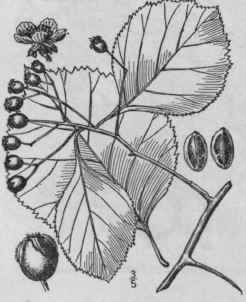
16. Crataegus Calpodéndron (Ehrh.) Medic. Pear-Thorn. Pear Or Red Haw
Fig. 2350
Crataegus Crus-galli Mill. Dict. Ed. 8, n. 5. 1768.
Not L. Crataegus tomentosa Du Roi, Harbk. Baumz. Ed. 1, 183. 1771. Not L. Mespilus Calpodendron Ehrh. Beitr. 2: 67. 1788. C. Calpodendron Medic. Gesch. Bot. 83. 1793. C. Chapmani Ashe, Bot. Gaz. 28: 270. 1899.
A shrub or small tree, sometimes 200 high, with ascending and spreading branches forming a broad crown. Spines occasional, 1'-2' long; leaves rhombic-ovate, acute or acuminate at the apex, 11/2'-4 1/2 long, 1 1/4'-3' wide, finely and doubly serrate, those on the vegetative shoots obtuse and more entire than the others, pubescent on both sides, becoming scabrate above, subcoriaceous, dull green; corymbs white-tomentose; flowers about 7" broad; stamens about 20 (occasionally 10); anthers small, pink; styles and nutlets usually 2 or 3; fruit pyriform or ellipsoid (in var. microcarpa, globose), orange-red or red, 4" or 5" thick; calyx-lobes reflexed, laciniate; flesh glutinous; nutlets with deep pits in their ventral faces.
Central New York, northeastern New Jersey and Pennsylvania to Minnesota and Missouri, south in the mountains to northern Georgia. May-June; fruit ripe September. Long mistaken for C. tomentosa L. White or common (Pa.) thorn. Thorn-apple or -plum. Black thorn.

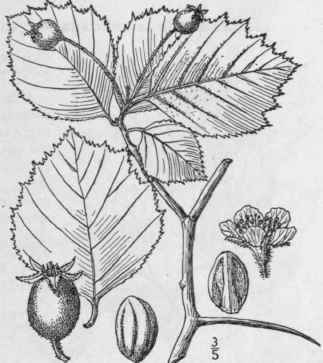
17. Crataegus Globòsa Sargent. Globose-Fruited Thorn
Fig. 2351
Crataegus globosa Sarg. Rep. Mo. Bot. Gard. 19: 118. 1908.
A slender shrub, or tree, sometimes 250 high, with numerous spines 1-2 1/2' long. Leaves oval, obovate or elliptic, 1 1/2'-4' long, 1 1/4'-3 1/4' wide, coarsely serrate or doubly serrate with shallow, obtuse lobes towards the apex, acute or bluntish, broadly cuneate at the base, membranous, dark yellow-green and pubescent, becoming scabrate above, pubescent beneath; corymbs villous; flowers 7"-8" broad; calyx-lobes lanceolate, acuminate, glandular-laciniate; stamens about 20; anthers large, pink; styles and nutlets usually 2; fruit globose or short-ellipsoid, about 4" thick, light orange-red, shining; calyx-lobes closely appressed, often deciduous; nutlets with large shallow cavities on the ventral faces Southern Missouri to southeastern Kansas. May; fruit ripe October.
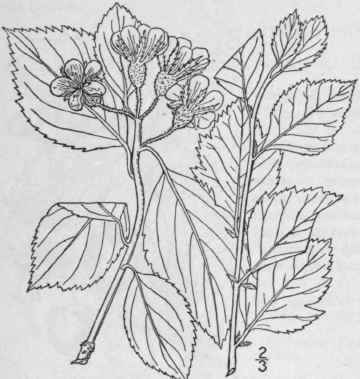
18. Crataegus Pertomentòsa Ashe. Prairie Thorn
Fig. 2352
Crataegus pertomentosa Ashe, Journ. E. Mitch.
Soc. 16: 70. Feb. 1900. Crataegus campestris Britton, Bull. N. Y. Bot.
Gard. 1:5: 449. March 1900.
A small tree, sometimes 20° high, with nearly horizontal branches and a flattened crown. Spines numerous, curved, 1'-3 1/2' long; leaves oblong to obovate, 1 1/4'-2 3/4' long, i'-2.i' wide, acute at the apex, abruptly cuneate to rounded at the base, finely and doubly serrate or lobed, slightly villous or glabrate above, villous beneath, particularly along the veins, vivid dark green, subcoria-ceous; corymbs and calyx densely villous; flowers about 10" broad; stamens 10-15; styles and nutlets 2 or 3; calyx-lobes deeply serrate; fruit globular or nearly so, 4"-6" thick, cherry-red, villous when young.
Rocky barrens, Iowa, Kansas and Missouri. May: fruit ripe September.
Continue to:


My Books

