


5. Chamaenèrion [Tourn.] Adans. Fam. Pl. 2: 85. 1763
Description
This section is from the book "An Illustrated Flora Of The Northern United States, Canada And The British Possessions Vol2", by Nathaniel Lord Britton, Addison Brown. Also available from Amazon: An Illustrated Flora of the Northern United States, Canada and the British Possessions. 3 Volume Set..
5. Chamaenèrion [Tourn.] Adans. Fam. Pl. 2: 85. 1763
Showy perennial herbs, with tufted stems which are often woody at the base. Leaves alternate, leathery, entire; flowers perfect, irregular, showy, white or purple, in terminal racemes; calyx-tube not prolonged beyond the ovary, narrow, the 4 calyx-segments deciduous; petals 4, entire, broadest above the middle, spreading; stamens 8, declined; filaments dilated at the base; anthers oblong; ovary 4-celled; united styles filiform; stigmas 4-cleft; ovules numerous, in 2 rows, ascending. Capsule 4-celled, obtusely 4-angled, elongated, opening loculicidally. Seeds numerous, with a tuft of hairs. [Greek, ground rose-bay.]
About 4 species, chiefly in the north temperate zone. Type species: Epilobium angustifolinm L. Bracts small; lateral nerves of the leaves confluent in marginal loops; style pubescent at the base.
I. | C. angustifolium. | |
Bracts leaf-like; lateral nerves of the leaves obsolete; style glabrous. | 2. | C. latifolium. |
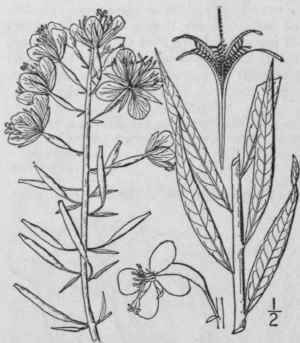
I. Chamaenerion Angustifòlium (L.) Scop. Great Or Spiked Willow-Herb. Fire-Weed
Fig. 3025
Epilobium angustifolium L. Sp. Pl. 347. 1753.
C. angustifolium Scop. Fl. Cam. Ed. 2, 1: 271. 1772.
Epilobium spicatum Lam. Fl. Fr. 3: 482. 1778.
Erect, rather stout, simple or branched, glabrous or often finely pubescent above, 2°-8° high. Leaves alternate, very short-petioled, lanceolate, entire or denticulate, 2'-6' long, 4"-12" wide, pale beneath, acute at the apex, narrowed at the base, thin, the lateral veins confluent in marginal loops; flowers 8"-15" broad, purple, or sometimes white, in elongated terminal spike-like racemes; bracts mostly shorter than the pedicels; petals entire; style pubescent at the base; stigma 4-lobed; capsules 2'-3' long, about 1 1/2" thick, finely canescent, at least when young; seeds about i" long, smooth, or nearly so, the coma long, whitish.
In dry soil, Greenland to Alaska, North Carolina, Indiana, Kansas; the Rocky Mountains to Arizona; Pacific Coast to California. Europe and Asia. Often abundant after forest fires. French-, bay- or Persian-willow. Rose-bay. Fire-top. Burnt weed. Purple rocket. French or bay willow-herb. Indian wickup. Herb-wickopy. Flowering or blooming willow. Pigweed. Blooming sally (i. e., Salix). Sally-bloom. June-Sept.
2. Chamaenerion Latifòlium (L.) Sweet. Broad-Leaved Willow-Herb
Fig. 3026
Epilobium latifolium L. Sp. Pl. 347. 1753.
C. latifolium Sweet, Hort. Brit. Ed. 2, 198. 1830.
Erect, usually branching, glabrate below, often quite canescent above, 6-18' high. Leaves mostly sessile, 1'-2' long, 2"-6" wide, denticulate or entire, lanceolate or ovate-lanceolate, acutish at both ends, thick, those of the branches opposite, the veins inconspicuous; flowers purple, V-2' broad, in mainly short leafy-bracted racemes; petals entire; styles glabrous; stigma 4-lobed; capsules 1'-1 1/2' long, about 1 1/2' thick, canescent; seeds about 1" long, nearly smooth; coma elongated, whitish.
Moist ground, Newfoundland to Alaska, south to Quebec, Colorado and Oregon. Also in Europe and Asia. June-Aug.

Continue to:


My Books

