


31. Aster L. Sp. Pl. 872. 1753. Part 17
Description
This section is from the book "An Illustrated Flora Of The Northern United States, Canada And The British Possessions Vol3", by Nathaniel Lord Britton, Addison Brown. Also available from Amazon: An Illustrated Flora of the Northern United States, Canada and the British Possessions. 3 Volume Set..
31. Aster L. Sp. Pl. 872. 1753. Part 17
54. Aster Hirsuticaulis Lindl. Hairy-Stemmed Aster
Fig. 4335
A. hirsuticaulis Lindl.; DC. Prodr. 5: 242. 1836.
Aster lateriflorus hirsuticaulis Porter, Mem. Torr. Club 5: 324. 1894.
Stem slender, erect, 1 1/2"-3" high, pubescent, often nearly or quite to the base, the usually short branches spreading or ascending. Leaves thin, glabrous above, usually pubescent on the midvein beneath, serrate with a few appressed teeth, or entire, linear-lanceolate to lanceolate, sometimes 6' long, 2"-7" wide, sessile, or the basal ones spatulate and petioled; heads more or less unilateral on the branches, densely or loosely clustered, often also solitary or few in the lower axils; bracts of the involucre in 3 or 4 series, linear-lanceolate, acuminate or acute; rays white, about 2" long.
In woods and thickets, New Brunswick to Pennsylvania, Kentucky and Michigan. Perhaps a race of the preceding species. Aug.-Oct. Wise-weed. Old-field sweet. Farewell-summer. Old-Virginia. Stickweed. White-devil. Nail-rod.
55. Aster Vimineus Lam. Small White Aster
Fig. 4336
Aster vimineus Lam. Encycl. 1: 306. 1783.
Aster folioiosus Ait. Hort. Kew. 3: 203. 1789.
Aster Tradescanti T. & G. Fl. N. A. 2: 129. 1841. Not L. I7S3. Aster vimineus folioiosus A. Gray, Syn. Fl. 1: Part 2, 186. 1884.
Glabrous or nearly so throughout; stem slender, divergently branched, 2°-5° high. Stem leaves linear-lanceolate, entire, or with a few low teeth, 3'-5' long, 2"-4" wide, acuminate at the apex, narrowed to a sessile base, those of the branches much smaller; heads very numerous, small, 3"-5" broad, 2"-3 high, generally densely racemose-secund, sometimes subpaniculate, short-peduncled; involucre broadly turbinate, its bracts linear, acute or acutish, imbricated in about 3 series, green-tipped, appressed; rays numerous, about 2" long, white to purplish; pappus white; achenes minutely pubescent.
In moist soil, Ontario to Florida, west to Minnesota and Arkansas. Aug.-Sept.
Aster racemosus Ell., with smaller heads, the leaves all very small, of the Southeastern States, apparently occurs in extreme southern Illinois.
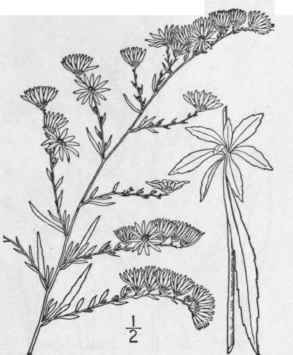

56. Aster Multiflorus Ait. Dense-Flowered Aster. White Wreath Aster
Fig. 4337
Aster multiflorus Ait. Hort. Kew. 3: 203. 1789.
A. multiflorus stricticaulis T. & G. Fl. N. A. 2: 125. 1841.
A. multiflorus exiguus Fernald, Rhodora 1: 187. 1899.
A. exiguus Rydb. Bull. Torr. Club 28: 505. 1901.
A. polycephalus Rydb. Bull. Torr. Club 33: 153. 1906.
Stem strict, much branched and bushy, rough-pubescent or scabrous, r°-7° high, the branches ascending or spreading. Leaves rigid, linear or linear-oblong, entire, mostly obtuse, sessile or slightly clasping at the base, rough and ciliate, those of the stem 1/2-1 1/2' long, those of the branches very small and crowded; heads 3"-4" broad, densely crowded, nearly sessile, sometimes slightly secund on the branches; involucre 2"-3" high, its bracts coriaceous, mostly ciliate or pubescent, in 3 or 4 series, their short green tips obtuse or mucronate, spreading; rays 10-20, white, 1 1/2"-2" long; pappus brownish white; achenes puberulent.
In dry open places, Maine and Ontario to Alberta, Georgia, Texas and Arizona. Consists of many slightly differing races. Fall-flower. Aug.-Nov.
Continue to:


My Books

