


Notes. Continued
Description
This section is from the book "Alcohol, Its Production, Properties, Chemistry, And Industrial Applications", by Charles Simmonds. Also available from Amazon: Alcohol: Its Production, Properties, Chemistry, And Industrial Applications.
Notes. Continued
1 Chem. Zentr., 1916, i, 530.
Method of Thorpe and Holmes.1 - This process is based upon the fact that, under the conditions described, methyl alcohol is completely oxidised to carbon dioxide and water by treatment with potassium dichromate and sulphuric acid, whereas ethyl alcohol in the same circumstances gives acetic acid The carbon dioxide produced is then weighed.
The liquid to be analysed is mixed with water in such proportion that 50 c.c. of the mixture shall contain not more than 1 gram of methyl alcohol, and in the presence of ethyl alcohol not more than 4 grams of the mixed alcohols.
Fifty c.c. of the diluted liquid are then introduced into a flask of about 300 c.c. capacity, 20 grams of potassium dichromate and 80 c.c. of dilute sulphuric acid (1: 4) added, and the mixture allowed to remain for eighteen hours. A further quantity of 10 grams of potassium dichromate and 50 c.c. of strong sulphuric acid mixed with an equal volume of water are now added, and the contents of the flask heated to the boiling point for about ten minutes, the evolved carbon dioxide being swept out of the apparatus by a current of air, and after drying with sulphuric acid, collected in weighed soda-lime tubes. From the weight of CO2 thus obtained a deduction of 0 01 gram is made for each gram of ethyl elcohol present, as it has been found that the process of oxidising ethyl alcohol in the manner described is always accompanied by the production of carbon dioxide in the proportion stated. The remainder, multiplied by 32/44, gives the equivalent weight of methyl alcohol.
The apparatus used for carrying out this process is as follows.
The flask in which the oxidation is performed is fitted with a ground-in stopper carrying (1) a funnel tube with stop-cock, and (2) an exit-tube also fitted with a stop-cock. In the absence of a ground-in stopper a two-holed rubber stopper can be employed. The funnel tube passes nearly to the bottom of the flask. Its upper end is fitted with a rubber stopper and tube to make connection with a soda-lime receptacle for freeing incoming air from carbon dioxide.
The exit-tube is attached to a small U-tube containing a little soap solution, in order to retain the bulk of the water and any small quantity of acetic acid which may distil over during the boiling. At its other end this U-tube is connected with the absorption current of air free from CO2 to ascertain that the weight of the tared tubes remains constant.
train. This consists of, first, two U-tubes containing pumice moistened with sulphuric acid to dry the gases expelled; next, two weighed U-tubes containing soda-lime to absorb the carbon dioxide; and finally, a guard U-tube containing soda-lime in the near limb and calcium chloride in the further limb, which is attached to a suitable aspirator. The tared soda-lime tubes contain, as usual, a little recently-heated calcium chloride at the top of each limb, covered with a layer of glass wool or cotton wool to keep fine particles out of the exits. The arrangement is, of course, tested with a
1 Trans. Chem. Soc, 1904, 85, i.
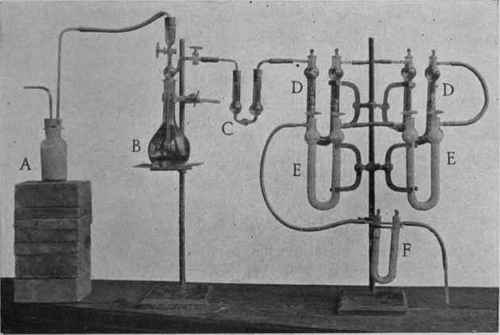
Fig. 30. - apparatus for estimation of methyl alcohol by thorpe and holmes's method.
A, soda-lime bottle for purifying air-current; B, oxidation flask; C, U-tube with soap solution; D, D, tubes with pumice and sulphuric acid; E, E, soda-lime tubes for absorbing CO2; F, guard tube.
In performing the experiment, the oxidation flask is kept cooled in an ice-bath during the addition of the first quantity of dichromate and sulphuric acid. It is then connected up with the absorption train, and allowed to stand at the ordinary temperature all night. In the morning the second quantity of dichromate and acid is run in through the tap-funnel; the latter is then connected with the air-purifying vessel, and a gentle current of air freed from carbon dioxide is aspirated through the apparatus. Heat is then applied, and the liquid kept boiling gently for about ten minutes, when the flame is withdrawn and the apparatus allowed to cool down, the current of air being maintained long enough to ensure that all the carbon dioxide evolved is carried into the absorption-tubes. The latter are then removed and weighed.
Details of an actual experiment are as follows.
Twenty-five c.c. of a mixture containing ethyl and methyl alcohols were purified by Thorpe and Holmes's method (p. 170), the distillate being made up to 250 c.c.
Specific gravity of distillate = 0.9873, = 9.39 per cent. of total alcohol by volume, = 7.452 grams per 100 c.c.
Fifty c.c. of the distillate (= 5 of the original sample) therefore contained 3.726 grams of total alcohols. This on oxidation yielded 0 2524 gram of CO2.
Let | X | = | grams of ethyl alcohol, | |
and | y | = | " | methyl ,, |
in the 50 c.c. taken for oxidation.
Then x + y = 3.726 . . . (i).
Also, since 1 gram of ethyl alcohol gives 0 01 gram of CO2, and 1 gram of methyl alcohol gives 44/32 gram of CO2, and the total CO2 produced is 0 2524 gram, we have
0.01x + 44y/32 = 02524. . . (ii).
Solving the two simultaneous equations (i) and (ii), we find x = 3.5684 and y = 0.1576. Whence the proportion of methyl alcohol in the original sample = 01576 x 100/5 = 3.15 grams per 100 c.c. Dividing this result by the specific gravity of methyl alcohol, 0.7964, we get 3.95 as the percentage of methyl alcohol by volume in the original sample.
For practical purposes, it suffices to deduct from the weight of CO2 found a quantity = 1 per cent. of the total alcohol - therefore in this case 0.0372 gram - and calculate the remainder to methyl alcohol, though this gives a result slightly lower than the truth. Thus 0.2524 - 0.0372 = 0.2152 net CO2; and 0.2152 x 32/44 = 0 1565 gram methyl alcohol in the 50 c.c. of distillate oxidised. Whence the proportion in the original sample, calculated as before, is found to be 3.93 per cent. by volume.
W. Koenig1 modifies Thorpe and Holmes's method slightly, and gives the following details. A flask of 1 litre capacity is used for the oxidation operation. It is fitted with a two-holed rubber stopper through which passes (1) a dropping funnel closed at the top with a soda-lime tube, and (2) a reflux condenser connected at the upper end with the absorption train for the carbon dioxide.
1 Chem. Zeit., 1912, 36, 1025 - 1028.
This train consists of, first, two drying-tubes, one containing calcium chloride, the other sulphuric acid and pumice-stone; next, two tared U-tubes containing soda-lime; and finally, two guard-tubes containing soda-lime and calcium chloride.
Air freed from CO2 is drawn through the apparatus, and the mixture of methyl and ethyl alcohols passed into the flask. From 5 to 10 c.c. of the mixed alcohols are used, according to circumstances. The oxidising mixture, consisting of 30 grams of potassium bichromate in 500 c.c. of water with 50 c.c. of sulphuric acid (sp. gr. 1.84), which has been boiled for fifteen minutes and then cooled to 5°, is then run into the flask from the dropping-funnel. The contents of the flask are mixed and allowed to stand four hours, after which they are heated slowly to the boiling-point and boiled for an hour. To sweep out the carbon dioxide from the flask, air is aspirated through the apparatus, at first gently, and then more rapidly, during about forty-five minutes, after which the absorption-tubes are weighed. The weight of carbon dioxide obtained, multiplied by the factor 0 728, gives the amount of methyl alcohol in the quantity of alcohols taken.
Pure ethyl alcohol in the conditions described yielded carbon dioxide equivalent on an average to 0.5 per cent. of methyl alcohol.
Mixtures made up to contain from 4 to 15 per cent, of methyl alcohol gave results agreeing with the theoretical quantities within ± 0 19 per cent.
W. A. R. Wilks1 has also published the results of an investigation upon Thorpe and Holmes's method, and describes a modified procedure which reduces the correction for oxidised ethyl alcohol to 0 004 gram of carbon dioxide instead of the 0 01 gram indicated in the original process. Less sulphuric acid is used, and the temperature is kept low during the initial stages.
A solution of 30 grams of potassium dichromate in 150 c.c. of water is first run into the distilling flask, which is well cooled with a freezing mixture. When the contents are thoroughly cold (a large proportion of the dichromate crystallises out), 50 c.c. of the suitably diluted sample are added, and finally, in small quantities at a time, a mixture of 20 c.c. of sulphuric acid and 20 c.c. of water previously cooled in a mixture of ice and salt. The flask, connected to the absorption apparatus, is allowed to stand overnight, and then heated to boiling and the experiment concluded as in the original process. Under these conditions the subtractive correction is 0 004 gram of CO2 for each gram of ethyl alcohol present.
1 Bulletin No. 1, 1914, Wellcome Tropical Research Laboratories, Chemical Section. Pub. by the Sudan Government.
Continue to:


My Books

