


Menu Making
Description
This section is from the book "The Profession Of Home Making", by American School Of Home Economics. Also available from Amazon: The Profession Of Home Making.
Menu Making
Through the test questions, the attention of our pupils has been called to the planning of meals for a household, for this is an important part of the housekeeper's duties. Under Part I we asked for menus introducing as many dishes as feasible containing milk and cheese. Such menus would be useful where the meat markets were poor, and milk abundant, since one may thus secure similar nutritive elements, and usually at less expense than for meats.
After Part II, the request was made for a menu for two days when eggs were cheap, and for two days more when they were expensive. This was done because few housekeepers pay sufficient attention to market prices. They get the idea that a certain food is costly, and therefore not to be used at all, when, perhaps, a careful comparison of the prices of all ingredients would show it to be cheap at some seasons. Angel and sponge-cakes, for example, when eggs are at their lowest price, are less expensive than average butter-cakes.
With eggs at 25 cents a dozen and butter at 25 cents a pound, a sponge-cake with five eggs costs no more than a cake with two eggs and half a cup of butter. If the whites of twice as many eggs are used, • the actual cost is no greater, since the yolks are available for other purposes.
At the close of the lessons we asked for a week's menu from each householder represented, with suggestions for their improvement, without increase of labor or expense.
The responses show an increased attention to the details that count in feeding a family satisfactorily to all concerned.
Yet menu-making is still a great bugbear to many pupils, and a few more hints on the subject may be helpful.
Many are hampered seriously by the habits and wishes of different members of their households.
One young woman writes: "My father demands griddle cakes every morning the year round."
Naturally, with such tastes, it is difficult to introduce many new dishes, or to secure a very varied menu.
In the old days of the brick oven, most of the necessary cooking for a family was done on one day of the week, for the proper heating of that oven could not be accomplished hurriedly.
Now with" the gas stove, condition's are very different, and two or three hours each day should be ample time for the actual cookery for an average family. But to accomplish everything in these limits wise planning is required. Whatever requires long cooking for breakfast, must be started the previous day, and preparation for the dinner or luncheon is begun while breakfast is being made ready, and so on.
Many business women keep house in this way, and their families are as well fed as those where more time is frittered away on petty nothings. It is only by application of business methods in our kitchens, that the routine in many households can be simplified and untangled.
The preparation of food for an average household is not a difficult matter when the manager has learned her trade and each individual member is not unreasonable in his or her requirements.
The housekeeper must think out her plan of action for days in advance and thus save unnecessary duplication of processes.
When one pair of hands must do all the cooking, it is a foolish waste of time and strength to cook fresh food for the purpose of making composite dishes. Let those come occasionally as an easy way of finishing up some bits too good to throw away, which have already appeared in other forms. For example, it takes no more effort or fuel to boil twelve potatoes than is required to cook six. These may appear one day as plain boiled, if we have a roast with a good gravy. The next day we are to serve the meat cold or perhaps fried fish with no sauce, so the second portion of potatoes is cut in cubes or slices and reheated in butter, flavored with onion, and sprinkled with chopped parsley just before serving, giving us Lyonnaise potatoes. Or we might prefer Delmonico potatoes and put them in layers in a pudding dish with a sprinkle of cheese between, pour a thin white sauce over, cover with buttered crumbs, and heat through in the oven. Or the potatoes may be mashed and for a second appearance take the form of a huge cone, or apples, or pears for individual service.
Sometimes in our zeal to use up left-overs, we expend much time and strength and more additional material than the value of the original article warrants. But if one owns a timbale iron, those fragile Shells resulting from frying a batter on it are attractive receptacles for a little creamed chicken or a sweetbread.
Croquettes have their place occasionally, and often save the purchase of more meat and thus justify the time they require. A garnish of crisp triangles of toast around a dish of creamed meat disposes of both the scraps of meat and bits of bread - or cases may be made of bread and browned in the oven and filled with meat.
The store closet should be kept well stocked, and this is less expensive and far easier than buying things as needed. One order a week ought to be enough for the staple groceries, and two orders a week in winter and three in summer for meats, fruits, and fresh vegetables. Do not order by telephone, but at least once each week visit the market and make the order according to what is available there.
The time often spent in a daily visit to markets or a daily call from the store-man can be used to better advantage in an average home.
A fair supply of good-grade canned goods should be kept in the house for emergencies; but as a whole these are more expensive than fresh cooked meats and vegetables; but where fuel is expensive and labor high, they may be used more freely.
Milk should be used generously. Many families would do well to double their present milk supply. Where milk is abundant and canned vegetables at hand, it takes but a few moments to prepare a nourishing and attractive cream soup of corn, beans, peas, or tomatoes. If the top of the milk has been used for cereal and coffee, the remainder will be quite as satisfactory as whole milk for soups or puddings, when butter or other fat is added.
If our home is at a distance from markets and we have an abundance of one type of food material and little of others, then it may be necessary for us to devise many ways of serving this one, and then we must use different forms and flavors that we may not tire of the monotonous diet. But when the season of any fruit, vegetable, or meat is brief, then we need serve it only in its natural form or cooked in the simplest manner.
As the seasons change, cold merging into heat and heat into cold again, we let our fires go out, then we kindle them, and we decrease and then increase our clothing. But few households make a correspondingly marked change in their food, adapting it to the differing needs of the body as the external temperature changes.

Making Timbale Cases
All of us know places where pork and pies occupy as prominent a position on the tables in July as in January, though their heat-giving qualities make them out of place in summer, even if admissible in winter.

Ready For Making Croquettes

Some Ways To Use Stale Bread

Boston Baked Beans

Some Ways of Serving Oranges
"Pork and beans," where the fat predominates, may be suitable for midwinter, while "baked beans," with a small amount of fat - be it pork, beef, butter or olive oil - are not out of place at any season.
Another phase of this matter is the improvement in flagging appetites, which is accomplished by a change in food. The city dwellers are often better off in the spring than the country family. From the South to the city markets come greens of several kinds, asparagus, lettuce, cucumbers, and radishes, while the country garden is still bare. A small bunch of asparagus as a garnish around some inexpensive meat like lamb or calf hearts will give relish when a larger quantity would be an extravagance.
Those who prepare the food for the family deserve a change of labor from season to season, and many women in the country would do well to strike from pie making and spend the time so saved out of doors. It is no harder to care for a strawberry bed than to wield the rolling pin or bend over a hot stove, and strawberries may well be substituted for pies.
True economy must be practiced in the planning of menus and one thing fitted into another so that nothing is lost.
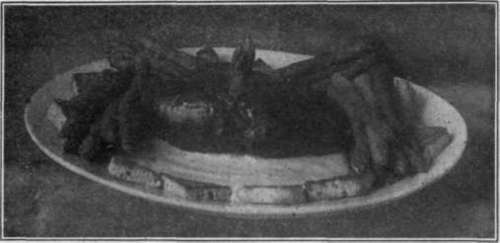
Lambs Heart with Asparagus
Apricot or Peach Jelly
Continue to:


My Books

