


Medical - Health And Hygiene In The Nursery The Child's Muscles. Continued
Description
This section is from "Every Woman's Encyclopaedia". Also available from Amazon: Every Woman's Encyclopaedia.
Medical - Health And Hygiene In The Nursery The Child's Muscles. Continued
The following are a few simple breathing exercises:
1. Stand straight, with the fed together and the hands resting on the chest just above the waist on each side. Let the child take a deep breath with the mouth closed. Hold it for four seconds, and then slowly let the breath go. Repeat this exercise twelve times
2. With the arms hanging, the mouth closed, and the head erect, take a deep breath whilst raising the arms at the same time until they are stretched above the head. Hold the breath two or three seconds, and slowly let go whilst the arms fall to the side. Repeat.
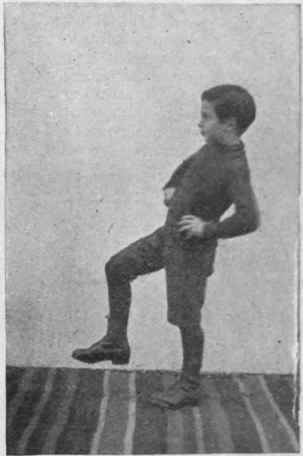
Hip and leg exercises
3. With the heels together and the hands on hips, inhale a deep breath whilst rising on the toes. Hold the breath. Then let it go and the heels sink to the ground.
A later article will deal more fully with breathing and lung development.
These exercises are excellent for children, who are apt to breath by the mouth, or who are subject to colds and to throat and chest ailments. Except in very cold weather, the exercises should be practised at an open window, so that the child gets the full benefit of the fresh air.
In these two articles we have considered the education of the chief muscles of the body. The directions are simple. The exercises can easily be followed. By practising these fully, the mother will ensure the child's physical develop-ment. Method and regularity are the important features. Five or ten minutes devoted daily to physical education are of far more value than one hour twice a week. A child cannot possibly become fatigued under this system. The muscles are properly exercised without strain or stress. The effect upon the child's constitution and health in the future can hardly be overestimated.
By Mary Westaway (Associate of the National Health Society) Wounds and Their Treatment {continued) - How to Treat Bruises
4. A punctured wound is such as results from a stab with a sharp instrument, and, although it may not appear a great injury, it is really more serious than a surface wound of greater extent. If bleeding occurs, arrest it by the method described in Part 3, and cover the wound promptly with a clean pad soaked with an antiseptic dressing, be it even only water with salt or vinegar or water which has been sterilised by being boiled.
5. A poisoned wound is less rare than is commonly imagined, for bites and stings from certain animals, insects, and plants introduce poison which causes irritation or may lead to serious consequences. The two great points to attend to in the treatment of such wounds are to prevent access of the poison to the circulatory system, and to apply an antidote which shall neutralise the poison.
Thus, with such a wound occurring on any part of a limb, a string or bandage should be immediately tightly tied round the limb between the wound and the heart, and rather than lose a second the limb should first be firmly grasped and compressed with the hand to prevent blood flowing from the wounded part towards the heart. Bleeding must be encouraged, so as to get rid of as much poison as possible, and this is done by sucking the wound (provided there is no wound or abrasion on the lips or in the mouth of the helper) or by holding the injured part in lukewarm water.
The antidote depends upon the cause of the wound. A bite from a cat or a dog should receive medical attention. Until the doctor arrives the wound should be covered with a clean cloth pad dipped in carbolic solution (1 part of carbolic acid in 20 parts of water) or a strong solution of boracic acid, and the ligature must be kept around the limb until the wound has been cauterised. If medical aid is not available, the wound should be cauterised with lunar caustic, nitric acid, or red-hot iron, and the burnt part kept covered with boracic ointment spread on lint until the wound is healed and the skin sloughed. It must always be remembered that wounds on the exposed parts of the body are more serious than those in which clothing has been bitten through, for the fabric dries up the saliva containing the poisonous matter, and renders the teeth comparatively innocuous.
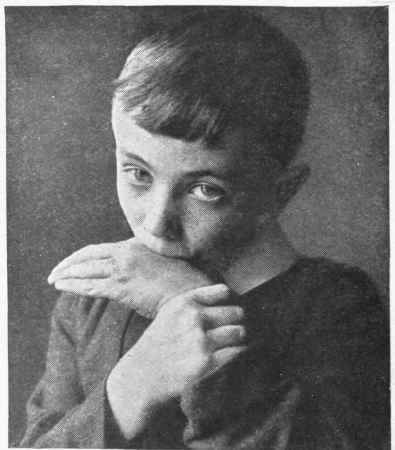
The immediate treatment of a dog or cat bite
Wasps and bees frequently leave the sting behind, and this must be pulled out before the antidote is applied. Ammonia is the best antidote, and a prompt application eases the pain and prevents swelling. Vaseline, olive oil, soda, salt, and the laundry blue-bag are homely remedies which are of great service. Mosquito and gnat bites are eased in the same way, but as bites and stings generally occur in country fields and lanes where domestic remedies are not at hand, it is best to look around for a dock leaf to spread over the wound. This can generally be found growing near a nettle bed, as though Nature had placed it there specially as an antidote to the poison of nettles - which, indeed, it is - as well as to that of noxious insects. Even a late application of an antidote is better than none at all, and should there be much irritation and swelling caused by the delay, rubbing the affected part with a lump of damp salt will be found to give great ease.
Fortunately, poisonous snakes are not common in this country. Vipers give a dangerous bite, which should be treated immediately by the method described in connection with a bite from a dog or cat, and medical aid must be promptly sought.
How To Treat Bruises
A bruise is an injury caused by a fall or by a blow from a blunt instrument. Although the skin is uninjured, the small blood-vessels underneath it are ruptured, and it is the
Medical ettusion of blood from these vessels which uses t he discoloration. Clearly the treatment of bruises must be such as will tend to draw the edges of the injured vessels together, and this can best be done by the application of cold. By covering the injured put with a linen pad soaked in cold water, or, better still, with a mixture of equal parts of spirit and cold water, and keeping it as still as possible, the injury will be so alleviated that it may pass off without even showing discoloration. On the other hand, hot applications and rubbing the injured part tend to open still more the ruptured blood-vessels, and should, accordingly, be avoided.
Sprains are accompanied by ruptured blood-vessels under the skin. They should be tightly bandaged, and should be treated as bruises, but with very intense pain, hot fomentations give greatest ease. When there is doubt about the nature of the injury, it is best to regard it as a fracture, and to treat it accordingly.
A grazed shin often seems such a trifling injury that no notice is taken of it until the pain becomes so severe that medical aid has to be sought. Without proper treatment a grazed shin refuses to heal, and may cause a patient to lie by for many weeks. As soon as possible after the injury the wound should be covered with a clean pad dipped in a mixture of equal parts of Goulard water and cold water, and as soon as the pad is warm it should be replaced by a cool one. Exercise should be reduced to a minimum for a few days, and the wound will soon cover itself with a new skin.
A fall out of doors may result in a grazed knee or elbow, and, although the accident appears trifling it may lead to serious issues. It is now known that germs of lockjaw reside in the earth and gain entrance to the body through an injured skin. Accordingly, cleanliness and antiseptic treatment are necessary. The injured part should be soaked and syringed with warm water con-tainining 1 in 40 of carbolic acid, and, when all dirt has been removed, the wound should be covered with a linen pad dipped in carbolic solution, and kept covered until it is healed.
Continue to:


My Books

