


Medical - Health And Hygiene In The Nursery The Child's Muscles
Description
This section is from "Every Woman's Encyclopaedia". Also available from Amazon: Every Woman's Encyclopaedia.
Medical - Health And Hygiene In The Nursery The Child's Muscles
Muscles in One Part of the Body Must not be Developed to the Exclusion of Others - Some Simple Exercises for Strengthening the Spine and Lower Part of the Body - Breathing Exercises are
Valuable for Weakness of the Nose and Chest
In the last article on the muscles of the child a few simple exercises for the arms and upper part of the body were given.
Physical education, however, should not develop one part of the body to the exclusion of others. It is a good thing for a boy to possess a well-developed arm, but it is a bad thing to concentrate the attention on developing the muscles of the arms and chest if the spine and lower part of the body are neglected.
Some slight degree of curvature of the spine is very common m childhood. It is often due to the habit of sitting or standing badly, slouching over work or carry-ing a schoolbag of heavy books under one arm. Simple muscular exercises regularly and moderately indulged in do much to correct round shoulders and spinal curvature in early years. A future article will deal with various deformities in childhood, with their remedies, and the consideration of spinal defects will be left alone till then. The following exercises, however, are all remedial. They are excellent for strengthening the muscles of the lower part of the spine, thighs, and legs; they develop the muscles and the joints, and are useful, instructive, and enjoyable for wet days in the nursery:

Barefoot exercises on an inclined plane to correct weak ankles

Exercises for lateral curvature of the spine. The lower, or lumbar, curvature (concave) is to the right
1. Barefoot exercises should be practised if there is the least tendency to weak ankles or flat-foot. Even where there is nothing the matter with the feet and ankles the exercises are good because they help to develop the foot and keep it healthy, and the foot is very much neglected in the human anatomy. After removing the shoes and stockings, let the child stand with the heels together, and raise the heels off the ground till he is balanced on his tiptoes. Repeat this six, eight, or ten times. Then make him walk up and down the room on tiptoes with the bare feet, and then up an inclined plane. This can be easily made by resting one end of a board against a low ottoman-box or footstool.
2. Crouching exercises are excellent for the hip joints. Anyone who has visited Japan knows how easily and gracefully the Japanese can squat upon their feet in a manner that is almost impossible to the foreigner. The assumption of this attitude at first is accompanied by creaking and cracking of bones, with a tumble to one side or the other. Now, this crouching attitude is excellent.
The small boy in the picture is crouching in a very graceful fashion, and at first the child should only be allowed to crouch down as far as he can do easily, rise to the position again, and repeat perhaps half a dozen times. Gradually the joints become more supple, and by letting the knees move outwards the child can soon squat easily on his heels.
3. Lunging first to the right and then to the left is another exercise which deserves to be practised. Standing easily with the heels together, let the child take one step to the right with the right arm outstretched as far as it will go. Then return to the first position. In the same way let him stretch out to the left with the left arm raised level with the shoulder. Repeat ten times.
4. Trotting exercises round and round the nursery will improve the general circulation, and counteract any weakness of the ankles or legs.
5. A very useful leg exercise consists in standing with the heels together, and slowly raising first one foot forwards and upwards, and then the other, three times. This requires some practise before it can be comfortably achieved.
Hopping on each foot alternately, alternated with trotting and tiptoe exercises will prevent flat-foot and strengthen the muscles of the calf.
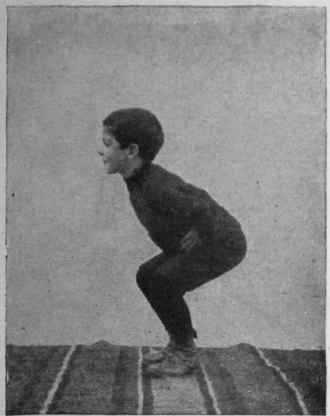
Crouching exercises for hips and legs
Many boys who get a good deal of sport at school, whose arms and chests are well developed, slow an evidence of weakness of the muscles of the thigh and hip joint. In such cases the following exercises will strengthen the waist muscles and the lower part of the back and hip joints:
1. Let the boy lie flat on the floor and rise to a sitting posture without using his hands.
2. Whilst lying on the floor let him raise the two legs perpendicular to the body.
3. Whilst standing erect with the hands hanging, bend first to the right and then to the left.
4. Whilst standing in the same position, bend forwards and then backwards.
Now it is not at all necessary to practise daily every exercise that has been given in these two articles on the child's muscles. Five minutes twice daily is quite enough to begin with. In the case of young children or girls who are having lessons at home, five minutes engaged in a few of these exercises make an excellent break between the lessons.

Lunging exercises for muscles of arm, body, and leg
Some doctors advocate a few minute devoted to simple muscular movements lesson every half hour. At one time the exercises given in the last article can be gone through. At another some of thou described above may be tried, whilst breathing should form a daily part of a child's physical education.
Continue to:


My Books

