


Our Jewels
Description
This section is from "Every Woman's Encyclopaedia". Also available from Amazon: Every Woman's Encyclopaedia.
Our Jewels
The Value of Pearls - Some Famous Pearls and Ropes of Pearls - The Various Species of Pearls-pearl Fisheries and How the Pearls are Found - How Imitation Pearls are Made - Ways by Which the Genuine May be Tested
Jewels are supreme in interest and importance. They adorn the wearer, they are treasures of art, and they make one of the best forms of portable property. Precious gems have varying values, and at this moment their price stands as follows. Pearls are apart; in stones, emeralds rank first, then rubies, then diamonds, and after these sapphires and Oriental amethysts. And they hold this high rank on account of their beauty, rarity, and durability. Next in value come the spinel ruby, the Brazilian topaz (the Oriental topaz is a yellow sapphire), turquoises, garnets, opals, cat's-eyes, zircons - a quaint, brownish gem - olivines, peridots, and tourmalines. And after these come onyx, agate, Scotch topaz (or cairngorm), jade, moonstone, chrysoprase, and chalcedony.
The Value of Pearls
Pearls, like opals and peacocks' feathers, are among the most beautiful things in creation. They have been used from very early times, and in almost all parts of the world, as jewels and for personal adornment.
The value of a pearl depends upon its size, shape, colour, and freedom from defects. The most precious pearls are those which are perfectly round; the button-shaped rank next, and after these come the drop or pear-shaped pearls. Perfectly round pearls, over twenty-five grains in weight, are extremely scarce and command high prices, and when of great beauty make a safe and most profitable investment. This would have been still more the case a few decades ago, as, on account of the keen demand, fine pearls have gone up from 1oo to 300 per cent. during the last twenty years or so - say, from the time of the first Jubilee, in 1887.
Pearls of great price have a pure white, black, or pink tint - that is to say, a distinctive colour and a soft sheen, with, at the same time, a brilliant lustre. The value of pearls is greatly increased when a large number of well-matched specimens are collected together.
Even in the days of the Romans, however, fine pearls fetched fabulous prices. Julius Caesar presented to Servilia, mother of Marcus Brutus, a splendid pearl that he obtained as booty in Egypt, and the cost of which has been estimated at 39,600.
Again, in more modern times, a pearl which belonged to a Shah of Persia was more than an inch in diameter, and has been priced at the high sum of £64,000.
The Largest Pearl Known
The largest pearl known at present is in the Beresford-hope Collection in the Victoria and Albert Museum. It weighs 1,800 grains, and measures two inches in length and four in circumference.
Some Indian princes possess pearls of untold value. Of these are the Gaekwar of Baroda, the Jam of Jamnagar - still better known as Prince Ranjitsinhji - and the premier ruling chief of India, the Nizam of Hyderabad.
Many famous pearls are to be found in Europe and America. The late Empress Frederic owned a one-row necklace of thirty-two big pearls, worth at least £40,000. And Countess Henckel has an equally valuable necklace formed of three rows of pearls, each of which has historic interest. One belonged to the ex-queen of Naples, sister to the late Empress of Austria ; the second was owned by the Empress Eugenie; and the third, once the property of a Spanish grandee, is known to fame as the "necklace of the Virgin of Atokha."
The Duchess of Marlborough possesses wondrous pearls that belonged to Marie Antoinette. Some of these are worth £1,000 a-piece, and the finest rows are said to be worn by their owner at all times and seasons.
The Spanish Duchess of Santona, who is often in London, has a single-row necklace of immense value, which was given to her mother, the late Duchess of Alba, by the Empress Eugenie, who, in her turn, received it at the opening of the Suez Canal from a former Shah of Persia.
Princess Blucher of Wahlstadt, another frequent visitor, has a splendid row of 228 pearls, each pearl said to be worth £400.
Some Famous Pearls
Among the most valuable pearls in London are the five-row necklaces owned by the Marchioness of Lansdowne and the Countess of Cork, and finest of all, the three-row necklace which belongs to Viscountess Iveagh, and which has been priced at about £100,000. The Marchioness of Ripon has one row of huge pearls; Lady Denman's long rope is said to be worth £60,000; and Victoria Countess of Yarborough has several rows of large and perfect pearls, which in the late 'fifties were bought for £5,000, but are now valued at over £20,000. The Marchioness of Waterford owns a one-row necklace of fine pearls, once worn by Mary Queen of Scots, and given by her, before her execution, to Lady Mary Hamilton.
An expert says that the price of good pearls rises year by year, and bids fair soon to become prohibitive.
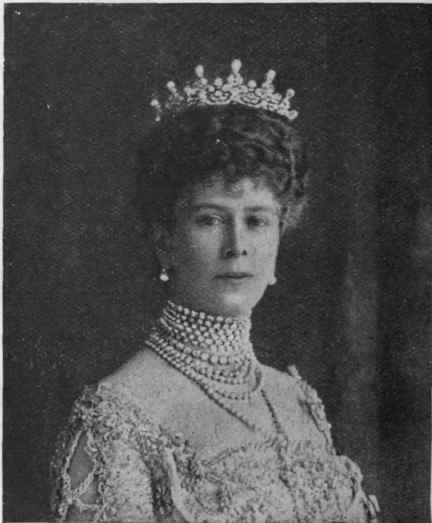
H.M. Queen Mary wearing her rare and costly pearls, which are of unusual size and lustre
Photo, IV. • D. Dcwney
Black pearls are exotic jewels, and have a price in proportion. They are found in India and Australia, but the best come from Lower California. They have two lustres, a grey and a green, the latter being by far the more precious. Mary Duchess of Hamilton has a one-row necklace of pear-shaped black pearls said to be worth £50,000. The Dowager Countess of Ilchester owns a necklace of black pearls valued at £25,000, which was once worn by the Empress Eugenie. Mrs. Spender Clay has a priceless necklace which belonged to her mother, the late Mrs. Astor, and Mrs. John Mackay often wears a pair of black pearl earrings that cost £10,000.
Continue to:


My Books

