


Our Jewels. Continued
Description
This section is from "Every Woman's Encyclopaedia". Also available from Amazon: Every Woman's Encyclopaedia.
Our Jewels. Continued
Pink and Coloured Pearls
Pink pearls are found in the Bahama
Islands, in Mexico, and on the sandbanks of the Gulf of California. The pink pearl ranks with the white pearl in value, but has one drawback - namely, that its ungraceful shape often renders it useless as a personal ornament. There are, however, some beautiful specimens. In the Hope Collection was a curious cameo pink pearl, mounted on a gold ring with a device of diamonds, and Mrs. William James owns an exquisite tiara of pink pearls mixed with fine diamonds.
Pearls are not only black, white, and pink, but are found in varied shades,such as pale blue, brown, grey, mauve, and yellow. Queen Mary owns a necklace, which was given to her in India, formed of graduated pearls all of different colours, which had taken over fifteen years to collect. The late Miss Van Wart, a hospitable American, used often to wear a single-row necklace of large pearls in many shades - grey, black, brown, pink, mauve, and yellow; white pearls were the only sort not represented.
The origin of coloured pearls is a question still undecided. The varied hues may, perhaps, be derived from the waters in which are found the pearl-producing oysters.
Pearl Fisheries
The most famous pearls are those of the East, and come from the Indian Sea, Ceylon, the Persian Gulf, and some parts of the sea off the coasts of Arabia. There are, moreover, pearl fisheries off New Guinea, and off
Dress certain parts of the coast of Australia. The method of fishing is as follows. The work is done by men trained to the task from childhood. Their limbs are rubbed with oil daily, and they take to a special diet some time before the fishing commences. At the time appointed, they go to the pearl bank, say their prayers, strip themselves bare, stop their ears with cotton-wool, bind a sponge soaked with oil tightly over their mouths, and compress their nostrils by means of a horn instrument. They then sling a rope round their body, and, with a big diving stone attached to their feet, fling themselves down to the pearl-bank. When the diver touches the bank he takes a sharp knife, removes the oysters, and puts as many as he can into the net which is fastened about his body. The work is done rapidly, and a diver is seldom under water for more than sixty seconds. With intervals for breathing, he can go down forty or fifty times in succession.
Imitation Pearls
Frauds are frequent in precious stones, and pearls can be copied with fatal facility. False pearls are made by blowing very thin beads or bulbs of glass, and then pouring in a mixture of liquid ammonia mixed with the white matter from the scales of the roach, dace, and other fishes. This is prepared as follows. The scales of the fish are carefully washed and put to soak in water, when the pearly film falls off and forms a sediment, which is removed and placed for future use with liquid ammonia. This pearl mixture has a high price, and, when of the best quality, costs as much as £4 or 5 per ounce. When used, it is injected into the glass beads so as thinly to coat them inside. Next melted white wax is poured in, so as to make the false pearl more durable. The art of giving the slightly irregular form of large pearls to these glass beads increases the resemblance, and the shiny look caused by the exterior coating of glass can be removed by exposing them for a short time to the action of the vapour of hydrofluoric acid. By these means are produced imitations of the finest whitepearls, which, unless tested, would be extremely difficult to detect.
Coloured pearls can be easily copied, but with only a measure of success. Pink coral can be made to simulate pink pearls, if cut into suitable form and shape. But its texture is entirely different, and may be recognised even with a hand magnifying glass.
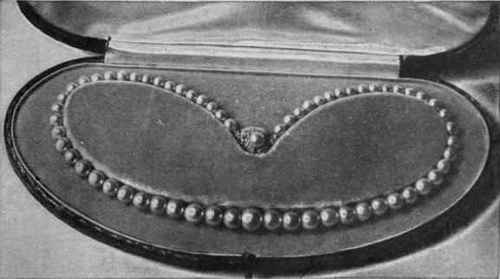
A beautiful pearl necklace. The most valuable pearls are perfectly round in shape, and their value is greatly enhanced when they are combined with others perfectly matched in form and colour Photo, Record Press
Pearls, again, dye well, and some defective white pearls once were sent into the market dyed pink. The fraud was most difficult of detection.
Black hematite, one of the chief ores of iron, makes a passable imitation of a black pearl, when not too highly polished; but as hematite is twice as heavy as black pearl, the fraud can easily be detected.
The above remarks show that to imitate pearls with success is a long and costly process, and, as a result, the best specimens are somewhat expensive. I who write know an instance of a well-known woman who, when going abroad, had her one-row necklace of big pearls stored at the bank, and took with her to wear a row of imitation pearls which a Paris jeweller had copied from her own necklace at the cost of £200.
A real pearl may be known by its hardness. It would take a heavy blow to break a real pearl; a sham one will be smashed to atoms by a light knock. The extreme hardness of a real pearl is shown by the fact that when drilled with a steel drill, this strong implement often breaks during the process. An expert told me that, when testing a pearl, it is a good plan to put a needle slantwise into the hole where the pearl is drilled. If the substance which the needle touches feels as hard as granite the pearl is a real one, but if the needle forces its way into what feels like wax or soap, the pearl is at once proved to be an imitation.
Baroque pearls are real pearls, but badly formed and shapeless specimens. These are cheap, but acquire value when set in an artistic style with dull gold and enamels. They have their uses, and shall be dealt with in a future article.
Pearls require careful treatment if they are to retain their purity of colour. They should not be locked away for long periods in jewel cases. Many owners of fine pearls see that they have frequent sun-baths, and it is said that Queen Magarita of Italy gave hers a sea-bath also, for they were lowered into the sea in a properly constructed re-ceptacle, and kept below the water for a certain period. This process was supposed to be highly beneficial in retaining their beautiful lustre.
Continue to:


My Books

