


Recreations
Description
This section is from "Every Woman's Encyclopaedia". Also available from Amazon: Every Woman's Encyclopaedia.
Recreations

Tools Required - How to Obtain the Iron - Bending the Iron - Clamping the Parts
Dent ironwork, sometimes called Venetian iron-" work, is a pretty and useful hobby. It is by no means an extravagant one, as both tools and materials are inexpensive.
The tools necessary are: (1)cutting shears; (2) square-nosed pliers; (3) round-nosed pliers (diagrams showing exactly what these tools are will be found on the following page), a yard measure, a pencil, also a foot rule. Some people prefer to work in gloves, in that case, strong leather ones should be obtained, as these often save the hands from sundry accidental hard nips. All the tools range in price from about is. 6d. each. When buying them it is better to get a good quality, as they will wear better and the handles are smoother, which the worker will find a great advantage if much work is done.
The iron required for the work is sold in strips about 24 inches long, and generally costs 9d. a pound.
The iron is in various widths, ranging from 1/8 of an inch to 1/2 inch, this being the widest. The beginner will find that of 1/8, 5/16, and 3/8 the most convenient. It is generally rough and unpolished (although sometimes slightly blackened over). This, however, is as it should be, for after the work is finished it must all be coated over with a dull black paint, which must only be bought from the shops selling bent ironwork requisites, as this particular paint must give a dull black surface, not a bright one. The paint costs is. a tin, and a tin is sufficient for several small articles. A short-haired brush is the best for applying it.
A strong, dark apron must be worn to protect the dress, and also a thick covering for the table is necessary, as it is apt to get dented and stained.
There are many and various articles that can be made with bent iron, and many more that can be ornamented with it. Those that can be made are all sorts and shapes of vase-holders, photograph-frames, scent-bottle Wands, candlesticks, fern-pots, and stands for small pictures, etc. Those that can be ornamented are brackets, newspaper-racks, calendar-stands, screens, hall-lamps, fire-guards, curtain-poles, ornamental panels for doors, to mention only a few.
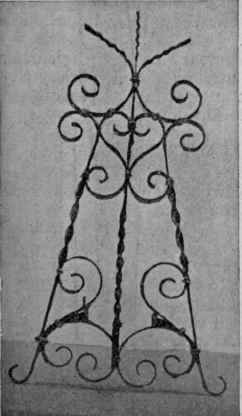
A pretty picture-frame holder. It is clamped with wire
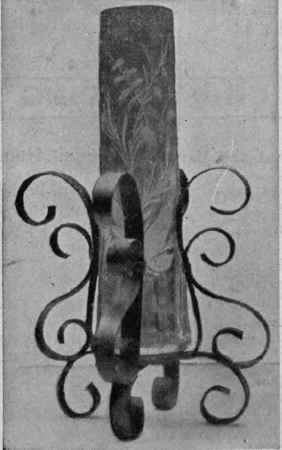
A vase-holder clamped with iron
The chief principle in bent ironwork is based on two scrolls, called the S and C scroll. These often vary in shape, and their curls are sometimes tighter or looser, as the case may be; but it is easy to trace this particular form all through the work.
To make a C scroll take a strip of iron, say 8 inches long, holding the iron in the left hand with the square-nosed pliers a little way from the end of the strip; take the other end of the iron in the right hand with the small-nosed pliers, and, holding it still firmly in the left hand, curl the right-hand end round the jaws of the small pliers, away from the body. This will give it a slight curl; then shift the square pliers further along the iron towards the centre (while holding it with the small ones), and. having the small pliers nearer them than at first, curve the iron just a little more; repeat this till about the middle of the strip is reached. Then reverse the strip, getting the curl in the same way as the first one was obtained.
The jaws of the small pliers always point from right to left, the large ones from left to right. Care must be taken that the ends of the scrolls are not made too tightly, they look very much better when a free and bold curve is given; but a smaller width of iron will stand a tighter curl than a wider one.
Then come the S scrolls; they are made in the same way as the C scrolls, except that when the middle of the strip is reached after making the first scrolled end, the next scroll is bent in the opposite direction, so that it looks as nearly as possible like a large S. These, too, can be varied in the making, sometimes keeping the two curved ends alike, sometimes having one closely curled, and the opposite end a bold free curve. Therefore it would be well for the student to practise carefully, making scrolls, curves, and angles, till she is proficient, and can handle her tools easily.
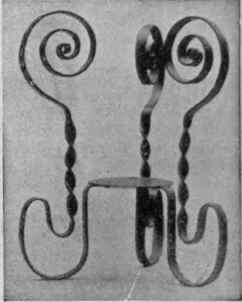
A more elaborate vase-holder
Continue to:


My Books

