


Wedding-Cakes
Description
This section is from "Every Woman's Encyclopaedia". Also available from Amazon: Every Woman's Encyclopaedia.
Wedding-Cakes
The Art of Choice - The Bride Cuts the Cake - Sending Wedding-cake Away
"The wedding-cake is neither Scotch nor English in origin, but came to us from Germany, one of the most desirable of our acquisitions from that country. Possibly the very first ever seen in England'was that made for the marriage of the late Queen Victoria and the Prince Consort.
Her Majesty ever after regarded the bridecake as an essential part of a wedding, and on the occasion of each one of her daughters' marriages commissioned that ancient firm, Bolland, of Chester, to make the cake and adorn it with appropriate emblems and devices.
Queen Victoria's example was followed by the late King Edward and his Queen with regard to the marriages of their children, and the wedding-cake ordered by them for the marriage of our present King and Queen, then Duke and Duchess of York, was probably the finest piece of confectionery ever designed. We-give a picture of it. The four large panels round the base showed bas-reliefs of the bridegroom's ships, the Thrush and' the Melampus. On the second tier were the monograms of bride and bridegroom, and on the third, dolphins and human figures bearing harps, and clusters of roses, thistles"; and shamrocks. The white rose of York; with May blossom (in compliment to the bride's pet name) and orange blossoms, composed the floral ornament.
When our present King (then Prince of Wdles) visited Eaton two years ago he accepted a beautifully decorated wedding-cake on the crystal anniversary (fifteen years) of his marriage.
The Duke and Duchess of Albany's wedding-cake in 1882 was nearly six feet high and weighed two hundredweight. A very usual cake of this kind is fifty pounds in weight, being generally made up of separate tiers. These Chester bride-cakes take six months to make, every ingredient being separately and carefully prepared. The recipe is kept a dead secret by the head of the firm. The cakes keep for twenty years, and a well-known lady, who celebrated her silver wedding some time ago, had on the table one of the tiers of the original wedding-cake still in good condition.
The Art Of Choice
The choice of the cake is not quite so simple a matter as might be expected by those who have never had to choose it. First comes the question of style, combined with that of price. Then follows the decision as to quantity, which must be regulated chiefly by the number of guests invited to the wedding reception,plus the relatives and friends living in the country and abroad to whom boxes of the cake must be sent.
The cake occupies the centre of the table or buffet on which refreshments are placed. It is usually set upon a highly ornamented stand in strong metal, coloured to resemble silver. The designs of some of these are very handsome. Appropriate subjects of the hymeneal order are chosen sometimes, but the tendency of the time is to avoid the sentimental.
Should the cake be of a comparatively small size it can be raised further by a second stand made in exact imitation of the cake itself in moulding, coloured to the tint of the sugar-work with which the real cake is ornamented. This raises the latter to a convenient height for the bride to cut it, and also gives it due prominence. Suppose that a cake weighing from fifteen to twenty pounds should be sufficient for the occasion, the. height would be about seven inches, and this would have a meagre effect, unless supplemented in the manner indicated.
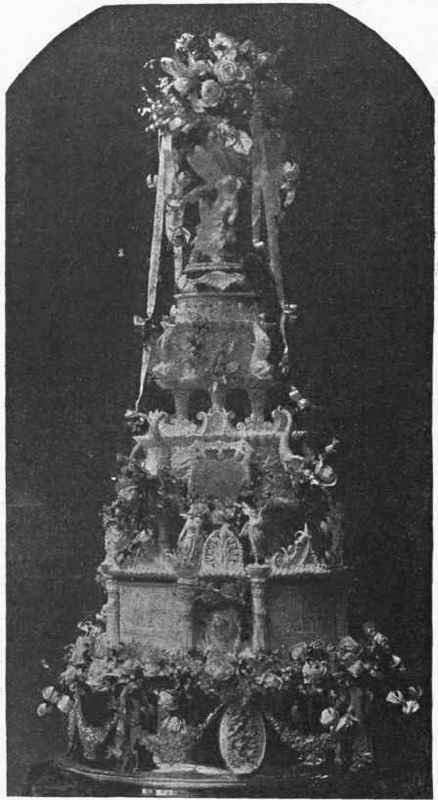
Wedding-cake prepared for the Duke and Duchess of York, now King and
Queen of England Bolland
When the bride and bridegroom have received the congratulations of all their friends, they go to the dining-room, followed by some, if not by all, of the bridesmaids, and the bride proceeds to cut the cake. Everyone crowds round to watch this ceremony. The knife is generally of an ornamental character, sometimes provided by the caterer who supplies the refreshments. Sometimes it is a weapon to which attaches some family association, or some curio that has been picked up abroad, and is of an ornamental character.
The Bride Cuts The Cake
There is occasionally a little difficulty in cutting through the sugar icing, but the bride should not let anyone help her in her task. A straight, downward thrust, the knife held perpendicularly, will manage the business, and the rest is easy. Only one incision need be made by the queen of the occasion. The slices are cut out by the attendants, and handed round on ornamental dishes, with white paper underneath the cake. When correctly cut, the slices have each a share of both almond-icing and sugar-icing. The well-made cake, let it be observed, crumbles but slightly, and keeps moist for three months.
Any flowers, or merely decorative sugar-work, are lifted off the top of the cake before the bride cuts the latter, and after a sufficient number of slices have been secured, the ornaments are replaced, for the admiration of those guests who have not had an opportunity of visiting the refreshment table beforehand.
The bride retires to another part: of the room with the bridegroom, and they taste their own wedding-cake and drink each other's health in champagne, with probably an interlude of some kind of refreshment better suited than wedding-cake to accompany dry champagne.
Sending The Wedding-Cake Away
Sometimes the bride's family undertakes the sending out of cake to friends and relations who have been unable to be present at the wedding. The necessary little boxes are procured from the stationer, and the wedding-cards* having been previously prepared, the packing up and addressing are all that then remain to be done.
The caterers undertake this business of sending out cake and cards, supplying the boxes and needing only a list of the names and addresses of those to whom it is to be sent.
Continue to:


My Books

